A Little Water Goes a Long Way

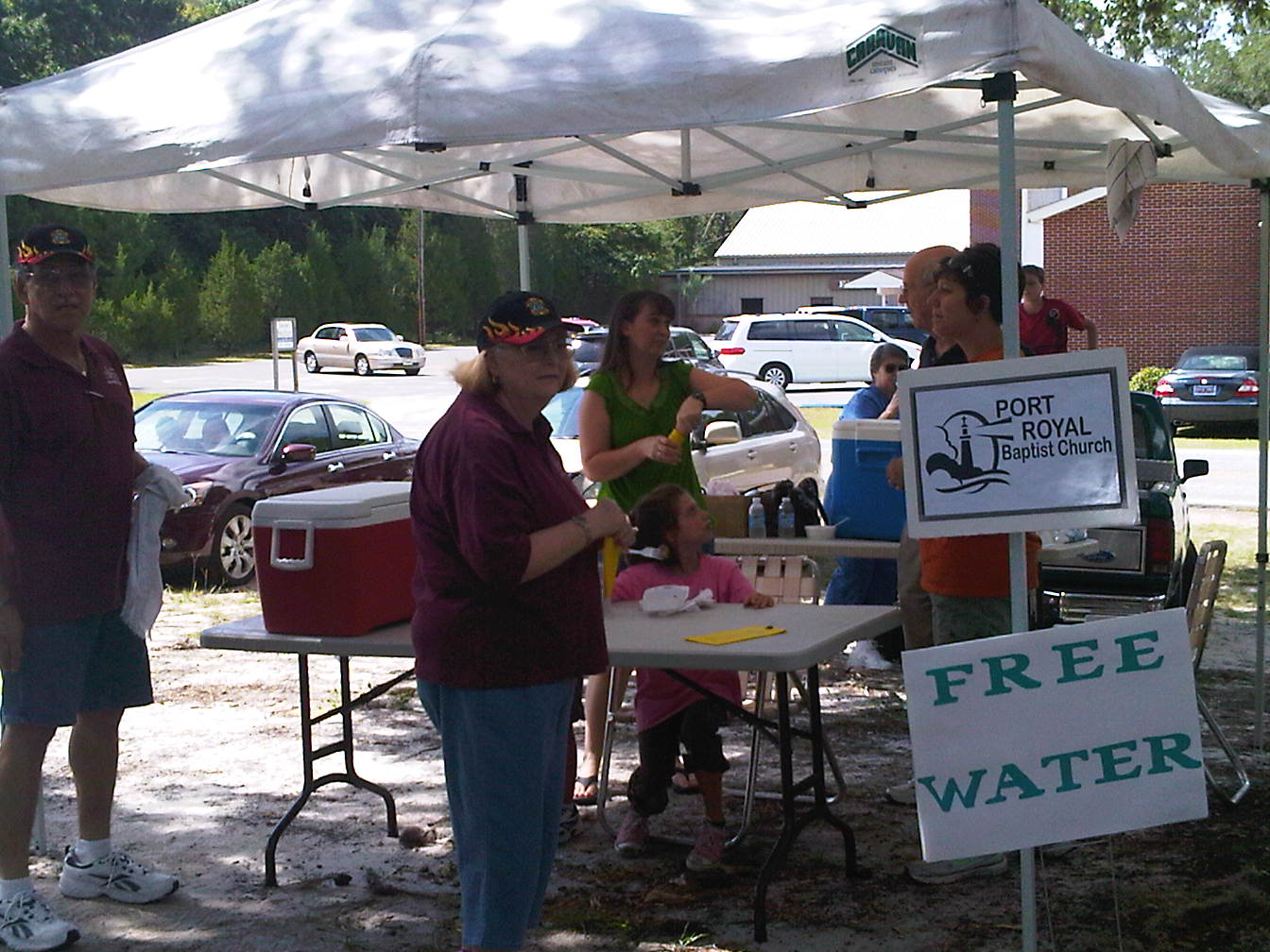
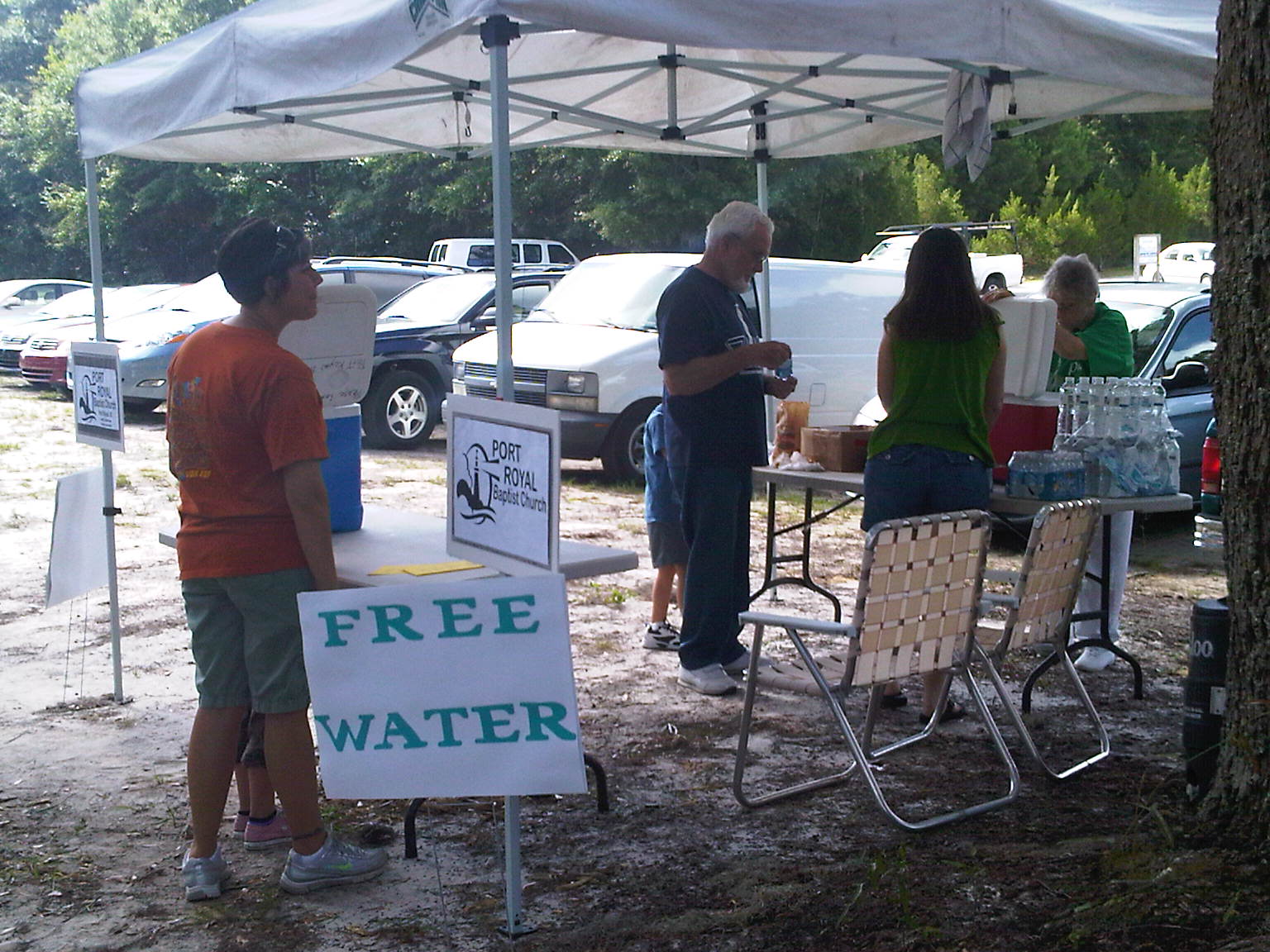
Today, Port Royal Baptist Church had the opportunity to minister to the people of Port Royal and Beaufort at the Farmer’s Market across the street from our church. This is the third time this summer that we have ministered there. Our goal in this project is simple: introduce ourselves to our community through servant ministry. We have chosen to give away free water. Through this approach, we as a church have been able to satisfy a need (thirst, who doesn’t like cold water on a hot day), while at the same time showing the love of Christ in a real and tangible way.

Opportunities have presented themselves to not only invite the community to our worship services, but also to just talk, and listen to them. I am thankful for the chances that we have had to hear their questions and their prayer concerns. It is true that a little water goes a long way. A little effort on our part has gone a long way toward building bridges of trust and friendship. As a pastor, I am extremely proud of our people and their willingness to move beyond the comfort of the church walls and meet the people where they are.


Days like  today excite and encourage me. Although it was a hot and tiring day, I believe God was honored by our efforts. I am excited to see the Lord work in the lives of our people. I am further encouraged that when future doors of ministry open, our people will ready to walk through them. Thank you Port Royal Baptist Church.

Vacation Bible School is Here

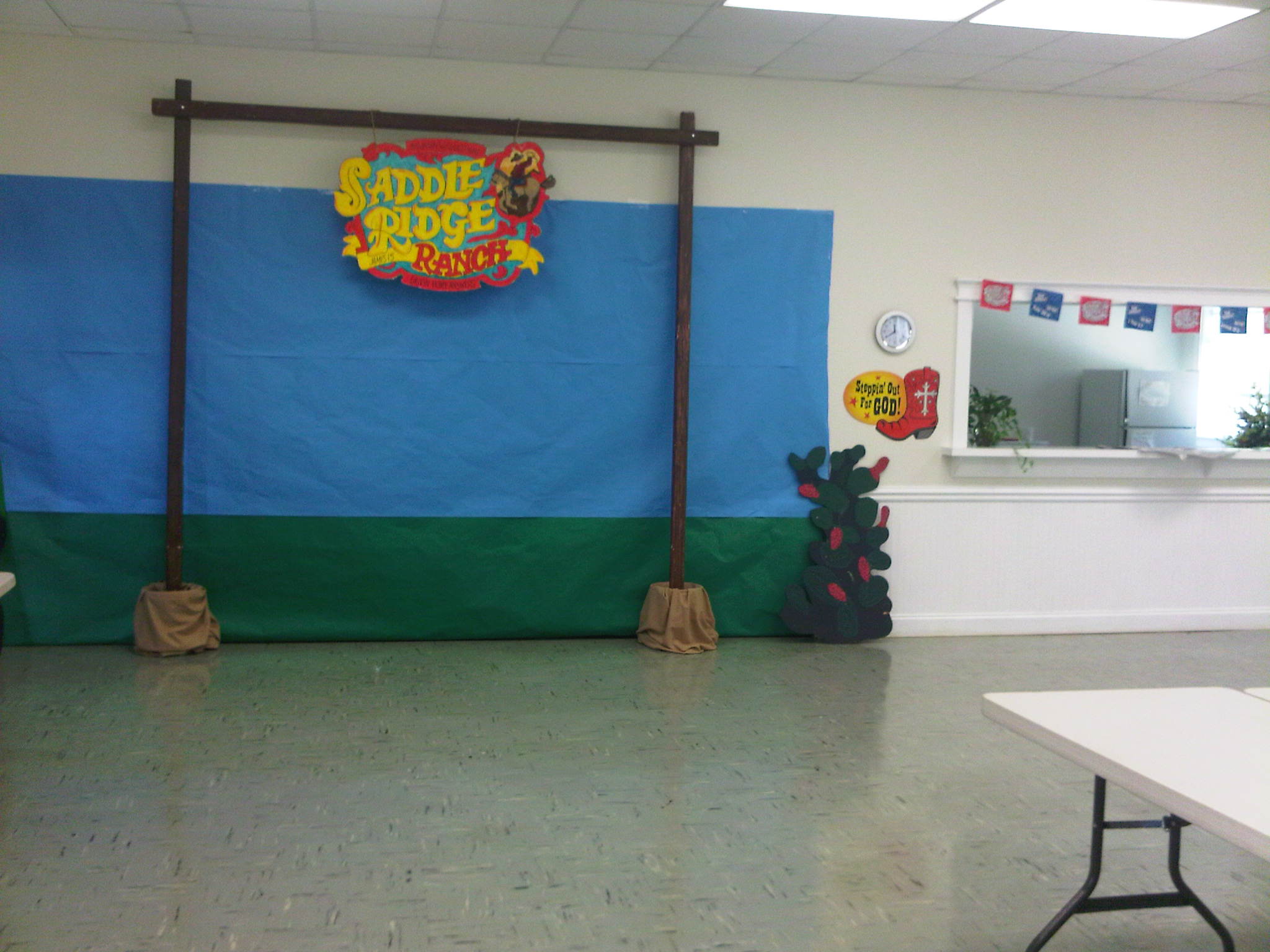
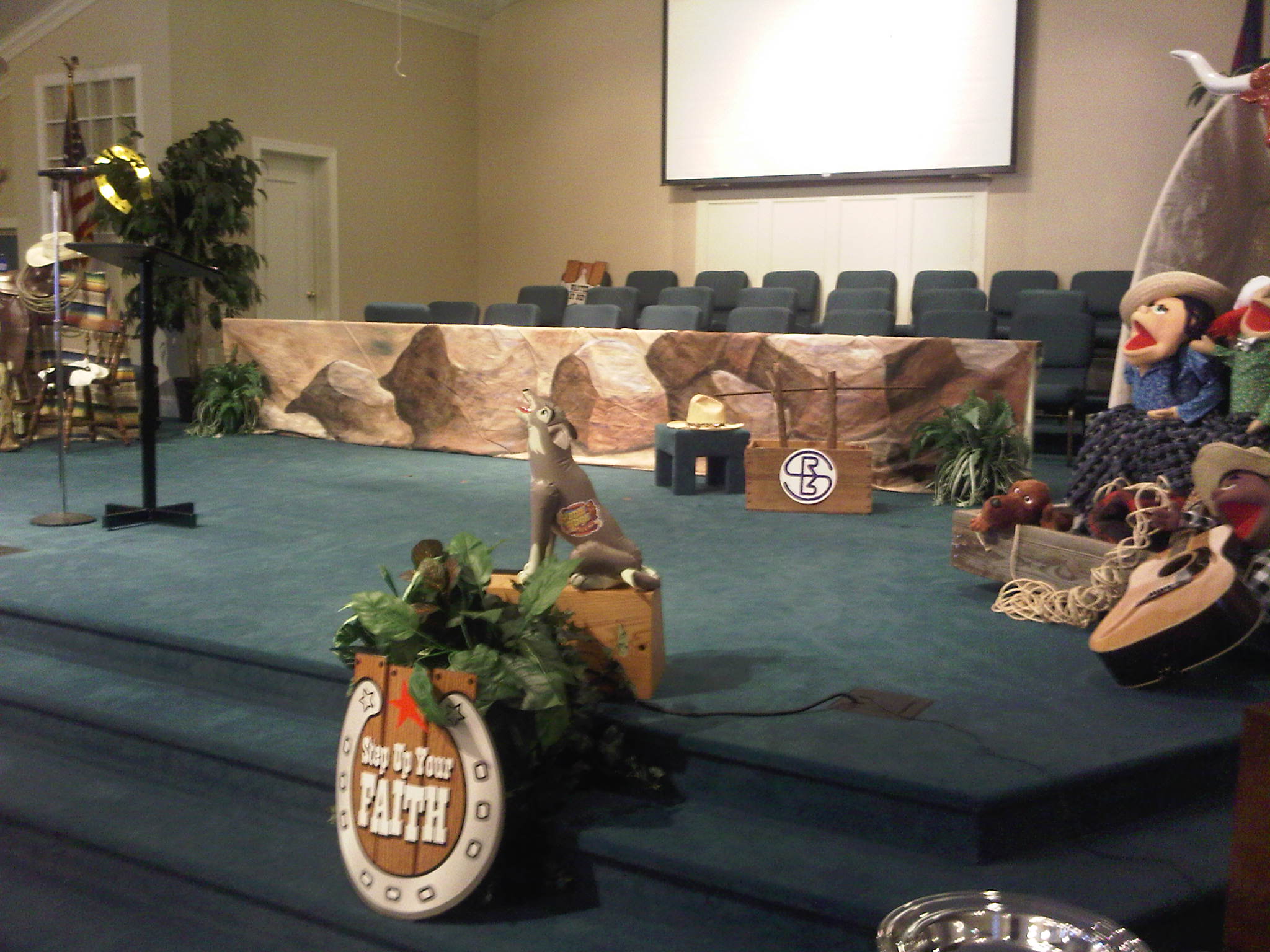
The days leading up to Vacation Bible School are always filled with activity. There are teachers decorating, lessons being finalized, and many “quick trips” to Wal-Mart for needed supplies. I always enjoy this week. I enjoy walking around and visiting with our teachers. I enjoy the plans that go into our largest outreach event of the year. This is a unique opportuity for me to spend some time with them in a different environment. I enjoy watching the sanctuary and other rooms being transformed from their typical look into theme-related masterpieces. Hard work is the descritpion for this week. This week of hard work prepares us for a week of hard work of a different sort. Our Vacation Bible School begins tonight. Tonight our students will saddle up and spend some time at Saddle Ridge Ranch Below are some pictures of the work that is in progress around our church as of today.

Worth Repeating

“Here is the message – ‘repentance and forgiveness of sins to be preached in his name to all nations.’ When it becomes something other than forgiveness and repentance, then the gospel itself is lost in the process. When we forget that the job of the church is to proclaim the message of repentance and forgiveness, the future of any church is bleak. We need to be reminded every day through God’s Word, ‘As the Father has sent me, I am sending you… to every people group… with a message.’ The only question is – Will we be faithful to respond? We are sent as missionaries, the only question is – Are we good ones?”

Ed Stetzer, Breaking the Missional Code

Worth Repeating

“The Sunday School is the church organized to do the work of the Great Commission. All other organizations within the church (discipleship training, choirs, etc) recruit its people from those who are already part of the church fellowship. The Sunday School alone is the organization with the task of reaching people. Therefore, it is imperative the main objective for the Sunday School be reaching lost and unchurched people. We must have a heart for the Great Commission. If we do not, then not only will the Sunday School regress but so will the other organizations within the church which enlist those who have been brought in through the Sunday School ministry. Therefore, if the Sunday School does not reach people, then the whole church suffers.”

Allan Taylor, from his book The Six Core Values of Sunday School

My Thoughts on the Final Report of the Great Commission Resurgence Task Force

One week ago, the Great Commission Resurgence Task Force released their final report, including recommendations to be made to the messengers in June at the SBC Annual Meeting. I had written previously on the initial report that was released back in February. This final report was greatly anticipated across SBC life. There was a belief that that final report would contain recommendations that were not listed in the initial report. That did not happen. There was however a new wording of the previous recommendations with some additional explanation of the task force’s thoughts on their work. Also, one of the original components was divided into two separate recommendations. New to this report is a series of challenges set forth by the task force. There are challenges issued to the individual Christian, individual families, local churches and pastors, local associations, state conventions, Lifeway, our seminaries, the Ethics and Religious Liberties Commission, Guidestone, and all Southern Baptist leaders. These challenges reflect how each group can do their part in carrying out the Great Commission.

The final report includes seven recommendations written out in the form that each will be presented to messengers in June. As parliamentary rule goes, this report, including all seven recommendations will be voted on as a whole, unless a motion is made to divide and vote on each one individually, which is 99.9999% likely. I hope this is the case. I believe that an up/down vote on the entire report would not be in the best interest of the convention. However, I am just one pastor. Listed below are the recommendations exactly how the messengers will receive them. If presented as a whole, I would still have to vote no.

Recommendation #1:

“That the messengers to the Southern Baptist Convention, meeting in Orlando, Florida, June 15-16, 2010, adopt the following as the mission statement of the Southern Baptist Convention:”

As a convention of churches, our missional vision is to present the Gospel of Jesus Christ to every person in the world and to make disciples of all the nations.

I plan on voting yes on this recommendation. I feel this is a good solid vision for the convention as a whole while allowing the church to keep their individual visions.

Recommendation #2:

“That the messengers to the Southern Baptist Convention, meeting in Orlando, Florida,  June 15-16, 2010, adopt the following as Core Values for our work together:”

CHRIST-LIKENESS

We depend on the transforming power of the Holy Spirit and prayer to make us more like Jesus Christ.

TRUTH

We stand together in the truth of God’s inerrant Word, celebrating the faith once for all delivered to the saints.

UNITY

We work together in love for the sake of the Gospel.

RELATIONSHIPS

We consider others more important than ourselves.

TRUST

We tell each other the truth in love and do what we say we will do.

FUTURE

We value Southern Baptists of all generations and embrace our responsibility to pass this charge to a rising generation in every age, faithful until Jesus comes.

LOCAL CHURCH

We believe the local church is given the authority, power, and responsibility to present the Gospel of Jesus Christ to every person in the world.

KINGDOM

We join other Christ-followers for the Gospel, the Kingdom of Christ, and the glory of God.

I plan on voting yes on this recommendation. These are solid value to pursue.

Recommendation #3:

 “That the messengers to the Southern Baptist Convention, meeting in Orlando, Florida, June  15-16, 2010, request the Executive Committee of the Southern Baptist Convention to consider recommending to the Southern Baptist Convention the adoption of the language  and structure of Great Commission Giving as described in this report in order to enhance and  celebrate the Cooperative Program and the generous support of Southern Baptists channeled through their churches. We further request that the boards of trustees of the International Mission Board and North American Mission Board consider the adoption of the Lottie Moon and Annie Armstrong offering goals as outlined in this report.”

I plan on voting no on this recommendation. I personally believe that creating another description of giving in order to recognize and celebrate churches that choose designated giving over CP giving will only lessen the emphasis on Cooperative Program giving.

Recommendation #4:

” That the messengers to the Southern Baptist Convention, meeting June 15-16, 2010, request  the Executive Committee of the Southern Baptist Convention to consider any revision to the  ministry assignment of the North American Mission Board that may be necessary in order to  accomplish the redirection of NAMB as outlined in this report; and that the Board of  Trustees of the North American Mission Board be asked to consider the encouragements  found within this report in all matters under their purview.”

I plan on voting yes on this recommendation. I share the concern for a re-emphasis of the North American Mission Board.

 Recommendation #5:

“That the messengers to the Southern Baptist Convention, meeting June 15-16, 2010, request  that the Executive Committee of the Southern Baptist Convention and the International Mission Board of the Southern Baptist Convention consider a revised ministry assignment  for the International Mission Board that would remove any geographical limitation on its mission to reach unreached and underserved people groups wherever they are found.”

I plan on voting no on this recommendation. On the surface this recommendation makes sense. With the recent funding issues of IMB missionaries, it seems appropriate to me to keep their focus, time, and resources committed to people groups around the world.

Recommendation #6:

 “That the messengers to the Southern Baptist Convention, meeting June 15-16, 2010, request the Executive Committee of the Southern Baptist Convention to consider working with the leadership of the state conventions in developing a comprehensive program of        Cooperative Program promotion and stewardship education in alignment with this report.”

I plan on voting yes on this recommendation. I feel that the state conventions are in the best position to promote and educate the local churches regarding the Cooperative Program.

Recommendation #7:

” That the messengers to the Southern Baptist Convention, meeting June 15-16, 2010 in  Orlando, Florida, request the Executive Committee of the Southern Baptist Convention to consider recommending an SBC Cooperative Program Allocation Budget that will increase the percentage allocated to the International Mission Board to 51 percent by decreasing the  Executive Committee’s percentage of the SBC Allocation Budget by 1 percent.”

I plan on voting yes on this recommendation. More funding to the IMB is vital to the effectiveness of missionaries around the world in pushing back lostness. With the task of CP promotion and education taken from the Executive Committee and placed in the hands of the state conventions, it is a good idea to reallocate what the EC used for CP promotion and education and forward that to the IMB.

As a pastor I feel this is an important time in the life of the Southern Baptist Convention. The passing of and rejection of these recommendations can and will have far-reaching effects upon Southern Baptist life as we know, effecting conventions, associations, and local churches. None of these recommendations will be implemented immediately. These proposed changes to the structure of the SBC may be years in the making. What we must do as a local is make an individual commitment to carrying out the Great Commission where we have been planted by God. I believe in the Southern Baptist Convention, but I believe in the local church more.

Book Review : Change Your Church For Good

 Across America today, churches are dying and they shouldn’t be. In some cases it is the fault of the congregation. In some cases it is the fault of the leader. Regardless of who is at fault, churches should be alive and thriving. Brad Powell has written a great work called Change Your Church For Good. Powell is the senior pastor of NorthRidge Church in Plymouth, MI. He writes from his experience in churches that have not always thrived. Powell has real credibility in that he has led his church from decline to a place of thriving success. Change Your Church For Good is the story of the “how” NorthRidge made the turn, along with practical concepts for every church leader. Powell constantly reminds the reader that churches can be changed with compromising the truth.

Powell reveals what keeps the church on the path toward death. Things like no clear vision, the leaders lack of courage to lead, traditions, irrelevant ministry, and poor location keep the church from becoming true change agents. Once identifying the problems facing the church, Powell gives ten solid principles for, as he says, “turning the ship’s wheel of the church”. Change Your Church For Good is not a how-to, do-this-and-all-will-be-perfect book on church growth. Instead, he gives the principles that have worked on the field of ministry through trial and error.

Parts of this book challenged me. I found the sections on communication especially helpful. Other parts were good reminders. I believe this book will benefit pastors and other leadership staff. It is an easy read as Powell has made a very serious topic engaging and more easily understood, and offers hope.

Worth Repeating

“God intended the church to be alive, not dead. Romans 6:4 says, ‘We were therefore buried with him through baptism into death in order that, just as Christ was raised from the dead through the glory of the Father, we too may live a new life.’ A dead church is an oxymoron. In light of the resurrection, how could you have a dead body of Christ?”

Brad Powell, Change Your Church For Good

Real Church Happens Outside The Church

I have done quite a bit of looking around lately. I have made it a point to intentionally notice the people and places around our church. I have noticed that we have both the traditional family structure and single-parent families in our area of influence. I have noticed that we have different races, nationalities, and religious beliefs in our area of influence. I have noticed that we have both ends of the economic spectrum in our area of influence, often living close together. I have noticed that we have people that share similar interests or are linked by some common bond. Some of these in our area of influence are skateboarders, multi-housing, and the military.

There is a reality that I believe I have always known to be true. That reality: there are people who will not connect with the body of Christ through the old “they know we’re here” mentality. Because everyone does not look, act, or respond in the same ways, our ministry approach must fit them. It is up to the church to go to the people. In the Parable of the Great Supper, Jesus tells the story of a man who prepared a banquet and when time come for the guests to arrive, excuses were made as to why they could not. The master of the banquet then went intentionally looking for those who would come. In Luke 14:23 we have the words of Jesus, ‘Go out into the highways and hedges, and compel them to come in, that my house may be full’. I believe there is a principle that we can carry over to the church today. We have made ready. We have prepared places and ministries. We have sat back and waited. We are to go out to where the people are.

Last night, I met with our Church Council, which is made of staff and department leaders. I appreciate this group of people for their passion in their area of service. I am thankful for their desire to see the lives of people changed. As we discussed upcoming community ministry, I posed a question to our leaders and challenged them to some “outside of the box” thinking. Here is the question I posed: ‘What meaningful services can we provide for our community that would be unavailable to them or cost them to obtain?’ I asked them to join me in considering this question and come up with areas of need that we meet “outside” the church walls. I am excited about what I am going to hear. I am looking forward to our church increasing its area of influence in our community.

FIFS : Matthew 28:19

Go therefore and make disciples of all the nations, baptizing them in the name of the Father and of the Son and of the Holy Spirit.” Matthew 28:19

One part of the commission that Christ left to the church was the making of disciples. A disciple is one who is intentionally following after a master in order to know more about him. In the context of the Great Commission, a disciple is pursuing after Christ in order to be more like Him.  However, before a person can pursue Christ, he/she must first know Him. So, for someone to know Christ, someone must first share Christ. Sharing Christ is the responsibility of every believer. Jesus said, “go therefore”, literally “as you are going”, make disciples. Our sharing of Jesus with others is to be a lifestyle rather than an activity. But why? Why should we share our faith with others? Why should we take time to tell others about the message of hope through Jesus? Why should we take time to verbalize the heart-change we experienced? Let me suggest a few.

1. Jesus left every believer the command to do so. There is something special about the last words of a person. Jesus told His disciples in Acts 1:8, “ But you shall receive power when the Holy Spirit has come upon you; and you shall be witnesses to Me in Jerusalem, and in all Judea and Samaria, and to the end of the earth.”

2. Because lostness is real. Paul wrote in Romans 3:23, “for all have sinned and fall short of the glory of God.”

3. The chosen method of God for the lost to hear the gospel is for the believer to tell them. I don’t know why God left this tremendous task to us, but He did. I am certain God could have come up with at least five other options. Perhaps it has something to do with the fact that God, through Jesus Christ, redeemed us. Only the redeemed can testify of redemption.

4.  Someone once cared enough for us to share Christ with us.  They have the right to expect that we will do what they once did for us.

It Is Not Enough To Just Say That Something Is False

Across the Christian faith today, there is an ever increasing wave of false and erroneous teaching being pushed upon people. Sometimes, false teaching is obvious. We can see this in the religious cults of today. Cults are truly masters of math. Here is what I mean. A cult will multiply the ways in which a person can be saved, thus denying the teaching of Christ in John 14:6. A cult will divide the loyalty of its followers between God and the earthly founder of that faith. A cult will add to God’s Word claiming the writings of the founder are equal to, supplementary, or complimentary to the Bible. A cult will also subtract from the deity of Christ, claiming that Jesus Christ was only a prophet, a teacher, or just a good man, but not God incarnate.

Sometimes false teaching is not so obvious. What does false teaching look like? It is false to teach that if a person gives a monetary gift to a ministry, they can expect a larger monetary blessing from God, and when that blessing doesn’t come, the individual’s faith was not strong enough. It is false to teach that the keeping of a list of rules, either man-made or church-made, will bring a person into a closer relationship with God. Why should all of this matter? Teaching that does not place Christ first in all things and exalt the One True God of the Bible, keeps people from experiencing true freedom in Christ, thus keeping them bound in rules, regulations, and ritual.

During Christ’s earthly ministry, He come into contact with false teaching that was leading people away from God, rather that bringing them closer. It was not His practice to just merely go around stating that certain teaching was false. Often, Jesus confronted the false teachers and called them on their message. Jesus would tells these teachers, who were often the religious leaders of the day, the negative effects their teaching was having on the people. And as only He could, pronounce judgment upon them. It is not enough for us to just say that something is false. It is not enough to just talk about how false teaching can harm others. There may come a time when we as Christians must confront false teaching. We are to confront the false with the true. We are to confront the wrong with the right of the Bible. The souls of people are at stake and we have a responsibility to them. I believe John MacArthur said it best,

‘Jesus knew something evangelicals today often forget: Truth doesn’t defeat error by waging a public relations campaign. The struggle between truth and error is spiritual warfare, and truth has no way to defeat falsehood except by exposing and refuting lies and false teaching. That calls for candor and clarity, boldness and precision – and sometimes more severity than congeniality.” John MacArthur, The Jesus You Can’t Ignore