A Little Water Goes a Long Way

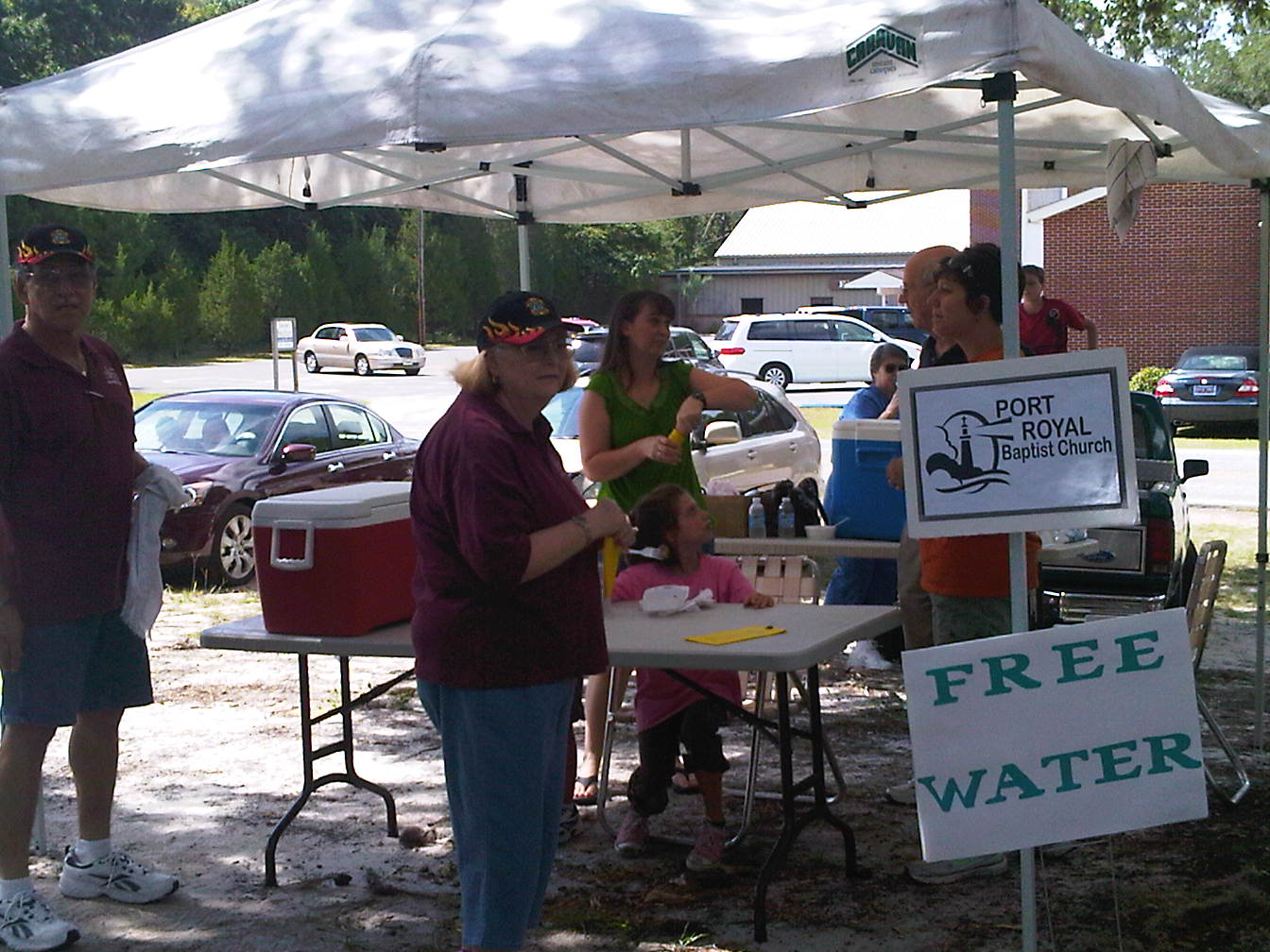
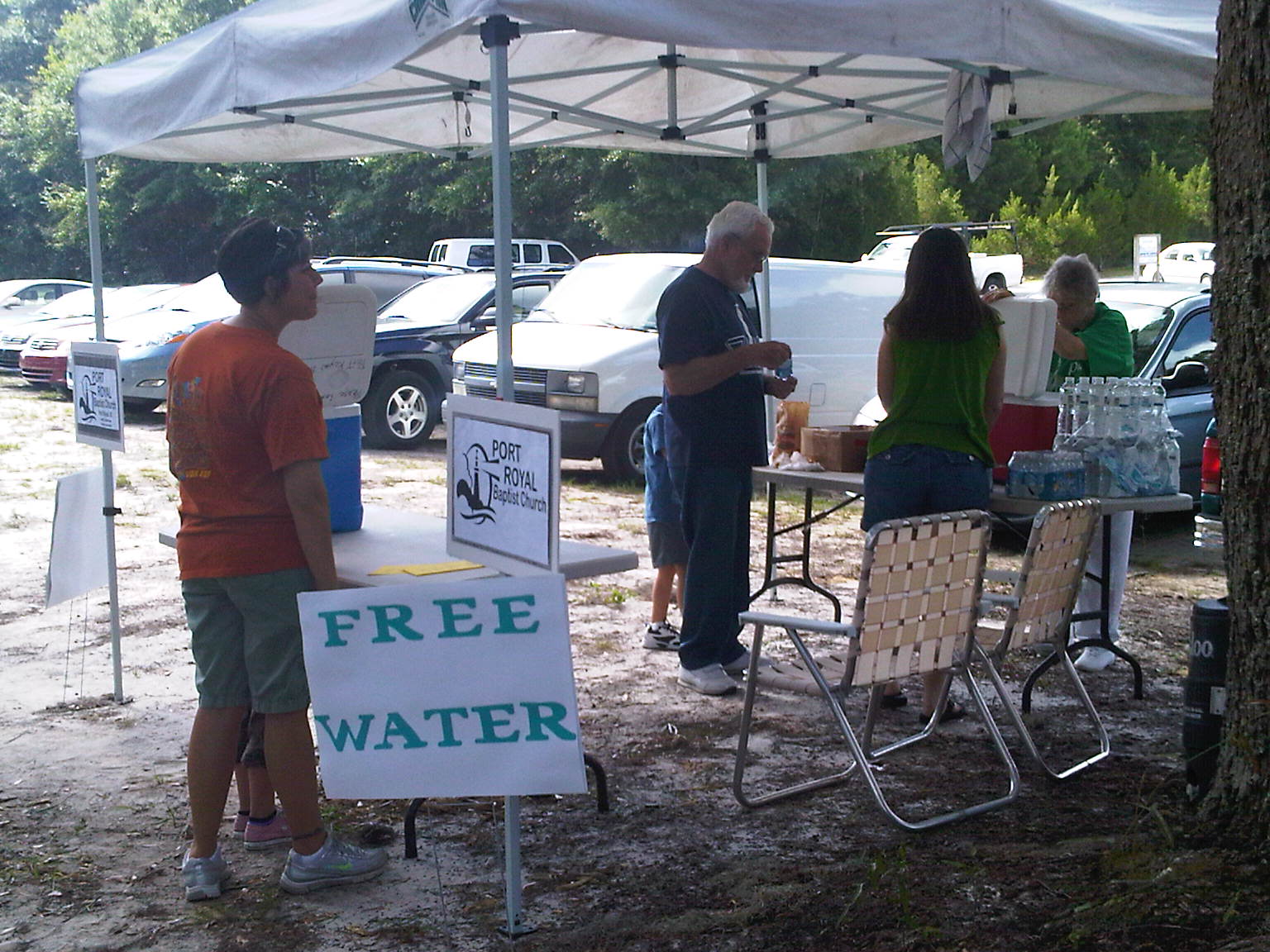
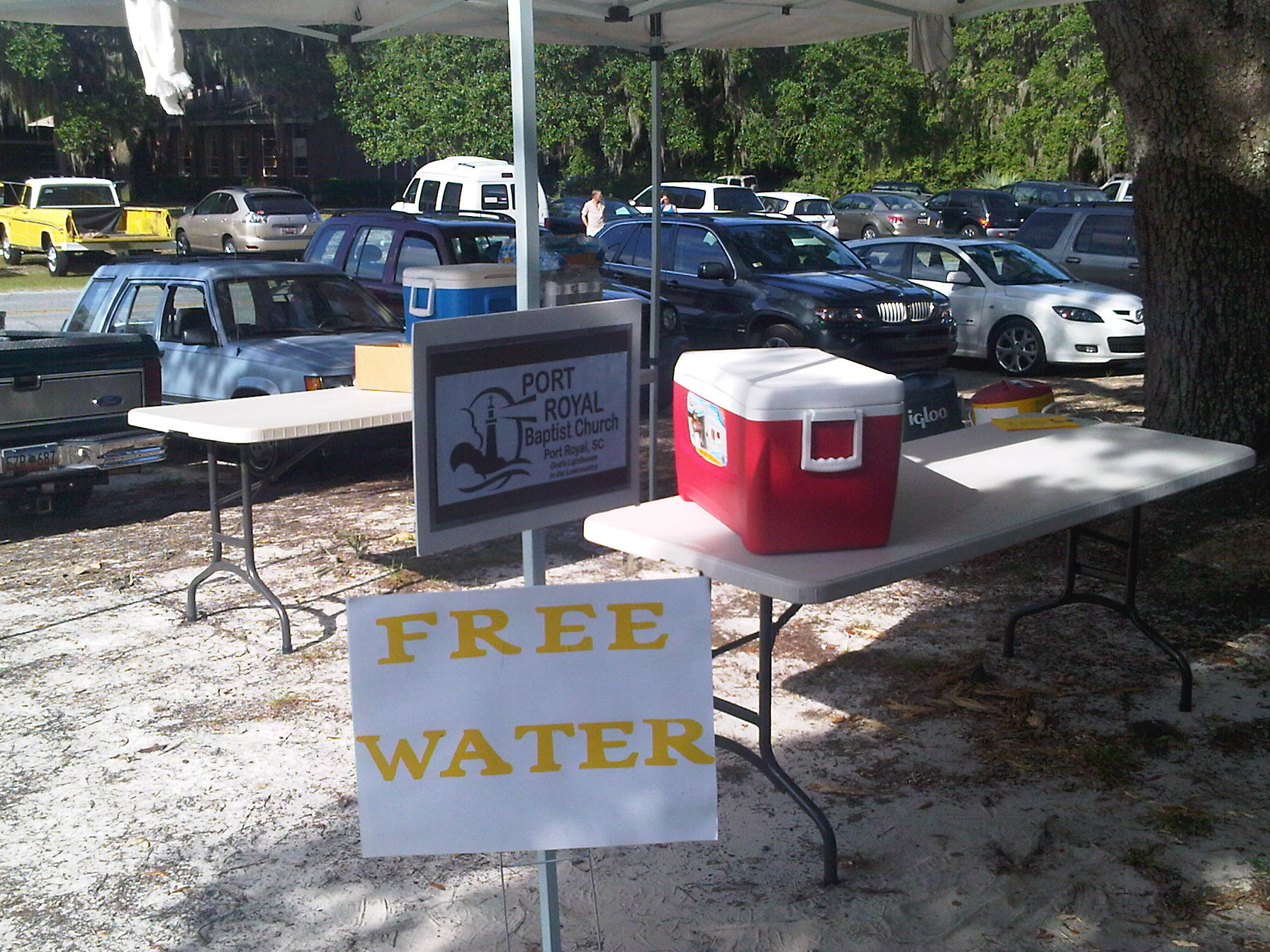
Today, Port Royal Baptist Church had the opportunity to minister to the people of Port Royal and Beaufort at the Farmer’s Market across the street from our church. This is the third time this summer that we have ministered there. Our goal in this project is simple: introduce ourselves to our community through servant ministry. We have chosen to give away free water. Through this approach, we as a church have been able to satisfy a need (thirst, who doesn’t like cold water on a hot day), while at the same time showing the love of Christ in a real and tangible way.

Opportunities have presented themselves to not only invite the community to our worship services, but also to just talk, and listen to them. I am thankful for the chances that we have had to hear their questions and their prayer concerns. It is true that a little water goes a long way. A little effort on our part has gone a long way toward building bridges of trust and friendship. As a pastor, I am extremely proud of our people and their willingness to move beyond the comfort of the church walls and meet the people where they are.


Days like  today excite and encourage me. Although it was a hot and tiring day, I believe God was honored by our efforts. I am excited to see the Lord work in the lives of our people. I am further encouraged that when future doors of ministry open, our people will ready to walk through them. Thank you Port Royal Baptist Church.

My Reflections on VBS 2010

Vacation Bible School has come to an end. The screams and shouts of kids running through the hall, Family Life Center, and the sanctuary are now a distant memory. Decorations have come down and the once vibrant and colorful rooms and hallways have returned to their natural look. It seems as though VBS never happened. It has been an exceptionally long week, longer than normal. I am a big fan of VBS and understand how important it is in the life of the church. Now than that VBS is over, I have a few observations I want to make from a pastor’s perspective.

1. Attendance: In the eyes of many, this is the criteria by which VBS is judged a success or a failure. I don’t believe in that line of thinking. Our average attendance for the week was 113. Our average attendance was up significantly over the past few years. I was encouraged that our kids were active in inviting their friends to attend VBS with them. Two of our classes doubled from one night to the next. We held Adult VBS the same time as the kid’s VBS. This was a huge success.  I feel is it so important for our adults to be on the grounds while VBS is going. It enables them to see the church taking steps to connect and minister to those outside the walls. They have the opportunity as well to experience the controlled chaos that is VBS.

2. Workers: I am thankful to all who worked this week. As I mentioned earlier, it was a long week. It was also very hot. I am especially thankful to all of our teachers who worked full-time jobs, left work, and came straight to church for five straight days. I appreciate so much those who worked in Crafts and Music. Thank you for reinforcing the daily lessons through these avenues. I want to especially mention and thank those who worked in the kitchen all week. During our VBS, we skip the Snack Rotation. Instead, we choose to provide a meal every night. Our kitchen workers come out early, set everything up, served the kids, and stayed until all was cleaned up. Thank you.

3. Ministry: Anytime you have kids on campus you have an opportunity to be engaged in real, one-on-one, life-changing ministry. I have to believe that is what happened this week. VBS is intentionally evangelistic. We were diligent to make sure that we communicate the gospel message all week long, not just on the night of the “evangelistic” lesson. With that being said, we were privileged with four professions of faith in Christ. We are so grateful for these four. We are here to share a message and plant a seed, understanding that it is God that gives the increase. Real ministry takes place when you take time to listen to a child, talk to a child, and show love toward them in the name of Christ. This is what we did this week. If down the road a year or two, in God’s timing, a gospel presentation is given and others respond because of the message that was  planted in their heart this week, then we were faithful to have done our part.

Overall, we had a great week and look forward to what comes out of the efforts of this week. I again want to thank every teacher, worker, and parent who allowed their child to be a part of our VBS. You are my heroes.

My Thoughts on the Final Report of the Great Commission Resurgence Task Force

One week ago, the Great Commission Resurgence Task Force released their final report, including recommendations to be made to the messengers in June at the SBC Annual Meeting. I had written previously on the initial report that was released back in February. This final report was greatly anticipated across SBC life. There was a belief that that final report would contain recommendations that were not listed in the initial report. That did not happen. There was however a new wording of the previous recommendations with some additional explanation of the task force’s thoughts on their work. Also, one of the original components was divided into two separate recommendations. New to this report is a series of challenges set forth by the task force. There are challenges issued to the individual Christian, individual families, local churches and pastors, local associations, state conventions, Lifeway, our seminaries, the Ethics and Religious Liberties Commission, Guidestone, and all Southern Baptist leaders. These challenges reflect how each group can do their part in carrying out the Great Commission.

The final report includes seven recommendations written out in the form that each will be presented to messengers in June. As parliamentary rule goes, this report, including all seven recommendations will be voted on as a whole, unless a motion is made to divide and vote on each one individually, which is 99.9999% likely. I hope this is the case. I believe that an up/down vote on the entire report would not be in the best interest of the convention. However, I am just one pastor. Listed below are the recommendations exactly how the messengers will receive them. If presented as a whole, I would still have to vote no.

Recommendation #1:

“That the messengers to the Southern Baptist Convention, meeting in Orlando, Florida, June 15-16, 2010, adopt the following as the mission statement of the Southern Baptist Convention:”

As a convention of churches, our missional vision is to present the Gospel of Jesus Christ to every person in the world and to make disciples of all the nations.

I plan on voting yes on this recommendation. I feel this is a good solid vision for the convention as a whole while allowing the church to keep their individual visions.

Recommendation #2:

“That the messengers to the Southern Baptist Convention, meeting in Orlando, Florida,  June 15-16, 2010, adopt the following as Core Values for our work together:”

CHRIST-LIKENESS

We depend on the transforming power of the Holy Spirit and prayer to make us more like Jesus Christ.

TRUTH

We stand together in the truth of God’s inerrant Word, celebrating the faith once for all delivered to the saints.

UNITY

We work together in love for the sake of the Gospel.

RELATIONSHIPS

We consider others more important than ourselves.

TRUST

We tell each other the truth in love and do what we say we will do.

FUTURE

We value Southern Baptists of all generations and embrace our responsibility to pass this charge to a rising generation in every age, faithful until Jesus comes.

LOCAL CHURCH

We believe the local church is given the authority, power, and responsibility to present the Gospel of Jesus Christ to every person in the world.

KINGDOM

We join other Christ-followers for the Gospel, the Kingdom of Christ, and the glory of God.

I plan on voting yes on this recommendation. These are solid value to pursue.

Recommendation #3:

 “That the messengers to the Southern Baptist Convention, meeting in Orlando, Florida, June  15-16, 2010, request the Executive Committee of the Southern Baptist Convention to consider recommending to the Southern Baptist Convention the adoption of the language  and structure of Great Commission Giving as described in this report in order to enhance and  celebrate the Cooperative Program and the generous support of Southern Baptists channeled through their churches. We further request that the boards of trustees of the International Mission Board and North American Mission Board consider the adoption of the Lottie Moon and Annie Armstrong offering goals as outlined in this report.”

I plan on voting no on this recommendation. I personally believe that creating another description of giving in order to recognize and celebrate churches that choose designated giving over CP giving will only lessen the emphasis on Cooperative Program giving.

Recommendation #4:

” That the messengers to the Southern Baptist Convention, meeting June 15-16, 2010, request  the Executive Committee of the Southern Baptist Convention to consider any revision to the  ministry assignment of the North American Mission Board that may be necessary in order to  accomplish the redirection of NAMB as outlined in this report; and that the Board of  Trustees of the North American Mission Board be asked to consider the encouragements  found within this report in all matters under their purview.”

I plan on voting yes on this recommendation. I share the concern for a re-emphasis of the North American Mission Board.

 Recommendation #5:

“That the messengers to the Southern Baptist Convention, meeting June 15-16, 2010, request  that the Executive Committee of the Southern Baptist Convention and the International Mission Board of the Southern Baptist Convention consider a revised ministry assignment  for the International Mission Board that would remove any geographical limitation on its mission to reach unreached and underserved people groups wherever they are found.”

I plan on voting no on this recommendation. On the surface this recommendation makes sense. With the recent funding issues of IMB missionaries, it seems appropriate to me to keep their focus, time, and resources committed to people groups around the world.

Recommendation #6:

 “That the messengers to the Southern Baptist Convention, meeting June 15-16, 2010, request the Executive Committee of the Southern Baptist Convention to consider working with the leadership of the state conventions in developing a comprehensive program of        Cooperative Program promotion and stewardship education in alignment with this report.”

I plan on voting yes on this recommendation. I feel that the state conventions are in the best position to promote and educate the local churches regarding the Cooperative Program.

Recommendation #7:

” That the messengers to the Southern Baptist Convention, meeting June 15-16, 2010 in  Orlando, Florida, request the Executive Committee of the Southern Baptist Convention to consider recommending an SBC Cooperative Program Allocation Budget that will increase the percentage allocated to the International Mission Board to 51 percent by decreasing the  Executive Committee’s percentage of the SBC Allocation Budget by 1 percent.”

I plan on voting yes on this recommendation. More funding to the IMB is vital to the effectiveness of missionaries around the world in pushing back lostness. With the task of CP promotion and education taken from the Executive Committee and placed in the hands of the state conventions, it is a good idea to reallocate what the EC used for CP promotion and education and forward that to the IMB.

As a pastor I feel this is an important time in the life of the Southern Baptist Convention. The passing of and rejection of these recommendations can and will have far-reaching effects upon Southern Baptist life as we know, effecting conventions, associations, and local churches. None of these recommendations will be implemented immediately. These proposed changes to the structure of the SBC may be years in the making. What we must do as a local is make an individual commitment to carrying out the Great Commission where we have been planted by God. I believe in the Southern Baptist Convention, but I believe in the local church more.
Real Church Happens Outside The Church

I have done quite a bit of looking around lately. I have made it a point to intentionally notice the people and places around our church. I have noticed that we have both the traditional family structure and single-parent families in our area of influence. I have noticed that we have different races, nationalities, and religious beliefs in our area of influence. I have noticed that we have both ends of the economic spectrum in our area of influence, often living close together. I have noticed that we have people that share similar interests or are linked by some common bond. Some of these in our area of influence are skateboarders, multi-housing, and the military.

There is a reality that I believe I have always known to be true. That reality: there are people who will not connect with the body of Christ through the old “they know we’re here” mentality. Because everyone does not look, act, or respond in the same ways, our ministry approach must fit them. It is up to the church to go to the people. In the Parable of the Great Supper, Jesus tells the story of a man who prepared a banquet and when time come for the guests to arrive, excuses were made as to why they could not. The master of the banquet then went intentionally looking for those who would come. In Luke 14:23 we have the words of Jesus, ‘Go out into the highways and hedges, and compel them to come in, that my house may be full’. I believe there is a principle that we can carry over to the church today. We have made ready. We have prepared places and ministries. We have sat back and waited. We are to go out to where the people are.

Last night, I met with our Church Council, which is made of staff and department leaders. I appreciate this group of people for their passion in their area of service. I am thankful for their desire to see the lives of people changed. As we discussed upcoming community ministry, I posed a question to our leaders and challenged them to some “outside of the box” thinking. Here is the question I posed: ‘What meaningful services can we provide for our community that would be unavailable to them or cost them to obtain?’ I asked them to join me in considering this question and come up with areas of need that we meet “outside” the church walls. I am excited about what I am going to hear. I am looking forward to our church increasing its area of influence in our community.

Reflections on the Great Commission Resurgence Task Force Initial Report : Part #5

This is the final post in a series on my personal reflections of the initial report from the Great Commission Resurgence Task Force.

Component #6: We believe in order for us to work together more faithfully and effectively towards the fulfillment of the Great Commission, that a greater percentage of total Cooperative Program funds should be directed to the work of the International Mission Board. Therefore, we will ask Southern Baptists to support this goal by affirming an intention to raise the International Mission Board allocation for the 2011-2012 budget year to 51%, a move that is both symbolic and substantial. At the same time, we will ask Southern Baptists to reduce the percentage allocated to Facilitating Ministries by 1% as part of our initial effort to send a greater percentage of total Southern Baptist Convention mission funds to the nations.

This component is closely linked to Component #4. The fourth component of the report recommended moving the responsibility of Cooperative Program education and promotion from the SBC Executive Committee and placing it in the hands of the state convention. The task force believes the International Mission Board deserves a bigger piece of the CP pie. Currently, the IMB receives 50% of all CP dollars forwarded by the state conventions. The task force recommend increasing the amount given to the IMB from 50% to 51%. The additional 1% would come from the Facilitating Ministries budget.

In simple terms, the task force is asking for a budget adjustment, a reallocation of funds. The 1% will likely come from the Executive Committee’s budget once CP promotion is no longer an SBC responsibility and is taken on by the state convention. I am in favor this component. I believe the IMB needs more of our CP dollars. They have a huge task before, taking the gospel to all the nations. I applaud the task force for recommending an increase in the IMB budget. This recommendation speaks volumes to the importance of, and the need for, more dollars to the mission field.

Overall, this is a good solid report with the capacity to bring about a needed change across the SBC as it relates the carrying out the Great Commission. I am not sure how these recommendations will be out to a vote in Orlando, if they even get to a vote. There are two options: vote on all six recommendations as one, or vote on each component individually. What would I do? If the report is offered as a whole for consideration, I would have to vote no. If these recommendations are offered individually, right now, I would vote this way:

Component #1: Yes

Component #2: No

Component #3: No

Component #4: Yes

Component #5: No

Component #6: Yes

If you like, you can read the entire initial report here.  

Reflections on the Great Commission Resurgence Task Force Initial Report : Part #4

Component #4: “We believe in order for us to work together more faithfully and effectively towards the fulfillment of the Great Commission, we will ask Southern Baptists to move the ministry assignments of Cooperative Program promotion and stewardship education from the Executive Committee of the Southern Baptist Convention and return them to being the work of each state convention since they are located closer to our churches. Our call is for the state conventions to reassume their primary role in the promotion of the Cooperative Program and stewardship education, while asking the Executive Committee of the Southern Baptist Convention to support these efforts with enthusiasm and a convention-wide perspective.”

 The task force believes the primary responsibility of education and promotion of the Cooperative Program among  local churches should be given to the individual state conventions. Since 1997, Cooperative Program education and promotion has been the responsibility of the SBC Executive Committee. Dr. Floyd, task force chairman states, We envision that a consortium can be created by these state convention leaders that involves the President and CEO of the Executive Committee and together they can plan and execute an annual strategy that will promote the Cooperative Program to our churches as well as challenge our churches in biblical stewardship.” In its infancy, Cooperative Program education and promotion was the responsibility of the Executive Committee.

 I don’t really have a problem with this component. I personally feel that the each local SBC church needs ongoing education as to how Cooperative Program funds are distributed. Churches also need new and varied ways to promote the Cooperative Program. I believe the state conventions are in the best position to fill this important assignment.


 Component #5: “We believe in order for us to work together more faithfully and effectively towards the fulfillment of the Great Commission, we will ask Southern Baptists to reaffirm the Cooperative Program as our central means of supporting Great Commission ministries; but in addition, we will ask Southern Baptists to celebrate with our churches in their Great Commission Giving that goes directly through the Cooperative Program, as well as any designated gifts given to the causes of the Southern Baptist Convention, a state convention or a local association.”

 I am 100% opposed to this component of the report. The task force desires to create a new category of giving entitled “Great Commission Giving”. The goal of this designation is to celebrate what every church is doing to fulfill the Great Commission by recognizing their CP gifts and their designated giving to other SBC, state, and associational causes. In a supplemental article, Dr. Floyd writes, “there was a need to ask Southern Baptists to celebrate with our churches the Great Commission Giving that is given through the Cooperative Program which is our priority, but also to celebrate with our churches those gifts they felt led to designate to the causes of the Southern Baptist Convention, a state convention, or a local association. When our churches give to offerings like Lottie Moon, Annie Armstrong, and state-related missions offerings, the Gospel is being advanced. Therefore, our convention should celebrate with our churches what God is leading them to do.”  

Dr. Floyd states that this new category of giving is not designed with traditional CP giving. He states, We are reaffirming the definition of the Cooperative Program that was adopted by the 2007 Southern Baptist Convention. We believe the Cooperative Program is Southern Baptists’ unified plan of giving through which cooperating Southern Baptist churches give a percentile of their undesignated receipts in support of their respective state conventions and the Southern Baptist Convention missions and ministries.” I believe this too. One area of possible confusion, at least to me, is the inclusion of Cooperative Program gifts in this new Great Commission Giving. I am fearful that a competition will naturally arise between these two giving designations.

 The Cooperative Program is a unified effort. This means that a portion of church’s offerings through the CP reach all the various ministries and missions across the state and SBC. This collective work enables all agencies, commissions, and boards to be funded and carry out the work they have been called to do. My question is this: How does including designated monetary gifts to the local association, state convention, and SBC causes, not given through the Cooperative Program channel, reaffirm the Cooperative Program as the primary plan of giving for the SBC? Hopefully this example will explain further.

 First Church gives 5% to the CP totaling $15,000, $2,000,000 to a church plant in New York City, $10,000 to the Lottie Moon Christmas Offering, and $8,000 to the Annie Armstrong Easter Offering. Under the new designation, their Great Commission Giving would total $2,033,000.

 Second Church gives 11% to the CP totaling $29,500, $3,000 to the Lottie Moon Christmas Offering, and $2,800 to the Annie Armstrong Easter Offering. Under the new designation, their Great Commission Giving would be $35,300. Who do you think will be celebrated? I am not opposed to church planting, nor am I opposed to individual churches supporting specific missions and ministries. Although First Church gave over two million dollars, only $15,000 went to the collective efforts of the state and SBC.  I am concerned that an atmosphere of “look at how much we gave” will overtake the foundational principle that “we can do more together than we can do alone”. The Cooperative Program  fuels us doing more together.

Personally, I believe that if this component comes to pass, there will be an abandonment and erosion of the CP as we know it years down the road. Although not intentional, when two classifications of giving are offered, one will fall by the wayside. The CP is the SBC at its best. Any effort, intentional or unintentional, to shift the focus off of collective funding of missions and ministries will would unravel the very fabric that holds our unified missions efforts together.


Reflections on the Great Commission Resurgence Task Force Initial Report : Part #3

I am continuing my thoughts on the initial report of the Great Commission Resurgence Task Force. What I thought would be three posts, will more likely be four or five.

 Component #3: We believe in order for us to work together more faithfully and effectively towards the fulfillment of the Great Commission, we will ask Southern Baptists to entrust to the International Mission Board the ministry to reach the unreached and under-served people groups without regard to any geographic limitations.

 The task force envisions the International Mission Board taking on the responsibility of assisting the North American Mission Board with reaching the lost across the North America. A large number of the world’s identified people groups that do not speak English are represented in major cities across the North America. Many of these groups have strategy coordinators working overseas with the same group. The task force seems to believe that a more effective reaching of these people groups would be accomplished by allowing the overseas coordinators to work in North America.

 I believe this is a terrible idea. One statement from the report seems especially ambitious. Dr. Ronnie Floyd, GCRTF chairman wrote, We are confident that the North American Mission Board and the International Mission Board can communicate with one another effectively about their respective work and communicate with our state conventions and local associations about what God is doing in their gospel work. I don’t understand how improved communication at denominational, state, and associational levels can be accomplished through this “unleashing” of the IMB on North American soil. I tend to believe the opposite will occur. Here are a few of the concerns I have about this particular component.

 1. The IMB has more than enough one their plate. With the number of unreached people groups around the world growing almost daily, their concern, efforts, and energy should be spent pursuing these groups. I believe with all of my heart that moving the IMB to North America will lead to a less-effective IMB. I would hate to see the IMB get so spread out that they would suffer the same ineffectiveness that the North American Mission Board is seeing now.

 2. North America should be the responsibility of NAMB. I believe the responsible thing to do would be to restructure NAMB in order to reach these same goals. Of course, I’m just one pastor.

 3. I believe this movement of the IMB to North America will blur the lines of responsibility  between these two mission boards. I can also see a funding nightmare as it relates to the Cooperative Program.

4. Does this mean that NAMB will be “hands-off” in the areas of North America in which the IMB is working? Who will have the ultimate responsibility of reaching North America?

 I would rather see the North American Mission Board strengthened through new structure and vision than to see the International Mission Board weakened by taking up the slack of the North American Mission Board.

Preparing for Lottie

As Thanksgiving arrives, so does the time of planning for the Lottie Moon Christmas Offering. Without a doubt, this is my favorite time of the year. The LMCO is our yearly missions offering that supports the work of our Southern Baptist missionaries around the world. One encouraging part of this offering is that every dime collected goes directly to the mission field. This offering is especially close to my heart. It’s not because I am a pastor. Over the past twelve years, I have been able to be part of six IMB work/witness teams that have worked in Honduras and Nicaragua with three different missionary couples. I have been able to see how the money collected through the LMCO is used on the field. Our missionaries are very mindful of the sacrificial giving back home that supports their calling to a specific group of people. Not only are they mindful of the giving back home, they are incredibly careful as to not waste any of it. They stretch every penny to get the most out of it for ministry. Having seen this first hand, I can with all of my heart champion the cause for their support and the continuance of God’s work around the world through them.

I am excited about this year’s events at Port Royal Baptist as it relates to the LMCO. Our missions leaders (of whom I am proud of) are planning an inspirational and educational missions study on Wednesday, December 2nd to showcase the area of this year’s study: North Africa. Also, during our family night supper that night, we will have an international menu made up of the foods from our study region. I am looking forward to sharing a sermon series on missions that will continue through our collection date.

The theme for this year’s offering and study is Whose Mission? Who’s Missing? Two great questions. The week of prayer that has been set aside for this year’s offering is December 6th-13th. December 13th is that date we have set aside to collect our offering. Our goal for this year is $3500. I believe that we as a church can meet this goal. I pray, for the sake of our missionaries, that we go above and beyond. Allow me to encourage you to be involved in the missions study, the week of prayer, and finally the giving toward the LMCO this year.

Opening Doors

This past Saturday we held our annual Fall Festival at PRBC. This was my first at Port Royal. I was very impressed . The events of the night were well put together and a smmoth flow of all events existed. Our festival included children’s games, face painting, cake walks, a trunk-or-treat, a chili cook-off, and a teenage scavenger hunt modeled after the television show The Amazing Race. Oh yeah, lots of candy. I believe that events like this one are important to the life and health of the church. We had two reasons for hosting this event:

1. To give families a safe alternative to the traditional Halloween activities.

2. To provide an entry point into thhe church that is non-threatening.

The second is more important that the first. We can’t expect a person who is not already part of the church body to know how the church works. It is events like this one that gives a person a chance to take a look at the church outside of a normal worship service.  An opportunity is given to make connections with others so that when they do visit a regular service, some barriers have been removed. These events help the unchurched to answer the question,”How do I get in?”

Saturday we had the opportunity to talk with guests who do not attend church at all. Once guest, along with her two children said they were driving by, saw the sign, and stopped. She later told me they were not involved in a local church. Bingo. That is the reason we plan and labor over events like these. It is not for us, it is for them. We need to open as many doors as possible. I want to thank everyone who planned, decorated a trunk, cooked, and manned a game booth. Your efforts made Saturday night a success.

Moving from Reactive to Proactive

Several months ago, as part of a pastor’s accoutability group, I read Thom Rainer’s book, ‘Essential Church? Reclaiming a Generation of Dropouts.’  The book is built around a study that found, according to Rainer, that “more than two-thirds of young churchgoing adults in America drop out of church between the ages of 18 and 22”. I have heard numbers similar to these often over the past several years. This is heart-breaking to me. To think that adults have dropped out of church at a time of major life-changing decisions breaks my heart. I was not surprised by this research. All “professional” church people know that our churches have back doors that we need to close. The inability for churches to keep and connect people who come in the front door only encourages them to slip out the back door. Although I was not surprised by the number or age of churchgoing adults leaving, I was surprised a little by the reason. Rainer wrote, “Most dropouts are not leaving because they no longer want to identify with organized religion. Dropouts do not all question their faith. Few are angry with or have stopped believing in God. These dropouts don’t completely depart from their faith. They rather part ways with the church.” 

What are we not doing as the church? As a pastor, the idea of people “dropping out” of church disturbs me. The thought of people “dropping out” also resonates with teachers and those in the school systems. I believe it disturbs teachers to see kids “drop out” of school. I have noticed something about the school system however. They tend to be proactive in their efforts to curb the drop out rate. I believe our efforts as a church should be proactive as well. We are guilty of trying to develop a plan or strategy to get them back rather than keep them in the first place. God has called us to minister to people. We can’t do this if they are no longer here. Let’s begin the process of closing the back door and keep the people God has given to us. I don’t have all the answers. I know we can do this together as a church. A quote from a former dropout, in my opinion, sums it up perfectly. “It should be harder to leave a church than to join a church.” I agree.