Book Review : Slave; The Hidden Truth About Your Identity in Christ

 In John MacArthur’s latest book, “Slave: The Hidden Truth About Your Identity in Christ”, he takes the reader back to the first-century concept of slavery. Through detailed research throughout the Scriptures and outside sources, MacArthur shows that in his studies the word for “slave” in the original Greek language has been incorrectly translated down through the centuries. With the word “slave” being translated as “servant” most of the time, MacArthur argues that the intent and meaning has lost its intended meaning. He argues that our concept and understanding of being a Christian and, as a result, a “slave of Christ” does not even come close to the unflattering reality of slave life. Throughout his book, Mac Arthur goes into great detail about the life and circumstances of slavery in first century Rome. He points out the relationship between slaves toward their masters and slaves toward other slaves and how these relationships mirror those of the believer and Jesus Christ. These portraits are both enlightening and sobering.

I enjoyed this book to a point. It is well researched and well written as all of John MacArthur’s books are. I was with MacArthur until he made the stretch to tie together his affirmation of the Doctrines of Grace, most notably particular redemption, with how first-century slave masters only paid for the slaves they wanted. He wrote, “The doctrine of particular redemption is also brought out by the marketplace language of the Scripture, where a business transaction or ransom is pictured. Christ’s death on the cross actually pays the penalty for the elect sinner, redeeming him from sin and rescuing him from God’s wrath. In Roman times, the master paid only for the slave he was purchasing. So also, the saving benefits of Christ’s redemptive work are applied only to those whom God has chosen for Himself.” Although I don’t agree with MacArthur theologically on this point, he has still written a thought-provoking book worthy of your time.

Book Review : The Next Christians

 I am immediately drawn to a book by its title. So, when I saw The Next Christians; The Good News About the End of Christian America by Gabe Lyons, I had to know what he meant by that. Lyons’ previous work, UnChristian which took a look at the conducts and actions that turned people away from the Christian faith is referenced several times in this book. It seems this book is the outflow of the previous work, whether that was the author’s intention or not. Lyons begins his book by examining the decline of Christianity in America by taking a look at the present reality that Christianity is losing its influence, respect, and strength in America. In a sometimes pessimistic tone, he puts forth categories that Christians have placed themselves into (Insiders, Culture-Warriors, Evangelizers, Blenders, and Philanthropists).

The second half of the book was much better than the first and carried a much more positive tone. Lyons speaks of the shift in the next generation of Christians from a faith that polarizes and pushes people away to a generation of Christians who are committed to the concept of restoration. He says this new generation of Christians will portray similar characteristics. These new Christians will be Provoked – not offended, Creators – not critics, Called – not employed, Grounded – not distracted, In Community – not alone, and Countercultural – not relevant. This section is by far the best part of the book. I am glad I stayed with it. The Next Christians is a helpful and insightful look into what the Christian faith was intended to reflect in this world.

Are We There Yet? Part #2

“Getting there”. In yesterday’s post, I began looking at the question that is being asked of all Southern Baptists during this Christmas season as we study about, pray for, and give to our missionaries through the Lottie Moon Christmas Offering. The question is “Are We There Yet?” The “there” is the lost world. The “there” is the culmination of our witness so that everyone has heard the name and gospel of Jesus Christ. Along the way, questions must be answered. The status quo has to be challenged. Priorities must be re-shuffled. Today, I want to offer two questions that surely will have to be dealt with before we can get “there”.

Question #1: Are we there yet in our willingness to place the funding of our missionaries as a top priority?

Our Southern Baptist missionaries are on the front-line in the battle over spiritual darkness and are funded solely by monies contributed through the Cooperative Program. This enables our missionaries to remain on the field engaged in training leaders, planting churches, building relationships with local people groups, and other gospel-proclaiming endeavors. The flip side of the issue is this. If churches decrease their giving, then less money will reach the mission field overall. If state conventions decide to keep for themselves larger and larger percentages of the CP dollar, then less money will reach the mission field.

It is a reality that ministry requires money. It is just the simple truth. Reaching the lost, and the nations for that matter, requires the individual believer, the individual church, the individual association, and the individual state conventions to give selflessly, in whatever manner is available to them in order for Christ to be proclaimed. Budgets reflect priority. It does not take an economist to tell that financially our county has been hurting for a few years, and continues today. I am also a firm believer that financial challenges further reveal priority.  When faced with financial challenges, churches can decide to either make missions and ministry a priority or play it safe and look within. At Port Royal Baptist Church, we have recently made decisions to further invest in what is fruitful and decrease what is not seen as fruitful. Associations, when faced with financial challenges, can either choose to cut ministries and play it safe or aggressively speak for the nations on behalf of the fellowship of churches. State conventions, when faced with financial challenges, can either decide that missions work beyond the state lines is as equally important and worthy of equal funding, or can allow the lobbying of the state agencies and entities to drown out the call for needed funding from overseas.

What makes me question whether or not the willingness is there or not comes from what I have seen over the past several months across the SBC. This willingness can be seen in several state conventions have voted to move their CP division to a 50/50 split, meaning the state retains 50% of funds sent to them from the churches and forwards the other 50% to the SBC. This is encouraging and exciting thing to see happen. It is at the very least a recognition that more funding is needed beyond the state in order keep already appointed missionaries where they are and fund the ones who are standing by. As I had mentioned in a earlier post, our state convention is South Carolina during it’s annual meeting voted to keep any excess funds beyond what is required to meet the operating budget within the state and divide the excess between the seven state entities, agencies, and schools. Do difficult financial times in our country give us a free pass on reaching the nations with the gospel? Absolutely not. Until we as Southern Baptists possess a willingness to make missionary funding a priority, “there” will remain just beyond our reach.

Question #2: Are we there yet in our realization that “business as usual” is no longer acceptable in our efforts to reach the lost?

 I believe this was the genesis for the Great Commission Resurgence Task Force. Going back to the original motion in 2009, there has been a realization across the SBC that on present course we are, at best, treading water in our efforts to fulfill the Great Commission. This passion and desire to get our practice right as it relates to the Great Commission is real. It is just as real as the passion and desire was to get our theology right during the Conservative Resurgence of the mid-late 1980’s. From time to time it takes something to rattle us and wake us up from our slumber. I believe GCRTF has put before us as Southern Baptists the picture of lostness and legitimate recommendations that would enable us to fulfill the Great Commission. These recommendations, if implemented by the various agencies, will change the face of our denominational structure and how we do “business”. I was encouraged to read what Dr. Kevin Ezell, President of the North American Mission Board, said recently at a missionary appointment service. Dr. Ezell said “As we go through changes, absolutely every change we make and every reduction we make is to put more missionaries in the field.

 It is very easy to get settled into routines, schedules, ministries, programs, and structures; and as a result, place our trust in them. Any changes to the present structure will be questioned and difficult. Territorial spats are already occurring and changes have only been proposed. Recently, a group of directors of missions from Alabama wrote an open letter to the SBC encouraging a slow down on the Great Commission Resurgence. I’ll be writing a response to that letter in the near future. How do you hope to slow down a renewed desire and passion to fulfill the Great Commission? Better yet, how dare you ask such a thing? I sat in the convention hall of the Southern Baptist Convention’s annual meeting in Orlando this past June, it was clear that Southern Baptists were saying “business as usual” is no longer acceptable. It is a willingness to let go of “business as usual” and set aside turf wars and territorialism that will determine our ability to get “there”.

Are We There Yet? Part #1

Are we there yet? This is a question that every parent with a child who has been on a road trip has been asked before. At least once. Usually in repetition. It is a question that assumes a destination. It is a question that assumes there is an ending point. For the child in the back seat, it is a question that assumes there will be a point in time when the journey will be over and they can get out of the car. Business leaders ask this question of their employees on the progress of assigned tasks. For the employee, it is a question that assumes the employer is looking for the finished product. Ultimately, it is a question of a completed task.

 “Are We There Yet?” is also the theme for the 2010 Lottie Moon Christmas Offering. Of all the themes in recent history, I believe this one is the most personal and urgent. The question that is asked is pointed. The question that is asked is honest. The question that is asked is demands an answer. The question that is asked requires examination on our parts. The question that is asked cannot be avoided. The question that is asked should cause us as Southern Baptists to evaluate our priorities.

As we consider this question, we have to determine where “there” is. After all, if we don’t know where “there” is, how will we know if get there? Our “there” is wrapped up in the commission Christ gave to His disciples prior to His ascension that has come to be known as the Great Commission. Jesus told us in Matthew 28:19, “Go therefore and make disciples of all the nations.” In Mark 16:15, we find Jesus’ words again “Go into all the world and preach the gospel to every creature.” For Southern Baptists, and evangelical Christianity as a whole, the “there” is reaching the lost world with the gospel of Jesus Christ.

In the latest figures available from the International Mission Board, the numbers are both staggering and sobering. There are 3,724 people groups that are not engaged at all with the gospel. People groups refer to groups of individuals, families, or clans that share a common language and ethnic identity. Scott Holste, Director of the IMB Global Research Department says, more specifically, “a people group is the largest group through which the gospel can flow without encountering a significant barrier of understanding or acceptance.” There are 6,426 unreached people groups (those with less that 2% of people who profess to have a personal relationship with Christ). There are 1.7 billion people worldwide that have little or no access to the gospel. 89% of the North African and Middle Eastern people groups are unreached.

So, “Are We There Yet?” Not by a long a long shot. There is work left to do. There are choices to make. In part two of this post, I will examine some questions in which in our answers will determine how quickly we get “there”.  


Book Review : Son Of Hamas

 “Son of Hamas” is the story of Mosab Hassan Yousef, son of Sheikh Hassan Yousef, co-founder of Hamas, the Islamic Palestinian terrorist group opposed to the Israeli occupation of lands believed to belong to the Palestinians. It is this feud that is at the heart of the Middle East conflict today and is the backdrop for this book.

 More than a true story, “Son of Hamas” is a book about a journey. It is a journey of two men. For the father, it is a journey from the moderate religious side of Islam merely leading prayers and overseeing the community mosque to the political side of Islam. For the son, it is a much more complicated journey. Yousef loved Islam and loved only his father more. He saw the purity and ideal nature of Islam in his father; the love for the people and compassion for the poor and fatherless. As his father journeyed, so did he. “Son of Hamas” chronicles, as Yousef himself describes it, the climbing of the ladder of the Islamic faith.  His journey is one from faithful Muslim, to Israeli spy working for the Shin-Bet, to Christ-follower. This book is filled with real-life accounts of imprisonments (both of his and his father’s), torture, secret plans and operations, and acts of violence that would lead anyone to question whether or not the fighting was worth the end result.

I really enjoyed this book. It is a very quick and easy read that holds your attention. Anyone who even pays casual attention to world news has heard the name Hamas. This book does a very good job describing what Hamas is and how it relates to other organizations we hear about regularly. Well worth your time.

Do Not Forget God Today

Today is a special Thanksgiving edition of Friday is for Scripture.

 1 It is good to give thanks to the LORD, And to sing praises to Your name, O Most High; 2 To declare Your lovingkindness in the morning, And Your faithfulness every night, 3 On an instrument of ten strings, On the lute, And on the harp, With harmonious sound. 4 For You, LORD, have made me glad through Your work; I will triumph in the works of Your hands.

What a tremendous opening statement. “It is good to give thanks to the Lord”. This particular psalm was assigned to be recited during the weekly temple services on the Sabbath day. As worshippers gathered weekly, they heard this reminder, “it is good to give thanks to the Lord”.  It is in verse two that we are reminded of the frequency of our thanks, “in the morning” and “every night”. What a great reminder for Christians today to make Thanksgiving an attitude instead of a holiday.

I know that Thanksgiving is a busy day. Meals are being prepared, games are being watched, naps are being taken, and sales are being reviewed for Friday. As we gather together today with our families, I want to encourage you to take some time around the table and share what you are most thankful for. Slow down and remember the psalmist’s words, “it is good to give thanks to the Lord”. I am thankful for many things. I thank the Lord for my salvation. For it was first His and He made it available. I am thankful to be Jordan’s dad and Terri’s husband. I am thankful to be the pastor of a congregation of people who love the Lord, the lost, and me. The privilege is mine. As you think about what you are thankful for today, let me mention a few briefly.

1. Food – Today you will eat all you want. You will go back for more, and will likely take some home with you. There will be some today who won’t eat at all. Thank the Lord for what you have.

2. Shelter – We will enjoy houses full of family regardless of the weather outside. We may even say “there is not enough room in here”, while many today don’t adequate or permanent shelter. Thank the Lord for what you have.

3. Family –  Houses will be filled with people today. Children will be running in and out. They won’t be using their inside voices. Someone may say “it is too crowded in here, I’ve got to get outside”. There will be some today separated from their family. There may be some who don’t even know where a family member is. This may be the first holdiday without a spouse. Thank the Lord for what you have.

4. Clean Water – We will have all the safe water we need to wash with, cook with, and drink without having to leave the house. Many today will walk miles for water they know is not safe to drink. What else can they do? Thank the Lord for what you have.

God has blessed us beyond comprehension. Please don’t forget Him today.

Happy Thanksgiving.

My Reflections on the 2010 South Carolina Baptist Convention Annual Meeting

I attended our South Carolina Baptist Convention Annual Meeting in Columbia last week with a good pastor friend of mine. I enjoy annual meetings such as these. I have always made an attempt to attend these meetings and involve myself in the business of the state convention of which the church that I pastor is a contributing member. These annual meetings are times of fellowship, encouraging worship, challenging messages, reports from the agencies and entities owned by the state, and times for various business items to be handled.

As I look back on Columbia this year, I do so with mixed emotion. On one hand it was an enjoyable positive experience. I had the opportunity to represent my church as a messenger and participate in the voting process. Opportunities presented themselves for me to meet new people and form new relationships. Being new to the SCBC, this was important. I was personally encouraged by the messages I heard during the annual meeting and the pastor’s conference. Mike Stone, Ed Stetzer, James Merritt, and Ken Whitten and others personally touched my heart. I had been previously asked and was elected to serve on of the convention committees over the next three years. I am looking forward to this opportunity. I was also encouraged by a motion from the floor that called for the convention president to create a South Carolina Great Commission Resurgence Task Force whose purpose is to respond to the recommendations contained in the SBC GCR Task Force that were adopted back in June and bring their report to the messengers in Columbia next year. Anytime we can begin seriously focusing on how to better accomplish the Great Commission it is a positive step. Outgoing president Dr. Fred Stone has named this 35 person task force. You can read their names here.

On the other hand, it was a puzzling experience. To be honest, I don’t know any other way to say it than that. I was left scratching my head at times in disbelief. To put it plainly, there was a spirit of fear present during the meeting this year. As the budget was being discussed, this spirit of fear is something that could be felt. It is hard to explain, but can be characterized by statements like these, “let’s wait and see”, “what will happen if?” “we just don’t know”, “let’s make sure first”, and “how do we know what will happen?” To me, two motions demonstrate this.

First, under the 2010 SCBC operating budget, 40.44% of receipts are forwarded to the SBC. The proposed 2011 budget calls for 41% to be forwarded to the SBC. A motion was made to amend the proposed budget to freeze the SBC contribution at 40.44%. The argument was put forth that there was no way of knowing what kind of changes may be recommended or what revenue may look like. So, we should just wait before changing our percentage giving to the SBC. Unsaid was that while we wait, the nations wait. Thankfully this amendment failed.

Second, a motion was made that all receipts in excess of the 2011 budget be kept in state and divided among the seven state institutions, agencies, and schools. Again, the argument was put forth that the funding was desperately needed in the state due to the work that was going on here. I don’t doubt there is good work happening across the state of South Carolina. To ask that any extra, above and beyond what is necessary, be retained in the state and divided among the agencies who already, by percentage, receive budgeted funds is a mistake and a missed opportunity. A missed opportunity to send this surplus to the mission’s agencies whose sole source of funding comes from the gifts of the churches. Again, the nations will have to wait.

In my opinion, the upcoming year is going to be a crucial one for our state. As the task force meets to being their discussion over the recommendation the SBC has adopted and plan for the effects as the state level, a great deal is at stake. We could see a call for major changes or no changes at all. Will our state convention continue on the path of retaining large portions of the CP dollars from the member churches? Will there be a shift to move toward an even distribution of CP monies? I don’t know. I am praying for the latter. I don’t know how many more years we are Southern Baptists can absorb the number of missionaries having to leave the field due to lack of funding. I don’t know how long we can absorb the shrinking number of missionaries while the number of those without Jesus Christ continues to rise.  I do know one thing. I left Columbia convicted because I did not stand and voice my opinion and feelings on these crucial matters. That will be the last time that I walk away wishing I had said something.


Book Review : Start! The Bible For New Believers

I was recently introduced to a brand new resource for new believers in Christ. “Start! The Bible for New Believers” edited by Greg Laurie, is a Bible designed with the new believer in mind. A new believer who has just given their life to Christ cannot be expected to know how to live for Christ immediately. Start! is a great resource to help them to begin their faith journey. Start! is in the New King James Version which I believe to be both a solid and dependable translation for someone beginning their spiritual walk.

 The bright orange cover and the use of color throughout the pages in the headings and articles are visually appealing. Each chapter has an introduction that is simple, clear, informative, and connective to the entirety of the Bible. Laurie has also included the following four features scattered throughout the Bible to assist the reader in better understanding and applying the text. LIVE are articles on the various topics of what it means to be a Christian. GROW are tips that give the reader helpful guidance on the key principles of the Christian faith (prayer, witnessing, etc). KNOW are articles highlighting the core beliefs of the Christian faith. LEARN are commentaries on key passages that help the reader understand crucial passages. Also included in the back of the book is a section entitled “Essentials” which is a series of questions designed to help the reader have a better understanding of who God and Jesus Christ is.

Start! is a wonderful resource. I believe it to be a great tool for someone just starting out as a believer, for someone who has been saved for a while but has not grown, and a great Bible for teenagers. I recommend this Bible. This is a resource of which the reader will benefit greatly.

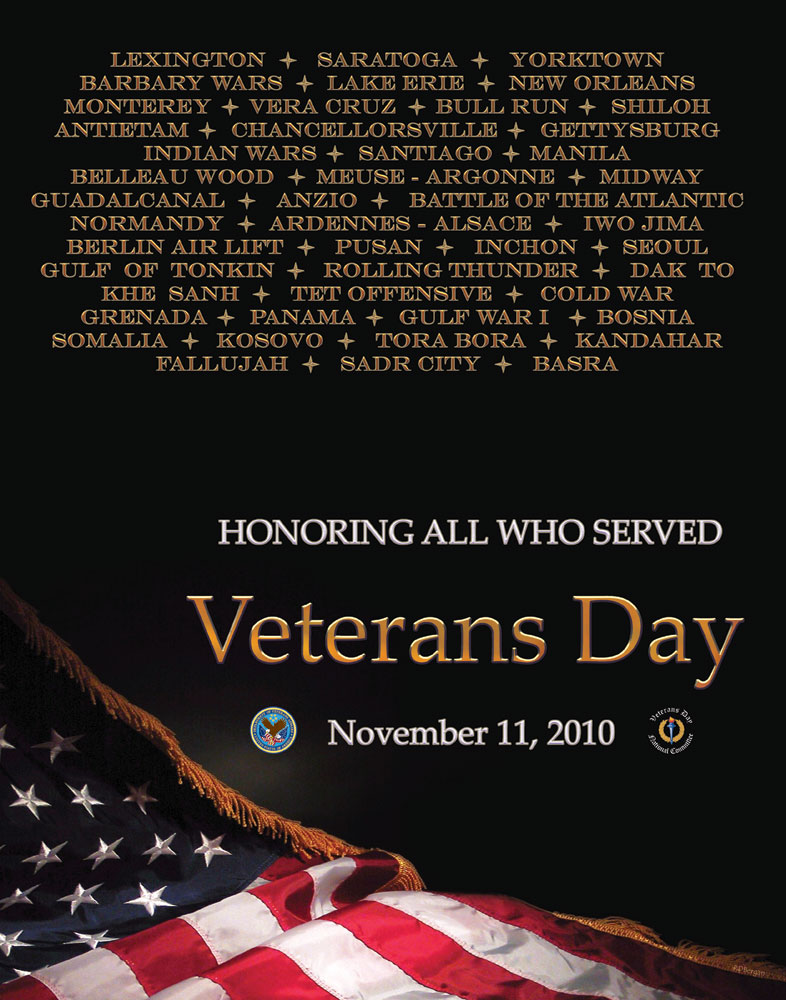
On This Veterans Day

Today is Veteran’s Day. It is the day set aside to honor and recognize all the men   and women who have served in the armed forces. Veterans Day originally began as Armistice Day. Armistice Day celebrated the signing of the armistice, or peace agreement, between the Allies and Germany that brought to an end the major hostilities of the First World War. These hostilities ended on the 11th day of the 11th month of 1918. President Woodrow Wilson proclaimed the first holiday for November 11, 1919. On that day he said, “To us in America, the reflections of Armistice Day will be filled with lots of pride in the heroism of those who died in the country’s service and with gratitude for the victory, both because of the thing from which it has freed us and because of the opportunity it has given America to show her sympathy with peace and justice in the councils of the nations.” Armistice Day was later changed to Veterans Day in 1954. Since the change, all veterans from all services and campaigns are recognized and honored.

Our service members sacrifice a great deal in the defense of our country. They sacrifice their personal comfort. Living conditions are not always ideal. From spending weeks in the field training to enduring extreme hot and colds in locations around the world, comfort is not always a priority. Our service members also sacrifice their families to some extent. Multiple deployments and extended training times pull our service members away from the ones they love. In some cases, a year or more. They miss important family dates (birthdays, anniversaries, holidays, etc.) and miss seeing their children grow up. More than anything else, they sacrifice themselves. Our service members expose themselves to not only physical harm, but emotional and mental trauma as well. The images of war are everlasting and life-changing. Our soldiers not only come home physically hurt, but mentally scarred as well.

On this Veterans Day, I would like to simply say “Thank You” to every Soldier, Marine, Seaman, Airman, and National Guardsman who has given a part of themselves in defense of the country we love so much. You and your family are appreciated more than words can express. If you enjoy the ability to come and go as you like, work where you wish, worship in the place you choose, freely and without restriction, thank a veteran. If you enjoy being able to participate in the democratic process, speak in opposition to government officials, vote, and even question why our military is fighting, thank a veteran. They fight so that we may enjoy personal freedoms.

Happy Birthday Marines

I served in the United States Marine Corps. I graduated from high school on a Friday night and was standing on a set of yellow footprints on Monday as a scared seventeen year-old. It was dark and the smell of marsh and saltwater filled the bus as we made our way past the front gate of Parris Island in what seemed like a slow-motion ride to the receiving barracks. As the bus pulled to a stop, one of the Marine Corps’ finest (I really mean that) boarded the bus. I can still remember every word he spoke. “On behalf of the commanding general, I want to welcome you to Marine Corps Recruit Depot Parris Island.” I thought that was nice. With a change in tone he followed that up with “Now get off my bus.” It took me about 30 seconds to wonder where the “nice” went. Funny, it never showed up again.

Parts of book camp are a blur. Although I remember a great deal, I can’t remember every single detail. I remember it was hot. Oh my, was it hot. If there is a place hotter than Parris Island in June, July, and August, I haven’t been there. I remember sounds, smells, and especially how quiet Parris Island is at night. It is almost eerie how quiet it is. I can remember the silence being broken with the beautiful sound of a drill instructor calling cadence. One memory is unique to my experience. On the evening of August 3, 1990, we were watching the evening news during our half-hour of free time. The headlines that night were that Sadaam Hussein had invaded their neighboring country of Kuwait. My Senior Drill Instructor came out and said that there would be some of going to Kuwait. How prophetic. Four months later, I was there. I turned eighteen about half-way through boot camp while at the rifle range. My graduation date, August 31st, 1990 is a day I will never forget.

I appreciate the Marine Corps more than I can say. I love what the Marine Corps stands for. I loved being a Marine. While those months at Parris Island are arguably the most difficult of my life, I would not give them back even if I could. The Marine Corps helped me to grow up. I found a sense of purpose and a place of belonging that I had never had growing up. Second only to Christ, the Marine Corps changed my life and made me who I am today.

I said all of that to say this. Today is the United States Marine Corps’ 235th birthday. Our Marine Corps has a very storied past. It is one of devotion, pride, and integrity. It is a way of life that I was privileged to be a part of once. So, to the institution that helped shape me, I say “Happy Birthday Marines.”