Book Review : Has God Spoken? Proof of the Bible’s Divine Inspiration

In our day, critics continually and consistently launch assaults on the validity, accuracy, reliability, and sufficiency of the Bible. Their thought seems to be that if the Bible can be reduced to just simply a collection of fables and stories, then there is no need for faith, repentance, Christianity, or even Christ Himself. In his latest book, “Has God Spoken? Proof of the Bible’s Divine Inspiration”, Hank Hanegraaff has written a powerful work that leaves no room for debate that God has truly spoken through His word. His proofs enable us to not only trust the Bible, but allow it change and guide our lives.

“Has God Spoken?” is separated into four major parts. The parts are presented by using the acrostic M-A-P-S; Manuscript Copies, Archaeological Spade, Prophetic Stars, and Scripture Lights. The first part of his book utilizes the subacronym (Hanegraaff’s term) C-O-P-I-E-S.  In this section, Hanegraaff tackles the object that errors, intended and unintended, were made in the copying of the original manuscripts which lead critics to sat the Bible is in no way accurate. The second part of his book utilizes the subacronym S-P-A-D-E. Hanegraaff demonstrates how archaeological discoveries prove the existence of, and are consistent with, places described in the Bible. The third part of his book utilizes the subacronym S-T-A-R-S. In this section, Hanegraaff shows how the truthfulness and validity of biblical prophecy only further prove the Bible’s accuracy. He also demonstrates how biblical prophecy is inconsistent with divination and predictors of the future. In his final part of the book, he uses the subacronym L-I-G-H-T-S. Here the author gives the reader tools to better understand biblical interpretation.

I enjoyed this book a great deal. Although this book is written by an apologist and serves as a defense for the validity of the Bible, it is not overly scholarly. This allows it to be used by Christians in every stage of their faith walk to better understand and be prepared to give a defense of the Bible’s accuracy. One thing I noticed seemed to get in the way. Within the subacronyms there were other acronyms that Hanegraaff likely intended to be helpful in further understanding his point. At times I found these distracting. That being said, “Has god Spoken?” is a great resource and a well-written and researched work. I highly recommend.

Disclosure of Material Connection: I received this book free from Thomas Nelson Publishers as part of their Blogger Review Program. I was not required to write a positive review. The opinions I have expressed are my own. I am disclosing this in accordance with the Federal Trade Commission’s 16 CFR, Part 255: “Guides Concerning the Use of Endorsements and Testimonials in Advertising.”
Book Review : Enemies of the Heart

I really enjoy the communication style of Andy Stanley. I have read many of his books and listen to his podcasts from Northpoint on a regular basis. I have his ability to communicate complex and difficult themes in a simple and practical way to be refreshing and useful. His new book, “Enemies of the Heart; Breaking Free From the Four Emotions That Control You” is no different. This book is a re-publish of Stanley’s earlier work “It Came From Within”. Stanley deals with what can be referred to as spiritual heart disease. He defines the heart not as the necessary organ that pumps blood to the rest of the body. Instead, he defines the heart as “that mysterious, wonderful, confusing part of you that enables you to love, laugh, fear, and experience life. It’s the sphere in which relationships happen.” Through the analogy of a heart patient going through the process of diagnosis and treatment, Stanley focuses on what are the four main enemies of the heart, of which the bulk of human problem can be traced back to. Stanley asserts that each of these conditions create a debt/debtor relationship in which both parties are negatively affected. The enemies as Stanley describes them are:  Guilt – “I owe you”, Anger – “You Owe Me”, Greed – “I Owe Me”, and Jealousy – “God Owes Me”.

Stanley details each of these conditions by looking at their cause and affect upon the heart of the believer. He then gives ways to practically confront each danger by what he calls “habits of the heart”, which he describes as “habits that exercise the heart and allow it to maintain the rhythm for which it was designed.” Enemies of the Heart is a quick and easy read. This being said, the truths that Stanley reveals will cause you to do some deep introspection. The discussion guide included at the end is beneficial and could be used for future small group study. Great resource. This book is well worth your time. I highly recommend.

Disclosure of Material Connection: I received this book free from Waterbrook Multnomah publishers as part of their Blogger Review Program. I was not required to write a positive review. The opinions I have expressed are my own. I am disclosing this in accordance with the Federal Trade Commission’s 16 CFR, Part 255: “Guides Concerning the Use of Endorsements and Testimonials in Advertising.”

Book Review : Muscular Faith

The concept of faith is a difficult one for many to grab hold of today. The practice of actually living by faith is even harder to understand. In his latest book, “Muscular Faith, How to Strengthen Your Heart, Soul, and Mind for the Only Challenge That Matters”, Ben Patterson builds the case that it is a strong, active, and vigorous faith in Jesus Christ that pleases the Father and enables the believer to fulfill what the Hebrews writer declared by saying, “without faith it is impossible to please Him”. Patterson submits that our faith is not be passive for we serve a Go who is not passive or inactive. On the contrary, our God is a “warrior” as Patterson describes. He consistently calls for us to battle the forces that would derail our spiritual walk. God’s Word itself call the believer to “fight the good fight of faith.”

“Muscular Faith” has an easy-to-follow and common sense flow to it. Patterson begins by showing the reader that we have been called to live a life of faith and how important and active that faith should be. He then takes the reader down the road of what is at stake in our pursuit of an active and vigorous faith. I enjoyed the part of this book where Patterson describes the obstacles (such as nominal Christianity and refusing to give God permission to change us) that get in the way of a muscular faith. He concludes with tools and disciplines that help to overcome obstacles and helps to pursue a God-honoring and life-changing faith.

“Muscular Faith” is a good work. Patterson does a great job of combining scripture, quotes, and personal experiences to make his point. I found nothing in this book to the earth-shaking. Everything I read I had read before in some manner or another. All in all, a good work. I believe this book would be a good first read for new believers as they start their faith journey.

Disclosure of Material Connection: I received this book free from NavPress Publishers as part of their Blogger Review Program. I was not required to write a positive review. The opinions I have expressed are my own. I am disclosing this in accordance with the Federal Trade Commission’s 16 CFR, Part 255: “Guides Concerning the Use of Endorsements and Testimonials in Advertising.”
Worth Repeating : David Platt

“There is a spiritual battle presently raging for the souls of billions of men and women around the world. The scope of this spiritual battle is universal. It covers and comprises every tongue, tribe, language, nation, person, and people group. There is no place on this earth where this war is not being waged.

The stakes in this spiritual battle are eternal. There is a true God over this world who desires all people to experience everlasting joy in heaven. There is a false god in this world who desires all people to experience everlasting suffering in hell. The enemy in this spiritual battle is formidable. He is like a lion looking for his kill, and he is dead set on defaming God’s glory and destroying God’s people. Where the church exists, he works to draw us in through temptation and discourage us in trial. He lures us with possessions and prosperity, and he lulls us to sleep with comforts and complacency. He deceives, deters, and distracts the church from knowing the wonder of Christ and declaring the worth of Christ to the ends of the earth.

Meanwhile, he holds thousands of unreached people groups captive through deceptive philosophies, hollow worldviews, and false religions. These people groups are virtually untouched by the gospel of the glory of God, and this is where the adversary’s stronghold exists. Any Christian and any church that desires to proclaim the gospel among the unreached people groups of the world can expect to be met with the full force of hell in the process.”

David Platt,  from the foreword of “Spiritual Warfare and Missions” by Jerry Rankin and Ed Stetzer

Book Review : Why God Won’t Go Away; Is the New Atheism Running on Empty?

I have just finished Alister McGrath’s new book, “Why God Won’t Go Away; Is The New Atheism Running on Empty?” In this book, scholar, historian, and theologian McGrath introduces the reader to a group of anti-theists known as “New Atheists”. New Atheism is defined as “an enthusiastic advocation of atheism and a scathing criticism of both religious belief and cultural respect for religion.” McGrath identifies two kinds of atheism. The first is Apathetic Atheism. This group takes the position that says “I don’t believe in God”. They feel no real need to defend their beliefs and have no serious heartburn with organized religion and faith. The second group is known as Committed Atheists. This group takes the position that says “God does not exist”. They have reasons for their beliefs and possess a desire to make those reasons known to all. New Atheism falls in this second category, but goes farther. They do not tolerate religion and believe that apathetic and committed atheists are “cowards”. New Atheism is aggressive and, as McGrath says, “militant” in nature. He says, “The New Atheists make rationality one of its core defining characteristics and emphatically and aggressively denies that any alternative view can be regarded as rational.”

Why God Won’t Go Away is divided into three sections. In the first section, he introduces the reader to the four leading voices of the New Atheism: Sam Harris, Richard Dawkins, Daniel Dennett, and Christopher Hitchens. He also lists their recent works and how they have contributed to this movement. In the second part, McGrath focuses on and unpacks the core themes of violence, reason, and science. It is here that he exposes the flaws in the New Atheism movement. Thirdly, McGrath explores the question, “Where does the New Atheism go from here?” It is here that he chronicles the decent of New Atheism from the mainstream and how it is losing traction with its original and sympathetic audience.

I really appreciate McGrath’s method of writing in this book. He was kind and fair while giving a solid rebuttal to New Atheism. He has chosen to take the high road in his explanation and handling of this movement. This makes the book work. “Why God Won’t Go Away” is well written, researched, and presented. He has succeeded in pointing out the internal problems of New Atheism and their reluctance to have an open mind. McGrath’s subtitle asks the question, “Is New Atheism Running on Empty?” I believe he has answered that in the positive. I highly recommend this book.

Disclosure of Material Connection: I received this book free from NavPress Publishers as part of their Blogger Review Program. I was not required to write a positive review. The opinions I have expressed are my own. I am disclosing this in accordance with the Federal Trade Commission’s 16 CFR, Part 255: “Guides Concerning the Use of Endorsements and Testimonials in Advertising.”

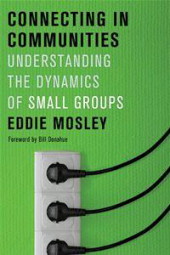
Book Review : Connecting in Communities: Understanding the Dynamics of Small Groups

Connecting in Communities: Understanding the Dynamics of Small Groups is the latest book by Eddie Mosley who is the executive director of GroupLife at LifePoint Church in Smyrna, TN. It is very evident from the tone and direction of this book that connecting people to small groups is a passion of Mosley’s. He writes from the perspective of experience. I believe what makes this book really work is that organizing and encouraging small groups and small group leaders is what Mosley does every day. This book is not about abstract thoughts and untested principles. Rather, it is about proven methods fleshed-out through years of “on the field” experience. Mosley has consulted with and learned from the top minds in small group ministry from across the nation including Saddleback and Willow Creek.

Connecting in Communities was written to help churches and church leaders who were looking to implement small group ministry. Throughout the book, Mosley stresses the benefits of small group ministry from the point of accountability, discipleship, assimilation to the overall church ministry, and the development of a community mindset. Mosley asserts that individuals connect better in their community when they spend time together, eat together, minister to one another, share each other’s lives, and personally take an interest in their neighbors. He uses the term “refrigerator rights” to describe this kind of personal involvement. This terms refers to the comfort level that small groups share with each other. Refrigerator rights describes the feeling of walking into someone’s home, opening the refrigerator, and helping yourself.

This book serves as  road map for leaders who want to plan, organize, and maintain small groups. Mosley uses personal experiences from the small groups he has been a part of. I like the fact that he cautions the reader that small groups are not right for every church. He cautions the reader small groups are not a band-aid for struggling ministries. He cautions the reader that small group ministry are not easy and require a great deal of effort and care. I liked the fact that Mosley gave what he calls “5 Practical Steps” and the conclusion of every chapter that helps the reader to connect and think. Years of ministry shine through in this book. A great book in which I recommend.

Disclosure of Material Connection: I received this book free from NavPress Publishers as part of their Blogger Review Program. I was not required to write a positive review. The opinions I have expressed are my own. I am disclosing this in accordance with the Federal Trade Commission’s 16 CFR, Part 255: “Guides Concerning the Use of Endorsements and Testimonials in Advertising.”

Worth Repeating : Mark Batterson

“I wonder if our lack of creativity stems from a false definition of faithfulness. Let me tell you what faithfulness is not. Faithfulness is not doing it the way it’s always been done. Faithfulness is not holding down the fort. Faithfulness is not defending the status quo. Faithfulness is the courage to incarnate the gospel in creative ways. Faithfulness is experimenting with new ways to of doing discipleship. Faithfulness is playing offense for the kingdom even if some Pharisees find it offensive.”

Mark Batterson, Primal

Book Review : Primal; A Quest for the Lost Soul of Christianity

I am a fan of Mark Batterson. His previous works, SoulPrint, Wild Goose Chase and In a Pit With a Lion on a Snowy Day area few of the book I love the most. I recently finished Batterson’s new book, “Primal: A Quest for the Lost Soul of Christianity”. A recent trip to Rome and an exploration of the catacombs brought Batterson face-to-face with one of the earliest Christian communities. This “rediscovery” as he calls it, of the primal beginnings of the faith changed the way he viewed Christianity. He begins by putting forth what he believes is the central problem facing the church today. His assessment is that the church is failing at the Great Commandment found in Mark 12:30, “And you shall love the Lord your God with all your heart, with all your soul, with all your mind, and with all your strength.’ This is the first commandment.” In his words, “We can’t afford to be merely good at the Great Commandment, we must be great at the Great Commandment”. What follows is an unpacking of the Great Commandment where he breaks the book, and the Great Commandment, down into four central elements. Those elements are: the heart of Christianity is primal compassion, the soul of Christianity is primal wonder, the mind of Christianity is primal curiosity, and the strength of Christianity is primal energy.

“Primal” is a challenge to rediscover the basic and driving forces behind the Christian faith. That most basic desire is to love Christ with all you have. This book is vintage Mark Batterson. It is written with an easy to follow style that is both addicting and challenging. I believe this book is Batterson’s most practical book to date. “Primal” is both convicting and encouraging, passionate and practical. Two chapters each are given to unpack these four elements. Batterson uses a brilliant mixture of scripture, illustration, personal experience, and outside quotations to drive his point home. If your faith has become common place and academic, this book is for you.

Big Apple Adventure : Day #4

Well, day number four of Big Apple Adventure VBS is in the books. What a night. It rained, and rained, and rained. No doubt that our attendance was affected by the storm that come through right at dinner time. We ended with a total of 127. As I talked with other leaders, one statement that was made by all was that it was “strangely quiet” for a VBS night. I agree. None the less, a good times was had by all. Our students were challenged to embrace the importance of Connecting with Others. The story of Jesus’ encounter with the Samaritan woman at the well served as the backdrop for this lesson.

I learned something about VBS last night. Vacation Bible School possesses the ability to bring out the child in every adult. As i walked around last night observing, I could feel the infectious spirit of VBS. I saw adults on the floor interacting with and teaching on their level. As I watched some very tired adults leave the building last night, they did so with a smile on their face. Moments like those are special and reinforce my belief that VBS can be life-changing, for everyone. Tonight is our final night and is also family night. It should be a great night. Thank you Lord.

Big Apple Adventure : Day #3

Night number three of Big Apple Adventure VBS is in the books. All I can say is WOW! Tonight was our largest night so far in terms of total number with 169 present. As I walked around I saw classrooms bursting at the seams. I saw teachers scrambling for extra books and supplies. I saw teachers and leaders take a genuine interest in the lives of our students. I witnessed ministry taking place among the hand motions of the music rotation, through the cut-outs and paint of the crafts station, and the missionary videos of the missions rotation. For all of this, I am proud to be serving how and where I am.

I had the privilege of leading the bible study for adult VBS tonight. It is refreshing to see adults of all ages engaged in bible study, small group interaction, and crafts. Tonight our students were challenged to Connect with Trust. We walked through the story of Jesus’ encounter with Nicodemus. Opportunities were taken to present a clear gospel presentation to all of our students, both children and adult. I want to thank the teachers who are leading our rotations. A big thanks to missions rotation leaders. Missions education is vital and I appreciate our leaders who share that passion. I  want to thank you our leaders in the crafts rotation. You never know what impact you will have on a child while helping them make the simplest piece of art to take home to their parents.  Excited to see what the rest of the week will bring.