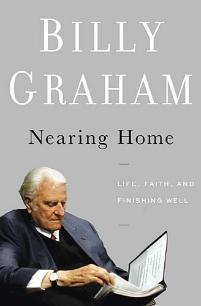
Book Review : Nearing Home

I recently finished Billy Graham’s new book, “Nearing Home; Life, Faith, and Finishing Well”. Billy Graham has been one of my favorite preachers, authors, and examples for many, many years. “Nearing Home”, in my opinion, was primarily written for, and directed toward, older adults. This is not a book of theology. In it you will not find the major doctrines of the Bible discussed and debated. Instead, it is a book of wisdom, advice, and encouragement written by a man who is staring the effects of old age squarely in the face. He writes with grace. It is this same grace that has marked his life as a servant of God, and it is the same grace that enables him to deal with poor health and other life-changing decisions. “Nearing Home” deals with the subject of aging, while practically dealing with subjects such as wills, retirement, and finances. Graham reminds the reader that our God-given purpose is not over until life itself is over.

 “Nearing Home” helps the reader learn how to take hold of God’s will for your life, lean on God when loved ones are lost, navigate life-changing transitions, and biblically deal with fear. The book falls into ten chapters. It does not have the standard feel and structure. Instead, this book takes on a conversational format;  mingled with scripture and personal stories.  This is a simple read written by a man who has given his life to the single purpose of honoring God and leading others to do the same. He encourages and inspires the reader to face the uncertain future with the certainly of Jesus Christ. A quote that inspired me is this one: “The most eloquent prayer is the prayer through hands that heal and bless. The highest form of worship is the worship of unselfish Christian service. The greatest form of praise is the sound of consecrated feet seeking out the lost and helpless.”  “Nearing Home” is well worth your time.

Disclosure of Material Connection: I received this book free from Thomas Nelson Publishers as part of their Blogger Review Program. I was not required to write a positive review. The opinions I have expressed are my own. I am disclosing this in accordance with the Federal Trade Commission’s 16 CFR, Part 255: “Guides Concerning the Use of Endorsements and Testimonials in Advertising.”


Worth Repeating

“There never was another Who caused all creation to be ransacked in pursuit of words appropriate to convey to human hearts and minds His glorious pre-eminence. There never was another Who was a human child and also a divine Son; Who was wounded by Satan and Who, at the same time crushed Satan; Who was appointed the Savior of men, yet was crucified by men; Who was Judge of men; yet was led as a felon from one tribunal to another.

There never was another Who died and was buried and yet lived; Who saved others and Himself could not save; Who had no sin in Him, yet all sin on Him; Who was the King of Glory, yet wore no crown but a crown of thorns; Who, in the glory He had with God before the world was, had the angelic hails of heaven and yet, on earth, gave Himself to the murderous nails of men!

There never was another Who was the Prince of life, yet died on Calvary; Who was as old as His heavenly Father and ages older than His earthly mother. There never was another Who was the victim of a Roman cross and victor at a Jewish grave.

There never was another Who poured all seas, all lakes, all rivers out of the crystal chalices of eternity, yet on a cross said with a mouth hot like a parched desert that cries for rain, ‘I thirst’”.

R. G. Lee, speaking of Jesus Christ

Book Review : The Jesus Mission

I recently finished Steven Scott’s new book, “The Jesus Mission: Christ Completed 27 Missions While on Earth. Take up the 4 He Assigned to You”. As a Christian, I am always looking for guidance and motivation to help me be more on mission for the things that matter to Jesus Christ. “The Jesus Mission” does just that. Scott take nearly half the book explaining the necessity of an intimate relationship with Jesus Christ and how everything flows from that. This book is not the casual reader. Scott deals heavily in scripture and extends the call to be intimate with and to whole-heartedly follow Christ and forsake the temptation to be a “passive-participant” on the journey of faith.

 I was initially skeptical that these 27 missions could be covered and sufficiently expounded in a single volume. I was correct. The reader has to be willing to stay with Scott as he makes his way toward the 27 missions that don’t come along until chapters 16 and 17. And then, they are treated in a cursory, survey-type method. I did however like he way in which he dealt with the 4 missions Christ asked us to take on. He provided sub-sections with actions and activities to help embrace and understand the missions. All in all, a great book. It is well-written and thoroughly researched. I found it to be smart, challenging, and convicting. I would recommend this book to anyone who is seeking to further develop their spiritual walk with the Lord Jesus Christ.

Disclosure of Material Connection: I received this book free from Waterbrook Multnomah Publishers as part of their Blogger Review Program. I was not required to write a positive review. The opinions I have expressed are my own. I am disclosing this in accordance with the Federal Trade Commission’s 16 CFR, Part 255: “Guides Concerning the Use of Endorsements and Testimonials in Advertising.”

Book Review : Culture Shift; The Battle for the Moral Heart of America

In every generation of evangelical Christianity, there is one who stands in the gap between the marketplace and the church house in order to communicate how biblical Christianity impacts and influences every part of our lives. I believe that Dr. Al Mohler is that man for this generation. Dr. Mohler is the president of Southern Baptist Theological Seminary in Louisville, KY. He has become the voice of conservative Christianity. He continues to be a consistent voice through television, radio, and print. In his new book and first solo effort, “Culture Shift; The Battle for the Moral Heart of America” demonstrates how America is losing its biblical center.

Dr. Mohler begins by stating the positions that most Christians take toward culture: extreme involvement or non-involvement. He sets up his work by using Augustine’s “City of God” as a model and guide. Augustine said that humanity is confronted by to cities: The city of God, eternal and seeking to honor God; The City of Man, passing and self-serving, characterized by disobedience, moral autonomy, and a spirit of rebellion. By way of introduction and a desire to provide necessary groundwork, Dr. Mohler introduces the reader to the voices for and positions of those who would seek a purely secular society void of any reference to God. With intellectual sharpness and respect, Dr. Mohler denounces these concepts and shows the futility of the arguments.

The bulk of his book is spent introducing the reader to the areas of culture in which our lives and society are experiencing shifts. Dr. Mohler discusses numerous topics including the perceived right to never be offended, the role of the Supreme Court and religion, terrorism, biomedicine, public school, parenting, abortion, natural disasters, New Atheism, and the “digital deluge” of modern technology. Mohler, in a very fair but firm manner, deals with each issue and the proponents of these issues in a way that honors God and elevates the Scriptures. These chapters are not an in-depth analysis, nor are they exhaustive. Instead, they serve as a primer for further study and discussion.

I found “Culture Shift” to be engaging, useful, enlightening, challenging, and a stern warning. As a Christian, the ideas and agendas that serve to diminish my worldview are exposed. As a pastor, I was able to see deeper into the competing worldviews that my congregation deals with every day. If there is one negative to say, it would be this. Not enough. The essay blog-post form of the chapters left me wanting much more. I believe the material and topics covered in “Culture Shift” could make up two books giving more attention to each. To say that Dr. Mohler has exposed the slippery slope of liberalism and the cravings of humanist thought would be a gross understatement. I highly recommend this book all who claim the name of Christ who desire to know the forces and agenda coming against your belief system. Well written, researched, and presented. Just what I expected.

Disclosure of Material Connection: I received this book free from Waterbrook Multnomah Publishers as part of their Blogger Review Program. I was not required to write a positive review. The opinions I have expressed are my own. I am disclosing this in accordance with the Federal Trade Commission’s 16 CFR, Part 255: “Guides Concerning the Use of Endorsements and Testimonials in Advertising.”

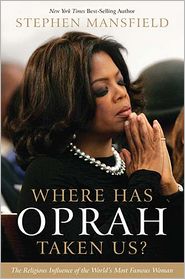
Book Review : Where Has Oprah Taken Us?

I believe that most everyone has heard of Oprah Winfrey. Over the past twenty-five years, her daytime talk show has been wildly successful, while at the same time a roller coaster ride at best. In the beginning it was one of negativity, trash, filth, and the very worst of societal topics, thus earning her the name, as Stephen Mansfield writes, “Slime Queen of daytime television.” At the end of its run her show had become positive. Her daytime talk show had become a launcher of careers, an influencer of people, and an encouragement for good around the world. What happened? Oprah started dealing in religion.

In “Where Has Oprah Taken Us? The Religious Influence of the World’s Most Famous Woman”, author Stephen Mansfield takes an honest and in-depth look at the events, people, tragedies, and successes that have made Oprah Winfrey the cultural icon that she is today. Although she has influenced many in many areas, Mansfield chooses to write about her religious influence upon Americans and those around the world. Mansfield begins by looking at Oprah’s early years growing up in the Baptist church. He shows what was the basis for her conservative evangelical faith and then what forces began to challenge that faith.  As Oprah become more successful in her broadcasting and television career, she began to open herself up to and eventually embrace eastern religions. Mansfield explores her shift from a biblical faith rooted in the worship of God to an eastern type, meditation-driven spirituality rooted in the worship of self. Mansfield writes, “It is not going too far to say that spiritually she is the composite of all that her gurus have taught her and that to know her one must first know them.”  He then lists who those influential gurus are. They include Marianne Williamson, Eckhart Tolle, Gary Zukav, Depak Chopra, Rev. Ed Bacon, and Iyanla Vanzant.

Where Has Oprah Taken Us?” is well written, thoroughly researched, and intentionally balanced, allowing Oprah’s words to speak for her. I found this book very informative and intriguing. I believe that with great influence comes greater responsibility. I believe Mansfield is right when he says that Oprah doesn’t know who she is. Mansfield describes Oprah’s faith system this way, “She found no tension in blending a Hindu version of reality with ancestor worship with chanting Hindu mantras with The Secret’s Law of Attraction with yoga with an animistic honoring of the spirits in nature with a belief in self-divinity with channeling with astrology with karma with the Bible with the certainty that right spirituality is rewarded with wealth and well-being with prayer to whatever force is god with the confidence we create the evil we experience with the unwavering assurance that a super-natural destiny rules human affairs. This was the buffet of beliefs she had chosen for herself and that she urged others to embrace as well.” I believe this book will be especially helpful to Christians. Anytime someone has the stage to influence millions of people, especially in the area of religion, to understand their beliefs is vital to defending a true biblical faith. If you place your convictions and standards on the altar of pride and self, you allow everyone else to define who you are. I recommend this book to all.

Disclosure of Material Connection: I received this book free from Thomas Nelson Publishers as part of their Blogger Review Program. I was not required to write a positive review. The opinions I have expressed are my own. I am disclosing this in accordance with the Federal Trade Commission’s 16 CFR, Part 255: “Guides Concerning the Use of Endorsements and Testimonials in Advertising.”

Worth Repeating

“The God of the Bible is a missionary God. For someone to suggest that one’s biblical beliefs should be disassociated from one’s philosophy and practice of mission ignores the important relationship between the two. In reality, one’s theology faithfully generates one’s missiology; and likewise, one’s missiology clearly reflects one’s theology.”

J. Sam Simmons, Missiology; An Introduction to the Foundations, History, and Strategies of World Missions

What Should Be The Standard of Cooperation In The Local Baptist Association?

Cooperation is the tie that binds in the local Baptist association. Cooperation is vital. Cooperation is fragile. Cooperation must be fostered and nurtured. Cooperation is what defines us as Southern Baptists. In a Baptist association, individual churches make the decision to come together and share resources, spiritual gifts, spaces, and finances as they work together toward a common agreed upon goal. The goal is different in every association and can be cloudy and undefined at times. Certainly the goal, at the minimum, should be the desire to see the Great Commission fulfilled. It is also  the prerogative of every local association to determine what it will accept from its member churches as the minimal level of participation as a cooperating church. The choice that is made here is so very important. This decision says a great deal about what the association values. It says a great deal about what the association pursues as its passion. This decision is often reflected in its governing documents. It must be remembered that the association is, at best, a “para-church” organization. The church has the final authority in the matter of contribution or affiliation with the association or any other institution.

I serve a church in the Savannah River Baptist Association which has 33 churches and missions. From where I sit, there seems to be some uncertainty as to what the standard of cooperation is. A standard is defined as “a basis for comparison; a reference point against which other things can be evaluated.” If there is no clearly defined statement of faith (i.e. Baptist Faith and Message) put forward by the association to unite the churches, everything becomes subjective. The Savannah River Baptist Association has no such defining statement of faith. It is this uncertainty that I want to write about openly, honestly, and in a way that is educational. Should the standard of cooperation be member participation, financial contribution, or something else all together?

Associations can choose to adopt (whether written or unwritten) the standard of member participation. This standard says that each church is expected to actively participate in and contribute to the events, fellowships, and decision making process of the association. The association as a whole benefits when this happens. When all of the member churches come together and share their talents, knowledge, and resources, the whole association prospers. There are some member churches who feel the association has nothing to offer them. That may be true. However, the member church that thinks this way may have much in the way of knowledge, experience, and resources to give that the remainder of the association could benefit from. I personally believe that participation is much more than just sending in a check every month. Looking at the  attendance numbers of both the spring and fall sessions of the Savannah River Baptist Association from 2000-2010 (11 years), I want to make a few observations. (The following numbers are based on 30 churches. Three of our churches are new works and were not active this entire time period).

* In the 11 year period between 2000-2010, 13 churches sent representatives to the Spring Session of the SRBA 6 or fewer times.

* In the 11 year period between 2000-2010, 17 churches sent representatives to the Spring Session of the SRBA 7 or more times.

* In the 11 year period between 2000-2010, 10 churches sent representatives to the Fall Session of the SRBA 6 or fewer times.

* In the 11 year period between 2000-2010, 20 churches sent representatives to the Spring Session of the SRBA 7 or more times.

* In the 11 year period between 2000-2010, 1 church sent no representatives to the Spring Session of the SRBA at all.

* In the 11 year period between 2000-2010, 2 churches sent no representatives to the Fall Session of the SRBA at all.

I am certain that churches have their own reasons why they don’t participate. Perhaps they feel the association has nothing to offer them. Perhaps they feel they are not being led adequately. Perhaps they feel abandoned. Perhaps they feel their local church work is more vital. I don’t know.

An association can also choose to adopt (whether written or unwritten) a standard of financial contribution. This standard would say that the financial gifts (frequency and amount) a member church gives defines whether or not they are cooperating. I believe there is a reality that we can all agree upon. Ministry requires money. This is true from the church pew to the foreign mission field. In all fairness, in the same way not all churches participate all the time, not every church financially supports the association every single month. This is no secret. I don’t know what the reasons are for this. Perhaps the reasons are the same as above. Perhaps they are completely different. There is one major difference. How you handle the two.

In my estimation, again, this is simply my opinion, I sense our association leaning toward the position that the standard of cooperation should be financial contribution. Our association will be voting on a significant overhaul of the Constitution/By-Laws in October. There are some really good things I agree with, and some not-so-good things I don’t agree with contained in this revision. The wording of this new document seems to speak to what I am have written here. Here is an example from that revision. Under the present constitution, there is a section entitled “Non-Reporting Churches” and it reads like this:

“When churches fail to support the work of the Association a committee appointed by the moderator shall consult with said church as to their desire and intent to continue in fellowship.”

This seems to allow for a variety of issues to be dealt with, whether those issues are lack of participation, financial, or doctrinal. Now, the proposed revision renames “Non-Reporting Churches” to “Non-Supporting Churches” and reads as follows:

“If a church fails to financially support the work of the Association, the Moderator shall request the Finance Committee to consult with said church to encourage its continued fellowship with and support of the Association. The Finance Chair shall report their findings, with or without recommendation(s), to the Executive Board at its next meeting.”

This proposed revision zeroes in exclusively on the financial aspect of support and participation. I believe the intention is very clear. How else could this be perceived, except that the member church’s  financial gift is what matters most. If this were not so, why then would the Finance Committee be asked to “consult with said church to encourage its continued fellowship with and support of the Association.”? If you combine past practices with the proposed policy, here is what you will get, whether intended or unintended: “It’s alright if you don’t come see us, just send your check. However, if you stop sending your check, we’ll come see you.”

Feel free to leave your comments and thoughts. This is a dialogue that we need to have.
Book Review : Our Last Great Hope

For Evangelical Christianity, the Great Commission represents the very heartbeat of our Savior Jesus Christ. For in its’ words and commands we find, with absolute clarity, the mission that we are to devote our lives to. In his new book, “Our Last Great Hope; Awakening the Great Commission”, Dr. Ronnie Floyd examines the Great Commission in a way that I have not seen or heard before. As a Southern Baptist, I am familiar with Dr. Floyd and his ministry as the senior pastor of Cross Church, a multi-site church in Northwest Arkansas. When I read that he had written a book of the Great Commission, I was immediately interested. Dr. Floyd recently chaired the Great Commission Resurgence Task Force that took an intentional and exhaustive look at how we as Southern Baptists could do better at fulfilling  the Great Commission. He shares in his book how his service on this task force gave him a renewed passion for and a heightened sense of urgency in joining Christ in the work of taking the gospel to the nations.

Our Last Great Hope is not so much an academic work that dissects the Great Commission verses and explores all its’ nuances. That being said, this work is well researched and sits on a firm biblical foundation. Instead, Our Last Great Hope demonstrates how to move the Great Commission from the classroom to the driving force in every believers heart, family, and life.

Dr. Floyd walks the reader through the ways in which the Great Commission can become a personal reality. He begins with the individual. He builds his case that the Great Commission must first be personal before it can be public. He then goes on show how a commitment to the Great Commission will affect their families, businesses, local communities, and then the nations. He also says that a commitment to the Great Commission will affect our prayer lives, plans, and our giving.

Dr. Floyd has written a very challenging work. As a pastor, I am familiar with the Great Commission, however, I have been challenged to think about it differently. If it were possible, Our Last Great Hope should be required reading for all staff members and lay leaders. This is a book that I will read again. His balance of scripture and personal experience makes this book a joy to read. I highly recommended this book.

Disclosure of Material Connection: I received this book free from Thomas Nelson Publishers as part of their Blogger Review Program. I was not required to write a positive review. The opinions I have expressed are my own. I am disclosing this in accordance with the Federal Trade Commission’s 16 CFR, Part 255: “Guides Concerning the Use of Endorsements and Testimonials in Advertising.”


Book Review : Dug Down Deep

Joshua Harris, in his new book, “Dug Down Deep; Building Your Life on Truths That Last” tells a personal growth story through the lens of a familiar parable told by Jesus Christ. He uses the story of two builders. One builder built his house upon the sand. The storm come against it and it fell. The other builder built his house upon a rock. The storm come against it and it stood. Dug Down Deep is a call for every believer to dig down and understand what God wants them to know that will lead them into a deeper and richer relationship  with Him. Harris maintains hat superficial understanding of the Bible will not hold when tried and tested by the storms of life.

The opening statement of the book sets the stage for the rest. Harris writes, “ We’re all theologians. The question is whether what we know about God is true.” Harris writes that doctrine, the proper understanding of God and what He is like, coupled with orthodoxy, the proper practice of what we know to be true about God, will make or break a believers walk with Christ. Harris deals with doctrinal matters in a way that takes them out of the classroom and places them into real-life practice. In each of his chapters, he deals with a different doctrinal discipline and makes it easy to understand. A few of those doctrines are: God, Jesus Christ, Salvation, the Bible, Sanctification, the Holy Spirit, and the Church.

I appreciate the path in which Harris took in writing this book. He has built the case for every believer becoming a student of God’s Word and not being afraid of digging deep. This book is well written, it is deep, but not overly academic. His personal story woven throughout the book is what makes the book believable. The study guide that is included in the book is a great tool for small group study. I highly recommend this book.

Disclosure of Material Connection: I received this book free from Waterbrook Multnomah Publishers as part of their Blogger Review Program. I was not required to write a positive review. The opinions I have expressed are my own. I am disclosing this in accordance with the Federal Trade Commission’s 16 CFR, Part 255: “Guides Concerning the Use of Endorsements and Testimonials in Advertising.”

Worth Repeating

“The great truths which the apostles declared were that Christ had risen from the dead, and that only through repentance from sin, and faith in Him, could men hope for salvation. This doctrine they asserted with one voice, everywhere, not only under the greatest discouragements, but in the face of the most appalling terrors that can be presented to the mind of man.

Their master had recently perished as a malefactor, by the sentence of public tribunal. His religion sought to overthrow the religions of the whole world. The laws of every country were against the teachings of His disciples. The interests and passions of all the rulers and great men in the world were against them. The fashion of the world was against them.

Propagating this new faith, even in the most inoffensive and peaceful manner, they could expect nothing but contempt, opposition, revilings, bitter persecutions, stripes, imprisonments, torments, and cruel deaths. Yet this faith they zealously did propagate; and all these miseries they endured undismayed, nay, rejoicing.

As one after another was put to a miserable death, the survivors only prosecuted their work with increased vigor and resolution. The annals of military warfare afford scarcely an example of the like heroic constancy, patience, and unblenching courage. They had every possible motive to review carefully the grounds of their faith, and the evidences of the great facts and truths which they asserted and these motives were pressed upon their attention with the most melancholy and terrific frequency. It was therefore impossible that they could have persisted in affirming the truths they have narrated, had not Jesus actually risen from the dead, and had they not known this fact as certainly as they knew any other fact.”


Dr. Simon Greenleaf, Harvard Royall Professor of Law from A Treatise on the Law of Evidence