FIFS : 7.12.2013

1 Now Peter and John went up together to the temple at the hour of prayer, the ninth hour. 2 And a certain man lame from his mother’s womb was carried, whom they laid daily at the gate of the temple which is called Beautiful, to ask alms from those who entered the temple; 3 who, seeing Peter and John about to go into the temple, asked for alms. 4 And fixing his eyes on him, with John, Peter said, “Look at us.” 5 So he gave them his attention, expecting to receive something from them. 6 Then Peter said, “Silver and gold I do not have, but what I do have I give you: In the name of Jesus Christ of Nazareth, rise up and walk.” 7 And he took him by the right hand and lifted him up, and immediately his feet and ankle bones received strength. 8 So he, leaping up, stood and walked and entered the temple with them–walking, leaping, and praising God. [Acts 3:1-8]

I believe that for the most part everyone like a good surprise. There is a joy in getting something you did not expect. Whether it is a refund check in the mail, a phone call from a friend you have not seen in years, finding money in the dryer, or a room full of people screaming “Happy Birthday”, the unexpected is refreshing. The unexpected has the ability to break up a routine and create a bright spot in an otherwise dreary day. The Bible tells us that Peter and John John went up together to the temple at the hour of prayer”. This was their routine. Their normal. Their daily activity. Theirs is not the only routine we are told of. We are introduced to a man who was lame and had been since the day he was born. We are told of his routine. He was, laid daily at the gate of the temple which is called Beautiful, to ask alms from those who entered the temple”. As Peter and John walked past this man, he asked for a handout. Their response was not expected. Peter said to him, Silver and gold I do not have, but what I do have I give you: In the name of Jesus Christ of Nazareth, rise up and walk.” I am sure the lame man was surprised. I am sure he was expecting to be ignored as usual. I am sure that when Peter and John did pay him some attention he was expecting money of some kind. What he found instead was much better than a refund check or five dollars falling out of the dryer. He was surprised by healing.

There are times in our lives when we are like Peter and John. We go through the routine of life unaware that we have within us the capacity to bless and change the life of another. There are times in our lives when we are like the lame man. We are the ones who need help, change, and blessing. Every day we should approach life with the desire to bring an unexpected blessing to someone else.

Some Needed Structure

I enjoy writing. I enjoy sharing my experiences with others. Sharing what God is doing in my life as a pastor, husband, father, and student is the reason why I started The Road Less Traveled. Personally, I need structure. I need a schedule. I need something to keep me on track and focused. I guess that you could say that I need routine in my life. I don’t function well in its absence. Ask my wife. I order to be more disciplined in the craft that I love; writing, I am putting a sense of structure in place here. I hope to follow this “schedule”.

Monday. I will begin a new blog series entitled Missional Mondays. Each week I will share a story, church missions project, an article, a resource, or highlight some missions organization that is making a kingdom difference.

Tuesday. I am dedicating Tuesdays to book reviews. I enjoy reading immensely. I review books for several publishing companies (Thomas Nelson, Tyndale, Waterbrook Press, and Bethany House to name a few). To keep a sense of order and expectation, I’ll post my reviews on Tuesday unless the review calls for a certain date.

Wednesday. Throughout the course of my reading, both recreational and in sermon preparation, I come across words that are “worth repeating”. Wednesdays will be dedicated to this discovery.

Thursday. Random thoughts. Maybe.

Friday. I enjoy giving away books that I have been given to me. As I have the opportunity, I will continue Free Book Fridays. I will also continue my devotional thoughts as a part of Friday is for Scripture.

Saturday and Sunday. Random thoughts. Maybe.

It is my prayer that you will be encouraged, blessed, challenged, enlightened, or inspired by something you read here at The Road Less Traveled. Thanks for stopping by.

Book Review : I’ve Got Your Back

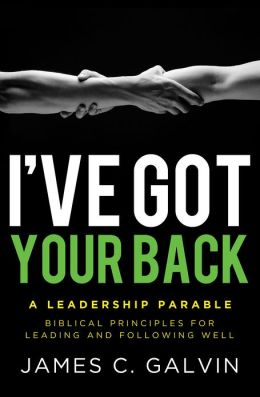
ivegotI am certain that all of have experienced some kind of “bad” leadership in our lives. Perhaps it was an elected official who displayed questionable behavior ethically. Perhaps it was an employer who was more concerned with profits and results than the well-being of their employees. Perhaps your “bad” leadership happened in a church setting as a pastor/ministry leader abused their position for self-gain. In his new book “I’ve Got Your Back; a Leadership Parable – biblical Principles for Leading and Following Well”, strategy consultant James Galvin takes on the matter of leadership in a unique and interesting way. Galvin believes that if Jesus were to write a book dealing with leadership today, He would communicate this message in story form.

Galvin’s book is in parable form which takes up the first two-thirds of the book. He chronicles the fictional journey of four college friends learning how to deal with various leadership problems at work and within the church. As these four gather together for Bible study, they realize they need guidance in the area of leadership. They are referred to a mentor who is a retired missionary for help. Through a series of weekly meetings, Jack (the mentor) gives the group assignments to work through while introducing them to good leadership principles. It is in this section that the reader is introduced to an aspect of leadership that is often overlooked and deserving of attention. Galvin describes this aspect as “followership”. He says, “the essence of leadership is helping people follow well.” Galvin says there are our kinds of leadership abusers and four ways to respond to them. The abusers are incompetent, disempowering, manipulative, and toxic. These are the issues that the mentees are dealing with in their own lives. Jack helps them to work through their difficulty by giving the four responses to “bad” leadership. The options are avoid leadership roles, perpetuate the cycle of abuse, hide behind servant leadership, and develop your unique potential. The reader here is introduced to the three types of follower scenarios: Type 1 (following God), Type 2 (following inherited leaders – family and government), and Type 3 (following human beings with or without organizational authority).

The last third of the book is a “Concise Theology of Leadership and Followership”. It is here that Galvin outlines the principles that are woven throughout the parable. Galvin uses extensive amounts of scripture to show the reader how following well in biblical. I enjoyed this book. I appreciate the emphasis on being a good follower as an integral part of leadership. “I’ve Got Your Back” reminds me a great deal of Patrick Lencioni’s “Death by Meeting”. A very practical and challenging work.

Disclosure of Material Connection: I received this book free from Handlebar Publishers as part of their Blogger Review Program. I was not required to write a positive review. The opinions I have expressed are my own. I am disclosing this in accordance with the Federal Trade Commission’s 16 CFR, Part 255: “Guides Concerning the Use of Endorsements and Testimonials in Advertising.”

Free Book Friday : Transformational Church

transformchurchIt is time for me to give away another book from my bookshelf.  I am giving away a copy of Thom Rainer and Ed Stetzer’s “Transformational Church”. In their new book, Rainer and Stetzer discuss the necessary changes  churches must make in order to become more effective disciple makers.

To be entered to win, you must do (2) things.

1. Follow my blog by clicking on the button at the bottom of the page.

2. Answer the following question by leaving your answer in the comment stream.

If you could change or restructure one thing about the local church in order to make it more effective in reaching the lost and making disciples, what would it be? Be specific.

Good luck. Deadline to enter is July 12th, 2013.

Book Review : Godonomics

godonomIt is difficult to turn on the television today and not hear someone’s take on the sad state of the American economy. Words such as debt, recession, bailout, investments, capitalism, and economic bubble are part of the everyday discussion. There is a mad rush today between our major political parties to see who will rescue the nation from an anemic, failing, and ever-shrinking economy. In his new book, “Godonomics; How to Save Our Country and Protect Your Wallet Through Biblical Principles for Finance” pastor Chad Hovind asserts that neither the economic policies of the elephant and donkey will correct the present economic tailspin. Instead, it will be the Lamb’s policies and principles that offer the best chance of recovery. Hovind defines Godonomics as “God’s teaching and wisdom in the realm of finances and economics”. The structure of the book is unique. Hovind poses hypothetical questions that God would ask past and current economic thinkers and political leaders who have negatively impacted the nation’s economy. Such people include john Maynard Keynes, Franklin Delano Roosevelt, Alan Greenspan, Karl Marx, and the Internal Revenue Service.

Through his book, Hovind keeps the difference between capitalism; the free exchange of privately owned good and services and socialism; state control and state ownership of industry ad property before the reader’s eye. He begins with the Pilgrims and what would become the Massachusetts Bay Colony. Their earliest form of governance was, at its heart, a form of socialism where the goods and services of the individual are pooled together and redistributed to the entire colony. This system failed quickly and William Bradford searched the Bible for answers. He found the foundational principles that would become the blueprint for a new economic system, then and now. He understood that property rights, incentive, and freedom were critical to economic success. Throughout the book, Hovind demonstrates the erosion of these three. Hovind states, “a strong economy is fueled by production, and producing leads to profit. Profit covers our expenses and builds savings. Out of savings we spend, invest, and give to others”. The questions that Hovind believes that God would ask deal with the areas that work against his idea of a strong economy. The areas of concern involve work, profit, spending, budgeting, unintended consequences, liberty, money supply, greed, rule of law, and voluntary giving. The author does an excellent job of placing the beliefs of these leaders alongside the Bible to demonstrate the wisdom and prudence of considering God’s position on financial matters.

I really enjoyed this book. The most profound and relevant chapter in my opinion is the questions that God would ask President Franklin Delano Roosevelt. By breaking down the reasons for and the method of payment for FDR’s New Deal, Hovind draws a striking and ominous resemblance to President Barack Obama’s Troubled Asset Relief Program (stimulus packages). This chapter is worth the price of the book. Hovind’s treatment of the subject is biblical, objective, and thought-provoking. Godonomics is well-researched and timely. Godonomics is a true clarion call to consider the biblical vantage point of financial matters. An outstanding work. I highly recommend it.

Disclosure of Material Connection: I received this book free from Waterbrook Multnomah Publishers as part of their Blogger Review Program. I was not required to write a positive review. The opinions I have expressed are my own. I am disclosing this in accordance with the Federal Trade Commission’s 16 CFR, Part 255: “Guides Concerning the Use of Endorsements and Testimonials in Advertising.”

Worth Repeating

“There are very few that ever gave this book of God, the grand character of salvation, one fair reading through: though we profess to have assented to the truth of scripture, as our Lord said, ‘In them we think we have eternal life,’ yet most read them as they would a proclamation, a romance, a play, or novels, that help only to bring them to the devil, but choose not to read God’s book, which is to be our guide to glory; ‘they are they (says Christ) which testify of me: ‘Lord God, convert and change our hearts.’” However, this was spoken in reference to the Old Testament, and certainly shews us, that Christ is the treasure hid in that field, yet, as there are equal proofs of the divinity of the New Testament, the word Holy Scriptures include both, especially as Christ is the antitype of all types, the Alpha and Omega, the beginning and the end, of all divine revelation.”

George Whitefield, 1714-1770

A Pastor’s Take on Vacation Bible School 2013

ccwColossal Coaster World Vacation Bible School has pulled into the station for the final time this year. Our theme park inspired adventure is complete. The screams and shouts of kids running through down the hallways and in the sanctuary are now a distant, but treasured memory. Decorations have come down and the once vibrant and colorful rooms, hallways, sanctuary, and common areas have now been returned to their traditional look. Sadly, it looks as if Vacation Bible School never happened. Vacation Bible School makes for a very long week around the church. If you take into account the weeks leading up to the actual teaching week, many long, long hours have been logged over the past three weeks. I am a huge fan of Vacation Bible School and am sold on its ministry value. As a pastor, I fully understand how important this week is in the life of the church. Now that Vacation Bible School 2013 is over, I have a few observations that I would like to offer here.

1. Attendance: For better or worse, this is often the criteria by which Vacation Bible School is judged as a success or a failure. I am not completely sold on this marker of success. Our average attendance for the week was approximately 115. As far as the numbers go, our attendance was down slightly from last year. I was encouraged by our attendance this summer. My reason for being encouraged is not so much about how many, but who was here. It is obvious that our people were active in inviting others this week. We did something different this year with our teenagers. Instead of Youth Vacation Bible School occurring the weeks before the children’s, our youth met the same week as everyone else. This was a success and we averaged 8 teenagers nightly. This does not count the high school students who were assisting in other areas. We had the expected students who were members of other churches. That is perfectly fine. We are happy to have them for a week. We also had students who were unchurched and not affiliated with a local church. This is one of the markers by which I judge success. We averaged 53 elementary aged children this year. I was further encouraged by our Adult Vacation Bible School class. We had an average this week of 30 adults. Our adult class was not only made up of our own church members. One of goals in Adult Vacation Bible School is to give parents who are not involved in a local church a place to go instead of dropping their children off and going home. We accomplished our goal here. Parents had the opportunity to interact and meet other people in a non-threatening manner and be exposed to the gospel message. I believe this was a success.

2. Volunteers: I am thankful to all of the volunteers who worked this week. As I mentioned earlier, it was a long week. It was also very hot. I am especially thankful and grateful to all of our teachers who worked full-time jobs who left work and came straight to church for five straight days. I want to especially mention and thank those who worked in the kitchen all week. During our Vacation Bible School, we skip the Snack Rotation. Instead, we choose to provide a meal for parents, children, and workers every night. Our kitchen workers came out early, set everything up, served the kids, and stayed until all was cleaned up. Thank you. I also want to thank the summer student missionaries who are a part of the Savannah River Baptist Association Low Country Ministries who came out and helped with our big kick-off event. To all those who worked so hard, your pastor wants you to know that you are appreciated.

3. Ministry: Any time you have kids on campus you have an opportunity to be engaged in real, one-on-one, life-changing ministry. I believe with all of my heart that is what happened this week. During our Worship Rally, our students take up an offering each night. There is anticipated and spirit-filled battle between boys and girls to see who can raise the most money for our designate ministry cause. This gives us an opportunity to further educate our students on the importance of missions. I am excited to report that this year we raised $510.00 for the Connie Maxwell Children’s Home. Vacation Bible School is intentionally evangelistic. We are diligent to make sure that we communicate the gospel message all week long, not just on the night of the “evangelistic” lesson. With that being said, we did not have any public professions of faith (to my knowledge) this week. I can’t explain it in human reasoning. For many who read this, the assumption will be that we failed as a church in Vacation Bible School. Nothing could be further from the truth. We are here to share a message and plant a seed, understanding that it is God who gives the increase. We trust God’s Word knowing that it will not return unto Him void. Real ministry takes place when you take time to listen, talk to, and show love toward a child in the name of Christ. This is what we did this week. If down the road a year or two or five, in God’s timing, a gospel presentation is given and a child responds because of something that was planted in their heart this week, then we were faithful to have done our part.

4. Sharing: Once again this year we had the opportunity to share and pass on the decorations and other resources we used to another church that was in need of them. The bulk of our props, supplies, and decorations will be utilized by at least two additional churches before the summer is over. I believe this is a stewardship issue. Lifeway Vacation Bible School material is not inexpensive. It does not make sense to spend all of that money and then store everything in a closet. I am pleased that we were able to help others in this way.

Overall, we had a great week and look forward to what comes out of the efforts of this week. Again I want to thank every teacher, worker, and parent who allowed their child to be a part of our Vacation Bible School. We are eagerly looking forward to Lifeway’s VBS 2014; “Agency D3: Discover. Decide. Defend.” After all, it is only 11 months away.
Book Review : Is College Worth It?

iscollegeMy son Jordan is an inbound high school junior. Conversations as of late have dealt with the importance of grades, potential college majors, and which, if any, colleges to attend. At the beginning of his freshman year, he was required, as every high school student is, to fill out an individual graduation plan. This is an ongoing process where parents, students, and guidance counselors meet and select future high school courses based on what the student anticipates majoring on in college. There is an assumption that every student will be attending college of some sort. Whether this turns out to be true or not, it is, at present, the across-the-board expectation. In his new book “Is College Worth It?, former US Secretary of Education William Bennett shares his perspectives on higher education in America and what the future of such education may look like. The premise and purpose of this book is found in his own words. He writes, “It’s time for parents and students to look at the entire enterprise of higher education and ask how, when, where, for whom, in what studies, and at what cost is a college education appropriate? And if it is not appropriate, what are the alternatives?” Bennett deals with the expectation I shared above.

“Is College Worth It?” breaks down into five chapters. In Chapter One: The Borrowing Binge, Bennett examines the costs of higher education. He deals with issues such as methods of paying for college, why tuition costs continue to rise at all schools, and the danger of amassing student loan debt. In Chapter Two: Creating a Financial Monster, Bennett deals in greater detail the national student debt crisis and the policies, both government and institutional, that have contributed to the growth of this “monster”. In Chapter Three: So Is It Worth It?, Bennett dives into the tangible and intangible factors that help to determine whether a college degree is worth the time and money. Here, Bennett deals with career choices and gives several lists of schools and universities to be considered based on student priorities. In Chapter Four: The Lower Side of Higher Ed, Bennett brings to light the reality that despite the high price tag of a college education, students are exposed to professors pushing their personal political and societal agendas, classroom instruction being farmed out to adjunct professors and graduate students, and ever-lowering expectation of students. He also deals with the party atmosphere of colleges and what students are exposed to. In Chapter Five: With Eyes Wide Open, Bennett shares suggestions, recommendations, and possible solutions to problems that are plaguing the higher education system today. A few of the options include online learning, hybrid models, and non-traditional approaches to obtaining a quality education including religious and military institutions.

“Is College Worth It?” is, in my opinion, a monumental work. Well-written, smart, honest, thoroughly researched, and extremely relevant, this book brings into plain view the challenges and obstacles facing students preparing for college. I will certainly use the information and wisdom here as we as a family deal with our upcoming college decisions. Every parent would benefit greatly by reading. I highly recommend.

Disclosure of Material Connection: I received this book free from Thomas Nelson Publishers as part of their Blogger Review Program. I was not required to write a positive review. The opinions I have expressed are my own. I am disclosing this in accordance with the Federal Trade Commission’s 16 CFR, Part 255: “Guides Concerning the Use of Endorsements and Testimonials in Advertising.”

Book Review : The Spiritual Warrior’s Guide to Defeating Jezebel

jezebelJezebel. Not a name mothers give to their daughters. The very name invokes an image. Biblically, it is an image of false worship, idolatry, pride, and manipulation. Culturally, it is an image of seduction, immorality, control, and power. in her new book, “The Spiritual Warrior’s Guide to Defeating Jezebel; How to Overcome the Spirit of Control, Idolatry, and Immorality” author and pastor Jennifer LeClaire introduces the reader to the “spirit of Jezebel” that is present in the world today. We know of the woman Jezebel from the biblical accounts from First and Second Kings. She was the wife of Israel’s King Ahab. A few of her sinister activities included having the prophets of God killed, the propagation of  false worship across the nation of Israel, and the scheme to defraud Naboth of a vineyard for her husband. LeClaire states that the spirit of Jezebel existed long before the woman Jezebel ever come along.

Although many descriptions have been given through the years, LeClaire succinctly proclaims “Jezebel is essentially the spirit of seduction. Jezebel works to seduce us into immorality and idolatry.” LeClaire uses Easton Bible Dictionary to show how evil this spirit is. “Jezebel has stamped her name on history as the representative of all that is designing, crafty, malicious, revengeful, and cruel. She is the first great instigator of persecution against the saints of God.” Matthew Henry call Jezebel “a zealous idolater, extremely imperious and malicious in her natural temper, addicted to witchcrafts and whoredoms, and every way vicious.”  LeClaire goes into great detail to show how this spirit is at work today. She demonstrates what this spirit looks like in the church today, the avenues by which the spirit of Jezebel operates, and the desired outcomes. She also gives the spiritual tools and weapons to defeat this spirit.

Overall, this is an okay book. I had a difficult time in a few places due to LeClaire’s theology (i.e. her belief that the office of the apostle still exists and the female pastorate). In her attempt to cover every possible manner in which this spirit could manifest itself, she has left this book a mile wide and an inch deep. This detracts from the overall effectiveness of the book.

Disclosure of Material Connection: I received this book free from Bethany House Publishers as part of their Blogger Review Program. I was not required to write a positive review. The opinions I have expressed are my own. I am disclosing this in accordance with the Federal Trade Commission’s 16 CFR, Part 255: “Guides Concerning the Use of Endorsements and Testimonials in Advertising.”

Book Review : Prepared for Grace, by Grace

preparedDepending on one’s theological point of view, the terms salvation, election, and grace have different connotations. For example, of an individual leans toward reformed theology, most commonly known as Calvinism, there is a belief that God’s sovereignty crowds out man’s God-given free will. As a result, He chooses who will be saved and they have no choice either way because God’s grace is irresistible. One of the functions of grace that reformers hold to is the Puritan belief in “preparatory grace”. This is the focus of Joel Beeke and Paul Smalley’s new book, “Prepared by Grace, for Grace; The Puritans on God’s Ordinary Way of Leading Sinners to Christ”. The authors point out that the Puritans believed and taught that God was working grace in the lives of individuals before they accepted the call of salvation. Simply put, the Puritans believed that the grace that was necessary for their salvation is applied to the believer even before the moment they are saved.

The authors state that this doctrine preparation addresses the question as to the manner in which God “ordinarily” brings a person to a saving knowledge of Christ. Not all questions are answered. In their own words, “Specifically, is conversion an event or a process? If a process, how does the work of conversion begin? There may be exceptional cases, but in general, is there a pattern to conversion? They take the position that it is a process. They write, “Many Puritans of England and New England answered these questions with the doctrine of preparation. People must be prepared to believe in Christ before they exercise such faith. Such preparation of the heart may be viewed as a part of the process that leads to conversion.” Even here, questions remain. The remainder of the book is dedicated to explaining this pre-working of God’s grace.

This book is full of quotes from Puritan authors and modern day reformed scholars. This book is well researched and has the feel of a collection of essays that don’t quite fit together. It also has a textbook feel to it. There are so many quotes and footnotes that is becomes distracting. The authors, in an attempt to elaborate their point, bring in too much peripheral work. For example, while saying what preparatory grace is, many times they give extensive examples of what it is not. Thus muddying the water. There is too much inclusion of unnecessary thought. Far too much time is given to trying to figure out God’s mind in terms of a human process.

I have to be honest here. I do not embrace Reformed Theology. I have a difficult time with the subject, not intellectually but practically. I am quickly offended by the pride and arrogance with which a number of reformed authors write. That being said, “Prepared by Grace, for Grace” has some excellent content with the covers and there is much to be gleaned here. I took away some great things from this book. It is however not a book that I can recommend.

Disclosure of Material Connection: I received this book free from Cross Focused Reviews as part of their Blogger Review Program. I was not required to write a positive review. The opinions I have expressed are my own. I am disclosing this in accordance with the Federal Trade Commission’s 16 CFR, Part 255: “Guides Concerning the Use of Endorsements and Testimonials in Advertising.”