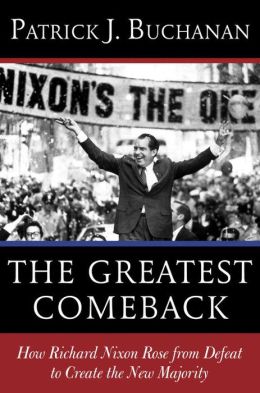
Book Review : The Greatest Comeback

comebackAs Americans we enjoy one of the greatest privileges and responsibilities that can be afforded to any people: participation in the electoral process. The election process in our country is something we are very familiar with. With presidential elections held every four years and mid-term congressional election in between, we seem to be in a constant election cycle where we are inundated with campaigning and campaign promises. We have also been exposed to some great, and no so great, politicians who have produced some incredible highs and embarrassing lows. We tend to elevate politicians to movie-star status. (Actually, we have had a movie star become president) One such political figure was Richard M. Nixon. Nixon’s road to the presidency was littered with success and failure. In his new book, “The Greatest Comeback; How Richard Nixon Rose from Defeat to Create the New Majority”, conservative political commentator and former presidential candidate Pat Buchanan tells the story of how Richard Nixon ascended to the presidency of the United States.

Pat Buchanan was an editorial writer for the St. Louis Globe-Democrat prior to becoming an aide to Nixon in 1965. His book covers the three year period of 1965-1968. The bulk of the book begins with, and moves forward from, the election cycle of 1966 with Buchanan describing the state of the union under President Lyndon Johnson and the democratic-held Congress. Buchanan offers a look into the struggles the Republican Party had in voicing their opposition to areas such as the war in Vietnam and other social concerns at the time.

The subtitle to Buchanan’s book speaks of a comeback. For someone to have a comeback they had to have had past success and then lost it. This was the case with Nixon. He served as vice-president from 1953-1961. After suffering sound defeats in the presidential race of 1960 and the California gubernatorial race of 1962, Nixon declared he was finished with politics saying, “You won’t have Richard Nixon to kick around anymore”. However, Nixon did come back into politics. Buchanan details how tirelessly Nixon worked to get Republican governors elected in 1966. This investment of time and attention paid off with big dividends in November of 1968. He also reveals that part of Nixon’s comeback success was the advisors he surrounded himself with, his knowledge of foreign and domestic issues, and his ability to appeal to both moderate and conservative Republicans. This appeal was solidified as Nixon weighed in on the chaotic events of 1968. Buchanan wrote about this year saying, “America was falling apart as witnessed by the assassinations of Martin Luther King and Robert Kennedy, the 77-day siege of Khe Sanh, the Tet Offensive, the worst race riots in history, anarchic violence at Columbia University and other campuses, and a President broken by Vietnam, where 200 to 300 U.S. soldiers were being killed every week.”

“The Greatest Comeback: How Richard Nixon Rose from Defeat to Create the New Majority” is a thoroughly researched, well-written, informative, and entertaining work. I especially enjoyed Buchanan’s enclosed memos that he sent to Nixon while he was a candidate, as well as Nixon’s hand-written notes. This really helped the book to excel. This book would appeal to history buffs and political junkies. Because Buchanan chose the conversational style over the documentary style, it is enjoyable read. Buchanan’s best work to date.

Disclosure of Material Connection: I received this book free from Waterbrook Multnomah Publishers as part of their Blogger Review Program. I was not required to write a positive review. The opinions I have expressed are my own. I am disclosing this in accordance with the Federal Trade Commission’s 16 CFR, Part 255: “Guides Concerning the Use of Endorsements and Testimonials in Advertising.”
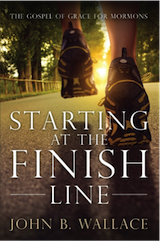
Book Review : Starting at the Finish Line

StartingAtTheFinishLine“Starting at the Finish Line; The Gospel of Grace for Mormons” is the story of Dr. John Wallace’s exit from the Church of Latter-day Saints (Mormons). He opens his book by providing unique insight into his childhood/early adult years in the church and the subsequent struggle to satisfy the requirements of the church. This struggle left him feeling empty and, at times, hypocritical. Wallace experienced a crisis of faith as became unsettled with the reality of God’s grace. In the second section of his book, he defends the accuracy and reliability of the Bible. This is crucial because the Mormon Church, as Wallace sees, is guilty of picking and choosing the parts of the Bible they will believe while at the same time dismiss it altogether. Wallace builds a solid defense of the Bible’s reliability.

In the third section, Wallace gives his readers a look into his crisis of faith as he came to terms with God’s holiness and the Mormon tenant that man has the capacity to become a god. This crisis served as the catalyst for his exit. Sections four and five consist of Wallace’s demonstration of the difference between Christianity and Mormonism in the areas of the person of Jesus Christ, the sufficiency of the blood atonement, grace, the balance between faith and works, and eternity. The latter sections are given to reconciling an existing tension between Christians and Mormons. That tension: Mormons believe there has to be something more than faith and Christians believe there can be nothing but faith.

“Starting at the Finish Line” is a good work. When it comes to leading someone out of a false belief system, the most effective means in doing so is the testimony of one who belonged to that belief system. Wallace takes a fair and balanced approach in his writing. This is not a Mormon-bashing book. Wallace puts Mormon theology and the words of their leadership alongside the Bible and asks the reader to decide. This is a great book for the Mormon who is struggling within their belief system. This is also a great book for Christians to be able to understand the basic beliefs of the LDS Church and how to defend the tenants of the Christian faith.

Disclosure of Material Connection: I received this book free from CrossFocused Reviews as part of their Blogger Review Program. I was not required to write a positive review. The opinions I have expressed are my own. I am disclosing this in accordance with the Federal Trade Commission’s 16 CFR, Part 255: “Guides Concerning the Use of Endorsements and Testimonials in Advertising.”
FIFS : Galatians 1:6-7

6 I marvel that you are turning away so soon from Him who called you in the grace of Christ, to a different gospel, 7 which is not another; but there are some who trouble you and want to pervert the gospel of Christ. (Gal 1:6-7)

The apostle Paul was a lot like the circuit-riding preachers of the early twentieth century. These preachers usually covered a certain area or a number of congregations.  They would then ride that circuit on a schedule either monthly or quarterly. We can see some of the similar travel habits in Paul’s letters. He was responsible, at least in some part, for the establishment of the churches we are familiar with in the New Testament (Galatia, Colosse, Thessalonica, Philippi, Ephesus). Paul would travel around to these churches and minister to and encourage them. He would write letters (our NT books) to encourage, teach, and address problems and issues they were facing. We see this happening in the first part of Galatians. Paul had delivered to the Galatians that the resurrection of Christ was the center of the gospel. He taught them that the death of Christ was sufficient for the forgiveness of their sin. The Galatian Christians were being led astray by false teachers known as Judaizers. Judaizers were Jewish Christians who were telling the Gentile Christians that in addition to their faith in Christ they must adhere to the Jewish Law in order to be truly saved. We see Paul’s reaction in v.6, “I marvel that you are turning away so soon from Him”. He says that he is surprised how fast they turned from the truth of the gospel to something different. Paul spoke of a desire of some in his day to pervert the gospel. The same desire exists today.

The gospel is very simple and amazingly clear. The resurrection is the power of the gospel and grace is the vehicle that delivers it. 1 Corinthians 15:3-4 says, “For I delivered to you first of all that which I also received: that Christ died for our sins according to the Scriptures, and that He was buried, and that He rose again the third day according to the Scriptures”. Paul wrote in Ephesians 2:8-9, “ For by grace you have been saved through faith, and that not of yourselves; it is the gift of God, not of works, lest anyone should boast.” To “pervert” means to “misinterpret or distort”. Across the landscape of Christianity we can see the pure gospel that has been delivered to us being perverted regularly. Here are a few examples.

1. The gospel is perverted by suggesting that Jesus Christ is just simply one of many ways to the Father.

2. The gospel is perverted by suggesting that grace is not sufficient and human efforts (works) are needed to complete salvation.

3. The gospel is perverted by suggesting that an individual can accept Jesus Christ as their personal Lord and Savior and continue living as they did before.

4. The gospel is perverted by suggesting that some are predestined to Heaven and some are predestined to Hell and there is nothing that can be done about it.

As believers who have been changed from the inside out, we have a responsibility to ensure that those who are lost receive the true gospel. They deserve the gospel, as offensive and difficult as it might be to hear, it is the only message that will release them from the bondage of their sin.

Worth Repeating : Ed Stetzer and Thom Rainer

worthrepeatingExtended quote from Stetzer and Rainer’s Transformational Churches.

“Most Bibles have several maps in the back. If you spent a lot of time in church services, you discovered those maps. When maps are included in the Bible, usually one or more of them trace Paul’s missionary journeys. Paul’s work was not just traveling from place to place. Paul traveled from people to people.

So how did Paul decide where to go and do his “mission work”? Paul’s choice to go was not random or accidental. Could he have gone anywhere he wanted to go? People are people, right? God is not willing for any of them to perish, right? There was nothing random about where Paul, the missionary, chose to do his work for God.

Every church is filled with people who are called to ministry (1 Peter 4:10) and sent on mission (John 20:21). Transformational Churches empower and release people to live on mission, with a missionary mentality, where they are right now – at the right time, following God’s activity and obeying His assignment.

Acts 16:6-10 gives us a snapshot of Paul in action, choosing (or actually being sent) to a specific place: “They went through the region of Phrygia and Galatia and were prevented by the Holy Spirit from speaking the message in the province of Asia. When they came to Mysia, they tried to go into Bithynia, but the Spirit of Jesus did not allow them. So, bypassing Mysia, they came down to Troas. During the night a vision appeared to Paul: a Macedonian man was standing and pleading with him, ‘Cross over to Macedonia and help us.’ After he had seen the vision, we immediately made efforts to set out for Macedonia, concluding that God had called us to evangelize them.” Paul’s choices were not random. Paul was a mission-minded man sent by our missionary God. There were three important factors behind where Paul went and ministered:

1. Time: Paul’s choice to go to Macedonia included another choice we seldom consider. It was a choice against going to Phyrygia. The Holy Spirit prevented Paul from going there. Paul had a limited amount of hours, days, months, and years. He needed to invest in the right places. He could not go everywhere at once. The assignment of God’s calling is critical to the Transformational Church leader. Transformational Churches understand that they must seize the time afforded to them in the community God has placed and given to them.

2. God’s Activity: God is already at work ahead of where He has called you. The vision Paul experienced of a receptive man from Macedonia was significant detail. God was at work preparing people for a church plant in Philippi. He was at work in the heart of a wealthy business woman named Lydia. He was preparing a demonized girl to experience freedom from bondage. He was even working in the life of a middle-class security guard (the Philippian jailor) preparing him to receive new life. To say no to Macedonia would have been to miss the incredible work of God for people who were hungry for more.

God lead Paul to say no to the right places. Where you pastor or plant a church matters to God because the people there matter to God. Your first calling is to the people of the place of God’s activity. He calls you to a people first, not to do the thing you do. The missionary mentality perceives how God is working in the people He assigned a church to live among.

3. God’s Assignment: God calls every believer to be on mission and an ambassador for Him. The what is settled. The variables are: Where? When? How? God’s assignment can be difficult and involves risk. Paul’s willingness to respond to the Macedonian call resulted in jail time. Paul never confused the Macedonia assignment with a promise of prosperity and success. He was clearly given an assignment and chose to obey. There was a place and a time where God wanted Paul to go and do something. Why? God assigned Paul to Macedonia because there were specific people in whom God was working and for whom He had a greater plan.

Paul is a great example of passion for God’s work. He spoke about the Philippians in these terms, “It is right for me to think this way about all of you, because I have you in my heart, and you are all partners with me in grace, both in my imprisonment and in the defense and establishment of the gospel. For God is my witness, how I deeply miss all of you with the affection of Jesus Christ (Phil 1:7-8). The missionary mentality demands a passion for God’s work because it is among a needy people.

A missionary mindset is focused more on geographic terms versus methodological terms. Evangelism, church planting, preaching, and discipling in Transformational Churches are a given. Adjusting their work to the community becomes natural.”

A Little Help Please

I have been writing here at The Road Less Traveled since April 2008. During this time I have written on a myriad of subjects including leadership, the Christian faith, missions, the local church, family, books, Southern Baptist life, and community ministry to name a few. My purpose for writing has always been for the benefit of others. My heart’s desire has been that this medium I enjoy so much would somehow encourage and challenge those who find their way here. So, to everyone who faithfully read what I write, thank you. With that being said, I could use your help. In order to better serve my readers, please consider answering the following question. You may leave your answers in the comment stream. Thank you in advance.

Is there a subject that you would like to read more about here at The Road Less Traveled?

Free Book Friday

graceofgodI am giving away a copy of Andy Stanley’s book “The Grace of God”. Referring to his book Stanley wrote, “We find in the pages of Scripture that the stories found there often mirror our own stories, and that we too need the very thing we do not deserve: the grace of God.” For a chance to win this book, simply record your answer in the poll below. I will choose a name from among those who participate. The deadline to enter is Friday, July 19th. Good luck. Once you have voted, please write “I Voted” in the comment section.


Book Review : Dear Son

dearsonI recently finished a book entitled “Dear Son; A Father’s Advice on Being a Man” written by Mars Hill Church’s Teaching Pastor Dave Bruskas. Bruskas lost his son at two months of age to a congenital heart defect. This book is a series of letters that Bruskas has written to his son saying the things he would have shared with him had he lived. These letters cover such as areas as Christian, Son, Brother, Young Man, Provider, Citizen, Member, Husband, Father, Vessel, and Mortal. After each letter, the author gives a picture as to what each of these areas look like when lived out practically. Through the application, Bruskas uses the letters of 1 and 2 Timothy as the basis for his application.

Dear Son is a tender book as you might imagine. The letters he writes to son are emotional, heart-felt, and sincere. You sense from the tone of his words the depth of the love for his son that he knew only a few short months. I encourage all fathers to read this book. I was challenged on what I might say to my son regarding these same areas. A good work.

Disclosure of Material Connection: I received this book free from Tyndale House Publishers as part of their Blogger Review Program. I was not required to write a positive review. The opinions I have expressed are my own. I am disclosing this in accordance with the Federal Trade Commission’s 16 CFR, Part 255: “Guides Concerning the Use of Endorsements and Testimonials in Advertising.”

Book Review : The Good Spy

good spyThe depth of American diplomacy and espionage around the world is a closely guarded secret. The American public is afforded little detail and insight into the workings of our most essential intelligence gathering agencies such as the Central Intelligence Agency and the National Security Agency. This is for a reason. Often the work of clandestine agents within these agencies, although hidden from view, have led to improved relationships with allies, uncovered information that has stopped potential attacks, and helped bring world players to the table of diplomacy. In his new book, “The Good Spy; The Life and Death of Robert Ames”, author Kia Bird tells the story of one such clandestine CIA spy. Robert Ames was a spy for the CIA during the early 1960’s through the early 1980’s. Ames’ career with the CIA included involvement with many now famous individuals and operations. The most well-known event surrounding his life was the bombing of the American Embassy in Beirut on April 18, 1983 where sixty- three people including Ames were killed.

After attending La Salle University on a basketball scholarship, Ames joined the Army where he found himself stationed at a base that was run by the NSA. It was here that he was introduced to the importance of intelligence gathering. After leaving the Army, Ames began working with the CIA in 1960. It was here that Ames excelled. He became an expert in Arabic language and custom (called an Arabist throughout the book). At any early point in his career, Ames became interested and involved in the Arab-Israeli conflict. He would be involved with this conflict his entire life. Bird chronicles his work assignments and travels, as well as his efforts to maintain a normal family life. This book is as much about American foreign policy in the Middle East in the 1970’s and 80’s as it is about Ames. While Bird details and helps the reader navigate the private meetings, back room negotiations, and fragile relationships with “assets” and other political players, he tells the story of the volatile atmosphere in the Middle East and America’s involvement in it.

One of the things I really liked about this book was the introductions that were made. Bird tells of Ames’ work in countries such as Lebanon, Syria, Israel, Iraq, the region of Palestine, Egypt, and others. Bird has done an excellent job of introducing the reader to figures such as Yasir Arafat, Ariel Sharon, Sadaam Hussein, and chronicles the rise of groups such as Israeli Mossad, Hezbollah, al-Qaeda, Osama bin laden, and the Taliban. “The Good Spy” is a great work. Intriguing. Informative. Prophetic. Honest. This is a book all Americans should read. It tells how arrived at where we are today and gives great lessons for moving forward into an uncertain future.

Disclosure of Material Connection: I received this book free from Waterbrook Multnomah Publishers as part of their Blogger Review Program. I was not required to write a positive review. The opinions I have expressed are my own. I am disclosing this in accordance with the Federal Trade Commission’s 16 CFR, Part 255: “Guides Concerning the Use of Endorsements and Testimonials in Advertising.”

Monday is for Missions : VBS, Pastorally Speaking

AgencyAgencyD3_Badge-4color D3 is in the books. The investigation of the evidence surrounding the person of Jesus Christ has been completed. As I walked around the church building this past Sunday morning, I could not help but think that it looked as if Vacation Bible School had never happened. No more colorful decorations and screaming children. Vacation Bible School makes for a very long week around the church. If you take into account the weeks leading up to the actual teaching week, many long, long hours have been logged over the past three weeks. I heard one of our workers say this past week, “There is tired and then there is Vacation Bible School tired.” This is absolutely true. Although it is physically and emotionally draining, it is worth it. When it comes to Vacation Bible School, I’m all in. I’m sold on its ministry value. I fully understand how important this week is in the life and overall ministry of the church. Now that Vacation Bible School 2014 is over, allow me to make a few observations.

1. Attendance: For better or worse, this is often the marker by which Vacation Bible School is judged as a success or a failure. I am not completely sold on this. I am not exactly sure what our average attendance was for the week. I do know that is was down from last year. Although lower, I was encouraged by our attendance. I know that may sound odd. My reason for being encouraged is not so much about how many, but who was here. It is obvious that our people were active in inviting others this week. I know this because as the kids passed through the Missions Rotation that I was leading, they wanted me to meet their friends they had brought with them. Again this year our students met the same week as our children. I was encouraged to see the largest number in Youth VBS than I had seen in years, about 16 each night. This does not count the high school students who were assisting in other areas. We had the children who were members of other churches. That is perfectly fine. We are happy to have them for a week. We also had students who were unchurched and not affiliated with a local church. This is one of the markers by which I judge success. If I can answer the question “Were we able to have children with no church affiliation on campus with us for a week and be exposed to the gospel?” positively, then we were successful. Our Adult VBS was not only made up of our own church members. One of goals in Adult Vacation Bible School is to give parents who are not involved in a local church a place to go instead of dropping their children off and going home. We accomplished our goal here. Parents had the opportunity to interact and meet other people in a non-threatening manner and be exposed to the gospel message. I believe this was a success as well.

2. Volunteers: I am thankful to all of the volunteers who worked this week. As I mentioned earlier, it was a long week. It was also very hot. I am especially thankful and grateful to all of our teachers who worked full-time jobs who left work and came straight to church for five straight days. I want to especially mention and thank those who worked in the kitchen all week. During our Vacation Bible School, we skip the Snack Rotation. Instead, we choose to provide a meal for parents, children, and workers every night. Our kitchen workers came out early, set everything up, served the kids, and stayed until all was cleaned up. This year we had many new faces working in Vacation Bible School. This is always a good thing. I say to all of our 30 plus workers, thank you. I also want to thank the summer student missionaries who are a part of the Savannah River Baptist Association Low Country Ministries who came out and helped with our big kick-off event. To all those who worked so hard, your pastor wants you to know that you are appreciated.

3. Ministry: Any time you have kids on campus you have an opportunity to be engaged in real, one-on-one, life-changing ministry. It was good to be able to spend some time with these kids one on one. During our Worship Rally, our students take up an offering each night. There is anticipated and spirit-filled battle between boys and girls to see who can raise the most money for our designate ministry cause. This gives us an opportunity to further educate our students on the importance of missions. I am excited to report that this year we raised almost $300 for M28 Church in Atlanta, a North American Mission Board church plant that we have the pleasure to partner with. To the best of my knowledge we did not have any public professions of faith. I can’t explain it in human reasoning. For many who read this, you might say we failed as a church in Vacation Bible School. Nothing could be further from the truth. We are here to share a message and plant a seed, understanding that it is God who gives the increase. We trust God’s Word knowing that it will not return unto Him void. Real ministry takes place when you take time to listen, talk to, and show love toward a child in the name of Christ. This is what we did this week. If down the road a year or two or five, in God’s timing, a gospel presentation is given and a child responds because of something that was planted in their heart this week, then we were faithful to have done our part.

Overall, we had a great week and look forward to what comes out of the efforts of this week. Again I want to thank every teacher, worker, and parent who allowed their child to be a part of our Vacation Bible School. We are eagerly looking forward to Lifeway’s VBS 2015; “Journey Off the Map” in only eleven short months.