Book Review : The Spirit Filled Life

spiritfilledIn John 16:7, Jesus told His disciples that it was necessary that He leave so that the Comforter may come to them. He was speaking of the Holy Spirit, the Third Person of the Trinity. There is much confusion today, both inside the church and out, in regards to who the Holy Spirit is and the role He plays in the life of the believer. It would be almost impossible to calculate the number of books that have been written on the person and ministry of the Holy Spirit. You can add one more to that list. Dr. Charles Stanley, pastor of First Baptist Church in Atlanta has a new work entitled “The Spirit Filled Life: Discover the Joy of Surrendering to the Holy Spirit”. Arguably this is Dr. Stanley’s most personal work to date.

It is very clear that Dr. Stanley wants his readers to have an accurate biblical understanding of the Holy Spirit. Through proper use of Scriptural context and personal experiences, Dr. Stanley helps the reader navigate topics such as common misconceptions about who the Holy Spirit is, empowerment, discernment, the Holy Spirit’s role in gifts, and the capacity for real life change. I found two chapters especially insightful. Chapter Five: My Life as a Branch deals with our need to connect to the master vine in order to bear the fruit that demonstrates our belonging to Him. In Chapter Twelve: The Baptism of the Holy Spirit, Dr. Stanley explains why a second baptism of the Holy Spirit is unscriptural. Best chapter in the book. If you are looking for a book that provides a no-nonsense explanation of the Holy Spirit, this is the book. Packed full of explanation and application, yet written in a personal conversational tone, this book is a winner.

Disclosure of Material Connection: I received this book free from Thomas Nelson Publishers as part of their Blogger Review Program. I was not required to write a positive review. The opinions I have expressed are my own. I am disclosing this in accordance with the Federal Trade Commission’s 16 CFR, Part 255: “Guides Concerning the Use of Endorsements and Testimonials in Advertising.”

Book Review : The Greatest Comeback

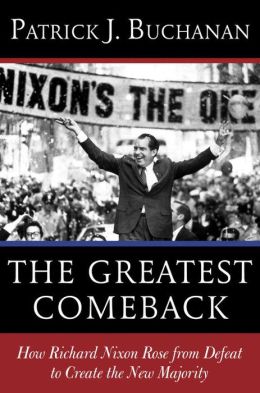
comebackAs Americans we enjoy one of the greatest privileges and responsibilities that can be afforded to any people: participation in the electoral process. The election process in our country is something we are very familiar with. With presidential elections held every four years and mid-term congressional election in between, we seem to be in a constant election cycle where we are inundated with campaigning and campaign promises. We have also been exposed to some great, and no so great, politicians who have produced some incredible highs and embarrassing lows. We tend to elevate politicians to movie-star status. (Actually, we have had a movie star become president) One such political figure was Richard M. Nixon. Nixon’s road to the presidency was littered with success and failure. In his new book, “The Greatest Comeback; How Richard Nixon Rose from Defeat to Create the New Majority”, conservative political commentator and former presidential candidate Pat Buchanan tells the story of how Richard Nixon ascended to the presidency of the United States.

Pat Buchanan was an editorial writer for the St. Louis Globe-Democrat prior to becoming an aide to Nixon in 1965. His book covers the three year period of 1965-1968. The bulk of the book begins with, and moves forward from, the election cycle of 1966 with Buchanan describing the state of the union under President Lyndon Johnson and the democratic-held Congress. Buchanan offers a look into the struggles the Republican Party had in voicing their opposition to areas such as the war in Vietnam and other social concerns at the time.

The subtitle to Buchanan’s book speaks of a comeback. For someone to have a comeback they had to have had past success and then lost it. This was the case with Nixon. He served as vice-president from 1953-1961. After suffering sound defeats in the presidential race of 1960 and the California gubernatorial race of 1962, Nixon declared he was finished with politics saying, “You won’t have Richard Nixon to kick around anymore”. However, Nixon did come back into politics. Buchanan details how tirelessly Nixon worked to get Republican governors elected in 1966. This investment of time and attention paid off with big dividends in November of 1968. He also reveals that part of Nixon’s comeback success was the advisors he surrounded himself with, his knowledge of foreign and domestic issues, and his ability to appeal to both moderate and conservative Republicans. This appeal was solidified as Nixon weighed in on the chaotic events of 1968. Buchanan wrote about this year saying, “America was falling apart as witnessed by the assassinations of Martin Luther King and Robert Kennedy, the 77-day siege of Khe Sanh, the Tet Offensive, the worst race riots in history, anarchic violence at Columbia University and other campuses, and a President broken by Vietnam, where 200 to 300 U.S. soldiers were being killed every week.”

“The Greatest Comeback: How Richard Nixon Rose from Defeat to Create the New Majority” is a thoroughly researched, well-written, informative, and entertaining work. I especially enjoyed Buchanan’s enclosed memos that he sent to Nixon while he was a candidate, as well as Nixon’s hand-written notes. This really helped the book to excel. This book would appeal to history buffs and political junkies. Because Buchanan chose the conversational style over the documentary style, it is enjoyable read. Buchanan’s best work to date.

Disclosure of Material Connection: I received this book free from Waterbrook Multnomah Publishers as part of their Blogger Review Program. I was not required to write a positive review. The opinions I have expressed are my own. I am disclosing this in accordance with the Federal Trade Commission’s 16 CFR, Part 255: “Guides Concerning the Use of Endorsements and Testimonials in Advertising.”

Book Review : Starting at the Finish Line

StartingAtTheFinishLine“Starting at the Finish Line; The Gospel of Grace for Mormons” is the story of Dr. John Wallace’s exit from the Church of Latter-day Saints (Mormons). He opens his book by providing unique insight into his childhood/early adult years in the church and the subsequent struggle to satisfy the requirements of the church. This struggle left him feeling empty and, at times, hypocritical. Wallace experienced a crisis of faith as became unsettled with the reality of God’s grace. In the second section of his book, he defends the accuracy and reliability of the Bible. This is crucial because the Mormon Church, as Wallace sees, is guilty of picking and choosing the parts of the Bible they will believe while at the same time dismiss it altogether. Wallace builds a solid defense of the Bible’s reliability.

In the third section, Wallace gives his readers a look into his crisis of faith as he came to terms with God’s holiness and the Mormon tenant that man has the capacity to become a god. This crisis served as the catalyst for his exit. Sections four and five consist of Wallace’s demonstration of the difference between Christianity and Mormonism in the areas of the person of Jesus Christ, the sufficiency of the blood atonement, grace, the balance between faith and works, and eternity. The latter sections are given to reconciling an existing tension between Christians and Mormons. That tension: Mormons believe there has to be something more than faith and Christians believe there can be nothing but faith.

“Starting at the Finish Line” is a good work. When it comes to leading someone out of a false belief system, the most effective means in doing so is the testimony of one who belonged to that belief system. Wallace takes a fair and balanced approach in his writing. This is not a Mormon-bashing book. Wallace puts Mormon theology and the words of their leadership alongside the Bible and asks the reader to decide. This is a great book for the Mormon who is struggling within their belief system. This is also a great book for Christians to be able to understand the basic beliefs of the LDS Church and how to defend the tenants of the Christian faith.

Disclosure of Material Connection: I received this book free from CrossFocused Reviews as part of their Blogger Review Program. I was not required to write a positive review. The opinions I have expressed are my own. I am disclosing this in accordance with the Federal Trade Commission’s 16 CFR, Part 255: “Guides Concerning the Use of Endorsements and Testimonials in Advertising.”

Book Review : Leadership Lessons; Avoiding the Pitfalls of King Saul

leadlessThere is certainly no famine of books, resources, and experts that are dedicated to the subject of leadership. Even a cursory examination of the shelves of your local bookstore will reveal volumes dedicated to the science, practice, and styles of leadership. One common theme found in this myriad of leadership advice and counsel is to give the “best practices” of leadership. In other words most leadership material comes from the “in order to succeed you must do this” point of view. There is nothing inherently wrong with this. It is refreshing however to see the matter of leadership approached from the other side. In their new book, “Leadership Lessons; Avoiding the Pitfalls of King Saul”, religion professors Ralph Hawkins and Richard Parrott examine leadership from the “worst practices” perspective.

Hawkins and Parrott write, “One of the unique features of this volume is that, in it, we take a sustained look at the life of a single, individual leader. This approach has a number of benefits. First, rather than arbitrarily selecting five or ten points upon which to pontificate, the selection of a key figure out of history and the examination if his life and leadership to allow the problem behaviors under consideration to emerge naturally. In other words, the ten behaviors examined in this book were not arbitrarily selected nor were they invented by the authors. Instead, they emerged from Saul’s own life story. They are rooted in reality. This means that, while these self-defeating behaviors are, to some extent, Saul’s own character defects, they may also be, to some degree, common or universal problems. A second benefit of tracing the foibles of one leader throughout his lifetime is that we are able to get a long-term perspective of how these problems arise and how they play themselves out if they are not addressed.”

Hawkins and Parrott shine the light on the life of Saul, Israel’s first king and expose the gross leadership failures of the man whom God chose to be the earthly leader of His people. (Reviewer’s note: It should not be concluded that God is to blame for Saul’s failure. It should also not be concluded that God was wrong in His choice of Saul as Israel’s first king. Saul’s failures were his own; the result of his free will.) Although King Saul is credited with some small successes, the authors term his overall reign as a “net-negative”. Hawkins and Parrott list the ten areas where King Saul suffered leadership failure. They term these as pitfalls. They are:

1. Saul Failed to Handle Authority Humbly.

2. Saul Failed to Break Out of His Tendency to Isolate Himself.

3. Saul Failed to Think Before He Spoke.

4. Saul Failed to Act When the Time Was Right.

5. Saul Failed to Lead the People, but Let Them Lead His Instead.

6. Saul Failed to Promote or Make Necessary Changes.

7. Saul Failed to Love the People.

8. Saul Failed to A Be True to His Own Ethics.

9. Saul Failed to Admit Failure or Concede to David.

10. Saul Failed to Consult God.

In each of the sections the authors make their case for Saul as a failed leader. Using the biblical account of Saul’s reign, Hawkins and Parrott demonstrate, through Saul’s actions, words, and attitudes that he is an example of who not to follow. Included in each of these ten pitfalls are modern-day examples of the same leadership style and failure. The authors provide solid examples of both secular and spiritual leaders who failed in the same manner as Saul. Action steps are included in each of the ten sections that help the reader to avoid making the same mistakes Saul did. Finally, each pitfall contains a section for group discussion and personal evaluation. Leadership Lessons is a fantastic book. In places it is brutally honest. In others it offers much needed encouragement. Still in others it passionately calls all leaders to understand the weight of their assignments. I feel strongly that this book should be required reading by everyone who holds a leadership position; most especially ministry leaders. It is that good. The term “must read” is over-used and is often inaccurately applied to many books today. However, this is one of them. In the beginning the authors asked the question, “Why study a failed leader?” They quote leadership expert Denis Waitley as their answer. He writes, “King Saul resides within each of us, and this marvelous book provides a magic mirror reflecting the essence of how to turn failure into the fertilizer of success.”

Disclosure of Material Connection: I received this book free from Thomas Nelson Publishers as part of their Blogger Review Program. I was not required to write a positive review. The opinions I have expressed are my own. I am disclosing this in accordance with the Federal Trade Commission’s 16 CFR, Part 255: “Guides Concerning the Use of Endorsements and Testimonials in Advertising.”

Book Review : The NIV Essentials Study Bible

nivessentialsIt seems that daily there is a new study Bible on the market. Each offers something special and significant that their contemporaries do not. Some hit it out of the park and some just strikeout. The NIV Essential Study Bible by Zondervan Publishers is one such new study Bible that, to be honest, falls somewhere in between. What does this Bible offer that others do not? More than what I first thought. The NIV Essentials Study Bible offers the same type of study notes as other study Bibles do. The unique thing about this Bible is layout. The NIVESB pulls information in from other NIV resources including NIV Study Bible, NIV Quest Study Bible, NIV Archaeological Study Bible, NIV Student Bible, The Great Rescue Bible, and the Essential Bible Companion. Combining all these resources into one location, the NIVESB helps the reader gain a quicker understanding of the Bible. Through eight different lenses, the NIVESB offers a new perspective to Bible study. The lenses include:

1. Flyover Lens: Each boom of the Bible begins with an easy-to-read introduction that comes from the Essential Bible Companion.

2. Unpack Lens: Bottom of the page study notes and in-text charts are included from the NIV Study Bible.

3. Dig Deep, Look Close Lens: Articles and photographs highlight the historical significance of the Bible, courtesy of the NIV Archaeological Study Bible.

4. Q&A Lens: Concise and easy to grasp answers to life’s most challenging questions are provided throughout using the NIV Quest Bible.

5. Important People in Focus Lens: This lens enables the reader to view scripture from the perspective of the Bible’s most notable figures.

6. Guided Tour Lens: This lens provides a “bird’s-eye view” of scripture showing how the theme and topic run throughout the Bible.

7. Insight Lens: These are magazine-style articles that provide a deeper look at the topic being discussed, courtesy of the NIV Student Bible.

8. R&R Lens: Reflect and Respond articles allow for deeper devotional thoughts utilizing the NIV Great Rescue.

Disclosure of Material Connection: I received this book free from Thomas Nelson Publishers as part of their Blogger Review Program. I was not required to write a positive review. The opinions I have expressed are my own. I am disclosing this in accordance with the Federal Trade Commission’s 16 CFR, Part 255: “Guides Concerning the Use of Endorsements and Testimonials in Advertising.”

Book Review : Simplify

simplifyOur lives are complicated and cluttered. Every day is a struggle to maintain healthy relationships, have meaningful interactions with our children, find time to exercise, carve out time for social activities, and connect with God in a real and life-changing way. As a result of this clutter and complication, we are unable to live out our intended purposes and find lasting satisfaction. How can we find the breathing room and margin that we desperately need? The answer to that question is that we need to make our lives simpler. In his new book, “Simplify; Then Practices to Unclutter Your Soul”, Willow Creek Community Church pastor Bill Hybels tackles the problem of cluttered and complicated lives. He identifies ten core issues that produce complication and rob us of peace and satisfaction.

Smartly, Hybels dedicates as entire chapter to each of the identified core issues. He identifies the issues leading to life complication and lists them in a “from – to” format. For example, he speaks of moving From Exhausted to Energized, Overscheduled to Organized, From Wounded to Whole, and From Isolated to Connected to name a few. Having exposed the negative, Hybels then offers the positive through what he calls “action steps” as how to simplify that particular area. Calling on years of pastoral experience, biblical narrative and principles, and good common sense Hybels demonstrates that simply because our lives may not be in perfect working order now, there is hope for a more rewarding life. I found the chapters on overscheduling and exhaustion especially helpful. I recommend this book without reservation.

Disclosure of Material Connection: I received this book free from Tyndale House Publishers as part of their Blogger Review Program. I was not required to write a positive review. The opinions I have expressed are my own. I am disclosing this in accordance with the Federal Trade Commission’s 16 CFR, Part 255: “Guides Concerning the Use of Endorsements and Testimonials in Advertising.”

Book Review : Dear Son

dearsonI recently finished a book entitled “Dear Son; A Father’s Advice on Being a Man” written by Mars Hill Church’s Teaching Pastor Dave Bruskas. Bruskas lost his son at two months of age to a congenital heart defect. This book is a series of letters that Bruskas has written to his son saying the things he would have shared with him had he lived. These letters cover such as areas as Christian, Son, Brother, Young Man, Provider, Citizen, Member, Husband, Father, Vessel, and Mortal. After each letter, the author gives a picture as to what each of these areas look like when lived out practically. Through the application, Bruskas uses the letters of 1 and 2 Timothy as the basis for his application.

Dear Son is a tender book as you might imagine. The letters he writes to son are emotional, heart-felt, and sincere. You sense from the tone of his words the depth of the love for his son that he knew only a few short months. I encourage all fathers to read this book. I was challenged on what I might say to my son regarding these same areas. A good work.

Disclosure of Material Connection: I received this book free from Tyndale House Publishers as part of their Blogger Review Program. I was not required to write a positive review. The opinions I have expressed are my own. I am disclosing this in accordance with the Federal Trade Commission’s 16 CFR, Part 255: “Guides Concerning the Use of Endorsements and Testimonials in Advertising.”

Book Review : The Good Spy

good spyThe depth of American diplomacy and espionage around the world is a closely guarded secret. The American public is afforded little detail and insight into the workings of our most essential intelligence gathering agencies such as the Central Intelligence Agency and the National Security Agency. This is for a reason. Often the work of clandestine agents within these agencies, although hidden from view, have led to improved relationships with allies, uncovered information that has stopped potential attacks, and helped bring world players to the table of diplomacy. In his new book, “The Good Spy; The Life and Death of Robert Ames”, author Kia Bird tells the story of one such clandestine CIA spy. Robert Ames was a spy for the CIA during the early 1960’s through the early 1980’s. Ames’ career with the CIA included involvement with many now famous individuals and operations. The most well-known event surrounding his life was the bombing of the American Embassy in Beirut on April 18, 1983 where sixty- three people including Ames were killed.

After attending La Salle University on a basketball scholarship, Ames joined the Army where he found himself stationed at a base that was run by the NSA. It was here that he was introduced to the importance of intelligence gathering. After leaving the Army, Ames began working with the CIA in 1960. It was here that Ames excelled. He became an expert in Arabic language and custom (called an Arabist throughout the book). At any early point in his career, Ames became interested and involved in the Arab-Israeli conflict. He would be involved with this conflict his entire life. Bird chronicles his work assignments and travels, as well as his efforts to maintain a normal family life. This book is as much about American foreign policy in the Middle East in the 1970’s and 80’s as it is about Ames. While Bird details and helps the reader navigate the private meetings, back room negotiations, and fragile relationships with “assets” and other political players, he tells the story of the volatile atmosphere in the Middle East and America’s involvement in it.

One of the things I really liked about this book was the introductions that were made. Bird tells of Ames’ work in countries such as Lebanon, Syria, Israel, Iraq, the region of Palestine, Egypt, and others. Bird has done an excellent job of introducing the reader to figures such as Yasir Arafat, Ariel Sharon, Sadaam Hussein, and chronicles the rise of groups such as Israeli Mossad, Hezbollah, al-Qaeda, Osama bin laden, and the Taliban. “The Good Spy” is a great work. Intriguing. Informative. Prophetic. Honest. This is a book all Americans should read. It tells how arrived at where we are today and gives great lessons for moving forward into an uncertain future.

Disclosure of Material Connection: I received this book free from Waterbrook Multnomah Publishers as part of their Blogger Review Program. I was not required to write a positive review. The opinions I have expressed are my own. I am disclosing this in accordance with the Federal Trade Commission’s 16 CFR, Part 255: “Guides Concerning the Use of Endorsements and Testimonials in Advertising.”

Book Review : HRC

hrcSince the early 1990’s, there has been a Clinton in the news. It all began with Bill being elected as POTUS is 1992 and 1996. This was followed by Hillary’s election to the Senate. This was followed by a failed attempt by Hillary to defeat Barrack Obama for the presidency in 2008. Her defeat was followed by confirmation as Secretary of State, a cabinet office which she held well into 2012. Suffice to say that Americans have come to know the Clinton family very well through both scandal and service. In their new book, “HRC; State Secrets and the Rebirth of Hillary Rodham Clinton” veteran Washington journalists Jonathan Allen and Amie Parnes have put together a snapshot of a very specific 4-5 year period of Hillary’s life. They chronicle her rise from the ashes of a failed presidential bid and subsequent work as Secretary of State in the Obama administration.

The opening of the books is reminiscent of a funeral service which lay to rest a failed political campaign. The authors reveal the thought process of Hillary’s camp, referred to as “Hillarylanders” as they attempt to determine what happened and who they need to blame. Allen and Parnes trace the steps and connect the dots as to how Hillary goes from defeated candidate and Obama’s most visible rival to Obama’s most trusted and influential cabinet member. The great majority of the book details the highs and lows of Hillary’s tenure as Secretary of State. The high points include the tracking and death of Osama bin Laden and the facilitation of the democratic efforts among nations involved in the Arab Spring. The lowest point of her tenure include the mishandling and leadership failure in protecting US personnel and American interests during the attacks in Benghazi, Libya where four American died. The authors dedicate an entire chapter to this tragedy, tragedy that will likely haunt Hillary the rest of her political life. The final part of this book deals with the possibility of Hillary’s presidential run in 2016.

There are two words that describe the Clinton political machine that comes through in HRC so very clear: loyalty and revenge. You need to look no further than the opening chapter, “Hillary’s Hit List”. One of the things that get in the way of the effectiveness of this book is the consistent muddying of the storyline through name-dropping. The authors seem to want the reader to know all of the people that personally know. This book is as much about Bill as it is Hillary. Although this book is intended to chronicle rebirth to the political landscape, the authors tell what Bill was to doing all along the way to facilitate that rebirth. This book proves a point that may have been unintended, but is still crystal clear. The point is that if it had not been for Barrack Obama and Bill Clinton, Hillary would likely have enjoyed a much smaller public stage.

Disclosure of Material Connection: I received this book free from Waterbrook Multnomah Publishers as part of their Blogger Review Program. I was not required to write a positive review. The opinions I have expressed are my own. I am disclosing this in accordance with the Federal Trade Commission’s 16 CFR, Part 255: “Guides Concerning the Use of Endorsements and Testimonials in Advertising.”

Book Review : Redefining Leadership

redefineleadershipThere is certainly no shortage of books written on the subject of leadership. Everything from principles for dealing with people, strategies to better manage time and goals, and guidelines for developing new leaders has been covered, at least once. In his new book, “Redefining Leadership; Character-Driven Habits of Effective Leaders”, pastor or Cornerstone University president Joseph Stowell brings an altogether different approach and viewpoint to the leadership conversation. Instead of asking questions centering on success markers and who should and should not lead, Stowell deals with the heart of a leader and what motivates him/her toward their goals.

Stowell puts forward two different kinds of leaders: outcome-driven leaders and character-driven leaders. The primary focus of outcome-driven leaders, as Stowell writes is “on motivating others to achieve great organizational outcomes” and “the power of their leadership is leveraged by the authority of their position instead of the credibility of their lives.” The primary focus on character-driven leadership, as Stowell writes, is to “empower those within the sphere of their authority to achieve great outcomes personally, spiritually, communally, and organizationally” and whose power is “leveraged by their moral authority that comes from the credibility of their lives.” The remainder of Part One, “A Redefined Priority”, is given to fleshing out the dynamics of these two leadership styles. Stowell highlights certain delusions that character-driven leaders should avoid.

In Part Two, “A Redefined Identity”, which is the best in the book in my opinion, Stowell introduces the term “followership”. As he describes the importance of following well before leading well, the author writes, “This is the deal-breaker moment in this book. The question is, ‘Are you ready to accept the identity of a follower…to fully surrender to Jesus as the final authority on life and leading?’” Stowell gives the three markers of followership. He says that Follower-leaders count it an honor to follow Jesus, actively pursue Christ, and are found in the “Way” with Him. In Part Three, “A Redefined Leader”, Stowell redefines the two types of leaders in light of the kingdom of God. Outcome-driven leaders are referred to as “instinctive” leaders and character-driven leaders are referred to as “kingdom” leaders. It is in this section that Stowell examines Christ’s sermons and teaching on kingdom and highlights the core competencies of the leader in light of following Christ as their primary example. Such competencies include humility, mercy, and meekness.

Redefining Leadership is an absolute treasure. With other leadership voices such as Al Mohler, John Maxwell, and Stephen Covey regularly instructing on the merits of effective leadership, Joseph Stowell must be included in these conversations. Although covering a deep subject, the book flows easily and never becomes “professional”. Stowell’s use of personal stories of victory and defeat, as well as the Scriptures themselves give this book a solid footing. Humbly and passionately written, Stowell has a winner here and should be required reading for all who occupy leadership positions whether secular or spiritual.

Disclosure of Material Connection: I received this book free from Thomas Nelson Publishers and BookLook Bloggers as part of their Blogger Review Program. I was not required to write a positive review. The opinions I have expressed are my own. I am disclosing this in accordance with the Federal Trade Commission’s 16 CFR, Part 255: “Guides Concerning the Use of Endorsements and Testimonials in Advertising.”