The Baptist Association : Part #3: Future

Over the past two posts, I have attempted to make the purpose of the Baptist association a little more clear. I also wanted to show that the association has some challenges facing it that will keep it from accomplishing its’ intended purpose. When you mix together the purpose of and the challenges facing the association, you are left with one question, “What is the future of the association?” “Does the association even have a future?” Depending upon whom you ask, the answer to this question is both varied and consistent, positive and negative, hopeful and hopeless. For example, Monty Hale, Director of Association and Pastoral Ministries for the South Carolina Baptist Convention said, “The association will be the face of Southern Baptists in the future. Most church leaders relate to the association to accomplish their God-given task of reaching the world for Christ.” Dr. Jimmy Draper, former president of Lifeway Christian Resources made the following statement, “In our obsession with what is new in world of church growth, let us not forget that all traditions are not bad and all of the past cannot be jettisoned. It is our tradition that builds our communities. The bedrock of that tradition in Baptist life is the local association.” Pastor Kyle Waddell of Pine Level Baptist Church in Early Branch, South Carolina says, “If I could sum my view up in one word it would be bleak. I personally have served in churches from three different associations in our state and have never seen the total effects come from any association in the capacity it was created to produce. I believe as do many in leadership in the SBC convention that the local association has outlived its usefulness in its present state and that if it were to close its doors many of our churches would never know.”  Dr. Jerry Nash, Director of Missions for the Harmony Baptist Association in Trenton, Florida writes, “With cooperative Southern Baptist pastors and effective leadership, the future of the Association is very bright.  It ultimately is at the local level that working relationships are built and trustworthiness is established.  As the SBC and state convention leaders and entities acknowledge and affirm the local Association we will be stronger as Southern Baptists.  It is just my opinion, but I believe to ignore or bypass the local Association will ultimately lead to the decline of Southern Baptists.”

I want to begin by saying that I believe the local Baptist association can have a future. I hold out hope that it is a bright future. I don’t believe it is automatic. It is my belief that the association’s future will look different than it does in the present. It appears to me that a great majority of associations still operate, at least in some manner, to the way they did fifty to sixty years ago. In the 1950’s and 1960’s the Baptist association served as a conduit for denominational programs from the SBC (Nashville) to the local church. For the most part the association still has the same programs (Brotherhood, WMU, Youth, Sunday School, Discipleship Training, Evangelism, Music, etc.) The strain comes when local churches either no longer utilize established programs or develop new ministries while the association continues with the traditional ministry structure. I believe relevancy is the Achilles heel of the Baptist association. Bobby Gilstrap, Director of Missions for the Huron and Southeastern Associations in Michigan wrote, “In the past, the associations and its leadership had predominately focused on two things: (1) How to get more churches involved in associational ministries and meetings, and (2) How to increase the giving of the churches to the association. As a result, there was a clear problem of relevance to our churches. The pastor’s frustration was they found no relevance in the association and our ability to provide for them as they struggled to fulfill their mission and calling. This brought me to a reality check. Our associations could not be the same as in the past or even the present. Our organization had to reinvent itself to be relevant and effective. We first realized that the association is not a church. That seems obvious, but many associations have been trying to do things that the church should be doing. That means, that the Associational Director of Missions is not the pastor and the association is not the church. The association should be a resourcing organization. In other words, the role of the association is to assist and resource the God-given vision of the churches.”

There are some who say that the association should not do ministry for the church. Others will say that this is not a problem. I believe it is in this discussion that the relevancy issue comes to light. Again, Dr. Nash writes, “As with the local church, there is a strong correlation between the strength of the ministry and missions program and the vision and leadership of the leader.  There is disagreement about whether it should be churches or Associations who do missions and ministry.  I challenge those who say Associations shouldn’t start churches or have ministries.  In the world in which I live, I do not have a single church which would be able to fund our Pregnancy Center. But together we have a vibrant ministry.” These are the issues that will shape the future of the Baptist association.

The future of the association is going to be shaped, at least in some part, by the Great Commission Resurgence Task Force recommendations that were approved by SBC messengers this past June. Mike Day, Direcctor of Missions for the Mid-South Baptist Asssociation in Memphis, Tennessee has an interesting opinion as to how these recommendations will shape the future of the association. He wrote, “Most associations I know of, large or small, struggle with “activity overload.” Our efforts to be all things to all churches often result in us becoming less than what we are supposed to be. We design programs, events, and ministries that often position us as a substitute for the church. As we affirm the GCR Recommendations, particularly the core values set forth in Recommendation #2, we are affirming the centrality and primacy of the local church and its Great Commission assignment for penetrating lostness and taking the gospel to the nations. An association’s acceptance of this principle puts us in position to affirm that the Great Commission was given to the church and not to a denomination. It provides us opportunity to focus on the “organism” that is the church rather than the organizations of a denomination. Our association will be strengthened as we sharpen our focus and concentrate upon what we can do to help the churches accomplish the Great Commission, rather than what the churches can do to help us accomplish our objectives.”

For the Baptist association to have a viable and fruitful future, the local church will have to be the focal point. The future of the Baptist association will depend upon the success of the local churches. As I see it, the church does not exist for the benefit of the Baptist association. If there were no association, the church would still exist. The association exists for the benefit of the local church. If there were no church, there would be no association. I believe that Dr. John McInnis, former Sunday School Consultant for the Florida Baptist Convention, said it right, “The association will be viable and effective to the extent that it understands and operates its mission to help churches accomplish their individual missions – one church at a time.”


Survivor : Port Royal Baptist Style

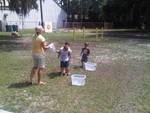
Most everyone has seen the cultural phenomenon that is Survivor. This television reality show puts two teams against each other through a variety of physical challenges. The goal is to outwit, outplay, and outlast your opponents. Today, we had our own version of Survivor at Port Royal Baptist Church. Monday is back-to-school day so we hosted a Survivor Back-to-School Fun Day for our kids and guests. We divided our kids into two teams and they competed in four team challenges for points. After all the competition, everyone was rewarded with an all-you-can eat ice cream bar. Here are some pictures from today.


I would like to thank all of our parents and everyone involved in our children’s ministry for their hard work in providing our kids and guests a fun and relaxing day. Your dedication and positive attitude is much appreciated my me, your pastor. Job well done.

FIFS : 2 Samuel 9:1-4

1 Now David said, “Is there still anyone who is left of the house of Saul, that I may show him kindness for Jonathan’s sake?” 2 And there was a servant of the house of Saul whose name was Ziba. So when they had called him to David, the king said to him, “Are you Ziba?” And he said, “At your service!” 3 Then the king said, “Is there not still someone of the house of Saul, to whom I may show the kindness of God?” And Ziba said to the king, “There is still a son of Jonathan who is lame in his feet.” 4 So the king said to him, “Where is he?” And Ziba said to the king, “Indeed he is in the house of Machir the son of Ammiel, in Lo Debar.”

Standard practice in ancient days was for the new king to remove any family of the former king that may pose a threat to his throne. This removal often meant sending those family members away to other parts of the country, imprisonment, and even death. It would have been appropriate and in line with the customs of the day for David to have had any of Saul’s family that was still alive put to death so there would be no threat to his throne. David shared a very close relationship with Jonathan, the son of Saul who was Israel’s first king. Although Saul pursued David in order to kill him out of jealousy and anger, Jonathan and David remained close. David wanted to do something for his friend Jonathan as a result of a vow that he had made. David’s relationship with God motivated to extend kindness to someone who the world would say did not deserve it.

David’s question in v.3 serves as a modern-day challenge for God’s people. “Is there not still someone of the house of Saul, to which I may show the kindness of God?” If this world today needs anything it is kind people. In our world of rudeness, inconsideration, and indifference, Godly kindness will make a significant difference. How well do we accomplish the demonstration of kindness? How well do we put others first? Kindness is listed as “fruit of spirit”  in Galatians 5:22-23 along with eight other traits that collectively characterize a Spirit-filled life. There are a few interesting things about David’s question in verse three.

First, David was intentional about showing kindness. He did not wait for the opportunity to come to him. It was important enough to him to go looking for a way to show kindness. Are we this intentional?

Second, David was not specific as to who he showed kindness to. David said “Is there not still someone”. Little did he know that Jonathan’s son Mephibosheth was still alive and that he was cripple in both feet. Kindness crosses all boundaries: physical, social, racial, and economic. Do we allow boundaries to stop our attempts at kindness?

Third, David was properly motivated. Again, David said, “the kindness of God”. I don’t believe David was trying to show off. I don’t believe he was trying to draw attention to himself. As a result the kindness God extended to him, I believe he wanted to pass that along. Kindness is contagious. God’s kindness toward us is our proper motivation. How well are you doing in returning kindness?

Worth Repeating

The church can, at times, communicate the need for change in peoples’ lives, and it ends up understood as some low-level therapeutic moralistic deism where a faraway God makes your life better and makes you a better person. But that is not the gospel. We don’t want to produce good religious people. We see what becomes of good religious people from the encounters Jesus had with the Pharisees. God wants–as should we–to see people transformed at a spiritual level rather than a behavioral level. Though often thought of in the same sense as a New Year’s resolution, transformation does not come from decisions made on January 1. Instead, it comes from re-creation, the re-creation that comes from new life in Christ. The change people need most is not in their circumstances, but in themselves. It is not the ability to try harder, but it is a life entrusted to Jesus. So, when you hear change, translate it to mean “gospel change.” It is not the same thing as trying harder; in fact, there is no trying involved. Transformation occurs not because we “do,” but because Christ has “done.” “

Ed Stetzer, President of Lifeway Research

Ordination Sunday

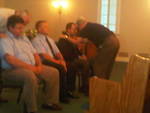
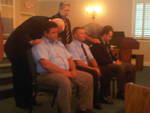
This past Sunday, we ordained three men as deacons at Port Royal Baptist Church. Josh Riley, Steve Michalski, and Danny Mallard were elected by the church to serve in this servant ministry. This is an important office in the New Testament church. Deacons are servants. Their office is not one of ruler, overseer, or financial manager. Instead it is a position of service and support. They are also to be examples to those around them. Their character and integrity is to be at the level that others may see Christ in their lives. Deacons are to be leaders as well. In the same way that pastors lead the congregation is spiritual development, deacons lead the congregation is physical development. I reminded our deacons that their model of leadership has been given to them by Jesus Christ, that model is to Love God and Love People. I am confident in these three men that they will serve the Lord and our church well. I am proud to be serving with them. Below are a few pictures of the service from Sunday. 


The Baptist Association : Part #2: Challenges

In part one of this series I put forth historically what the purpose of the Baptist association is. The history and purpose of the association is well documented (well beyond what I have documented here). My working definition of a Baptist association is “a collection of churches who share common beliefs that come together along specific geographic boundaries and voluntarily cooperate together in carrying out the Great Commission”. In much the same way that the local church is challenged in carrying out its purpose, the Baptist association is as well. I have been involved in the local Baptist association for over ten years. I have seen some good things where the association was able to fulfill its purpose. I have also seen some bad things where the association struggled in fulfilling its purpose.

Through my years of associational involvement, I have seen, and am seeing, certain challenges plaguing the local association. Let me say right here that I am not anti-association. Just the opposite. I want desperately to see the association succeed. I also believe in being honest. Introspection can be a positive and helpful thing. I want to share what I feel are the challenges facing the Baptist association today.

Challenge #1: The training and support that is offered to the local church at the associational level is readily available at the state level.

For the most part, the local Baptist association has ministry areas that closely mirror those of the church. The association may contain departments such as Sunday School, Discipleship Training, Music, Youth, Men’s Ministry, Women’s Ministry, WMU, and others. From time to time the association may offer training and resources to help the local church to be better equipped in these areas. This same type of training and resourcing is available to every church at the state convention level. Often times this training and resourcing is available quicker, in greater volume, and from staff with years of specific experience. The church has to make a decision. As a pastor, I have to answer a question much like this one, “If it becomes necessary to receive some of my training and resourcing from the state convention, why would I not receive all of it from the state convention?”  This is the challenge of assistance. The association faces the challenge of being an effective and consistent avenue of training, support, and resource.

Challenge #2: The local Baptist association may not be able to adequately resource and support the local church with the ministries that are specific to their own community.

This is not the same as challenge #1. As local churches explore their community, as they determine felt needs, as they identify new and specific ways to communicate the gospel, there will be a need for specific help and support. Churches are discovering new and emerging fields of ministry in the community that reflect segments of the population. These segments could include multi-housing ministry, skateboarders, resort and vacation settings, and the military. Each one of these fields requires specific support and even specific training. As a pastor, I have to answer a question much like this one, “Once I have identified ministries specific to my community, where is the best place to go for training and support?” This is the challenge of relevance. Can the association, in its present form, be of real and lasting help to the church? To be fair, the association cannot be “all things to be all people”. But, if the church determines that business as usual will not reach people with the gospel, the Baptist association faces a decision as well.

Challenge #3: The local Baptist association taking on ministry that is the responsibility of the local church.

I was once part of an association that felt that if the churches in the association were not doing ministry at a level they thought was acceptable, the association would sponsor that ministry. Instead of encouraging the churches to develop a comprehensive men’s ministry, the association sponsored the event. Instead of providing training on how to do it, the association just did it for them. That may seem fine on the surface. That may work for a time. However, it is not profitable for future ministry. Here is what I mean. In the event the association was no longer able to sponsor this type of ministry, the local church had not been equipped and empowered to do it. I witnessed this same practice in the area of youth ministry. Instead of bringing in training and empowering the church, the association just did the ministry. As a pastor, I have to answer a question much like this one, “Is the local Baptist association capable of performing ministry for the church instead of strengthening the church for ministry and hope to remain needed? This is the challenge of priority. Here is the struggle as I see it. Can the association do ministry, of course. But, the association has the responsibility to first assist and equip the local church to better conduct ministry.

Challenge #4: The local Baptist association faces financial challenges as their sole source of support is the local church.

Associations have budgets. These budgets are met by contributions from the local churches that cooperate in the association. Each church determines how much money is forwarded to the associational level. This amount usually either a percentage or a specific amount. The challenge for the association is to encourage and persuade the local church to give in a consistent manner.  There are times that the vision and priority of the local church and church pastor do not match up with the vision and priority of the associational leadership. Southern Baptist churches have a desire to cooperate. It is in the very DNA of the church to do this. It is not always easy for the local church to support everything the association does and plans to do. There are times when differing visions of purpose strain the cooperation between the church and association. Churches want to see the funds used in a meaningful way. Churches want to see real life-changing ministry taking place. As a pastor, I have to answer a question much like this one, “Am I able to stand before my congregation and assure them that the money that is sacrificially given to the Baptist association is being used for the furtherance of the gospel?” This is the challenge of accountability. Right or wrong, when visions differ at the associational level, churches don’t give as much or they reduce their giving. This is challenging to the association because, again, their entire source of funding comes from the church. If the church decides to re-route their giving to what they deem as meaningful, the association still has a budget to meet and must make up the difference.

In my next post, I will share what I feel is the future of the association.

The Baptist Association : Part #1 : Purpose

I am not a theologian. I don’t claim to be. I am not an excellent Greek or Hebrew scholar. I don’t claim to be. I am simply the pastor of a Southern Baptist church. I care deeply about the local church. I care about the people who make up the New Testament church today. Therefore I care about the things that affect the church that I pastor. The basis for this series of posts is to simply share my thoughts about the local Baptist association as I see it based on my personal experiences. I have been part of four associations (three in Florida and one now in South Carolina) and have served in leadership positions there. I will begin with the purpose of the association, move on to the challenges facing the association, and finish with the future of the association.

The reality of the local Baptist association is not foreign to Southern Baptists. In fact, the great majority of all Southern Baptist churches are members of a local Baptist association. This is their choice to make. When considering the purpose for the association, you may find many different viewpoints. For example, the members of the local church have their own thoughts as to why the association exists. These vary from congregation to congregation. The pastors of local churches have their own thoughts as to why the association exists. These thoughts vary from pastor to pastor. The leadership of the association has their own thoughts as to why the association exists. These views vary from association to association. The state conventions have their own thoughts as to why the association exists. Again, these thoughts differ from state to state. In order to find some kind of cohesive purpose for the local Baptist association, we must take a look at what this purpose has been historically.

Next to the local church, the Baptist association is the oldest unit of Baptist life. The Baptist association had its’ beginning in the United States in 1707 with the formation of the Philadelphia Baptist Association. From its’ beginning the association has served at least three fundamental purposes. Although there may be other purposes that have emerged over the years, there seems to be three at the center. Those three are fellowship, missions/evangelism, and doctrinal integrity.

1. Fellowship: In those early colonial days in the Philadelphia Baptist Association, the local Baptist churches struggled with their own individuality. These churches were weak financially and in weak in terms of resource. They were isolated from each other by distance. This led to a solitary existence. Churches were also very fragile due to all the circumstances occurring in colonial America just prior to the birth of a new nation.  Churches were few, small, and in need of mutual support. The Baptist association gave these churches the opportunity to come together, work together, and be encouraged by one another. The association would also give credibility in their area by identifying them with other churches who were like-minded. This same thought of fellowship has continued and evolved through the years. Today, the association still offers this much-needed fellowship between like-minded churches. The Baptist association offers churches the opportunity to come together under the same banner and fellowship together and be strengthened by each other. Under the umbrella of fellowship is that of churches helping each other. Dr. Jimmy Draper, past president of Lifeway Christian Resources made the following statement about this fellowship and cooperation, “It is the essence of our faith that the stronger help the weaker, that the greater help the lesser, that the larger help the smaller. In that sense we need to heed the Lord Who served with a towel in His hand.” Dr. Richard Harris, Director of Missions for the Santee Baptist Association in Sumter, South Carolina wrote, “There is a need for fellowship. None of the things listed above [accountability, encouragement, counsel, support] can happen if we remain isolated and separated from one another. We can be a mighty force and army for God, or we can go our separate ways, be disjointed and ineffective, weak, and powerless.”

2. Missions/Evangelism: Across Southern Baptist life there is a statement that we all know very well, “we can do more together than we can do by ourselves”. It is this thought that leads us to cooperate together and work together for our common faith. Historically, the association has been involved in mobilizing the local churches to be involved in mission work, church planting, and reaching beyond themselves. Again Dr. Draper writes, “In the latter half of the first century of the Philadelphia association, that entity turned from inward matters to outward matters of religious liberty and ministerial education. As the churches standardized their own internal life, the inevitable role of the association was to help them look out beyond themselves to the emerging world in Colonial America.”  Dr. Harris again wrote, “There is a need to be involved in a purpose greater than oneself. To avoid growing introverted, selfish, and ineffective, churches need exposure to ideas, methods, and opportunities for kingdom growth beyond their own church family.”

3. Doctrinal Integrity and Accountability: I believe in doctrinal integrity and accountability. I believe that all churches who choose to cooperate together in an association of churches should have certain agreed upon doctrinal positions and commit to hold to them. This is the reason for the Baptist Faith and Message. The BFM is our statement of faith as Southern Baptists that provides a comprehensive outline as to where we stand biblically on important doctrinal positions. Local churches “join” a Baptist association based on the promise to cooperate together and uphold those agreed upon biblical positions (BFM for example). Through the membership at the associational level, the church affiliates with the state and national convention. So, there is a sense that the Baptist association exists for this purpose doctrinal accountability. Dr. John Sullivan, Executive Director of the Florida Baptist Convention wrote, “The association is the theological watchdog of Southern Baptists”.  Dr. Harris wrote, “There is a need for accountability. Pressures from the culture, changes in current thinking, challenges from within church membership can cause compromised beliefs to become accepted. Knowing that there are standards for common beliefs and practices help keep the stresses of the moment from misguiding the church.” The Baptist association historically has been on the “front line” of doctrinal accountability, as seen in Dr. Draper’s statement, “But those earliest churches needed one another in other ways. In the absence of any seminaries, national or local denomination, in the pristine days of the emergence of our nation, they needed help with everything. The minutes of the Philadelphia Association reveal constant questions about baptismal doctrine, ordination, church disputes and other theological issues. The first Baptist association in America was a clearing-house of information on church polity and doctrine. The fellowship of an association is grounded in the unity of faith and practice. Each association may differ from others in particular doctrinal matters that are important to their fellowship and the amount of diversity tolerated on those issues. However, the association is, by its nature, a doctrinally based fellowship.”


FIFS : Romans 8:31-39

31. What then shall we say to these things? If God is for us, who can be against us? 32. He who did not spare His own Son, but delivered Him up for us all, how shall He not with Him also freely give us all things? 33. Who shall bring a charge against God’s elect? It is God who justifies. 34. Who is he who condemns? It is Christ who died, and furthermore is also risen, who is even at the right hand of God, who also makes intercession for us. 35. Who shall separate us from the love of Christ? Shall tribulation, or distress, or persecution, or famine, or nakedness, or peril, or sword? 36. As it is written:   “For Your sake we are killed all day long; We are accounted as sheep for the slaughter.”   37. Yet in all these things we are more than conquerors through Him who loved us. 38. For I am persuaded that neither death nor life, nor angels nor principalities nor powers, nor things present nor things to come, 39. nor height nor depth, nor any other created thing, shall be able to separate us from the love of God which is in Christ Jesus our Lord.

I believe the eighth chapter of Romans is perhaps the single most encouraging and uplifting chapter for the believer in the entire Bible. It begins with “there is therefore now no condemnation to those who are in Christ Jesus” and ends with “nor any other created thing shall be able to separate us from the love of God which is in Christ Jesus our Lord” and the middle part gives us the reasons why. In v.31, Paul asks a question, “What then shall we say to these things?” What are the “things” he spoke of? Here are a few.

1. According to Romans 8:1, we enjoy redemption. Through Christ we stand forgiven and our sin penalty has been paid.

2. According to Romans 8:6, we enjoy victory. Christ gives the believer the victory over the carnal nature that is opposed to everything Christ stands for.

3. According to Romans 8:14-15, we enjoy adoption. Being led and controlled by the Holy Spirit, the believer is no longer an enemy of God, rather now adopted into the family of God.

4. According to Romans 8:16-17, we enjoy assurance. In the low times of life when Satan casts doubt upon our salvation, the Holy Spirit bears witness that through the difficulty we are His.

5. According to Romans 8:26-27, we enjoy intercession. Ever felt like praying but were so burdened that words could not be found? The Holy Spirit hears our heart and speaks for us to the Father.

6. According to Romans 8:28, we enjoy a promise. This verse is for believers. All things in life that happen to us may not be fun, enjoyable, or painless. However, because of our relationship with Christ, “for those who love God, to those who are the called according to His purpose” all things that happen to us can be used by God to bring about good in our lives.

Our enjoyment and possession of these “things” should motivate us to share the gospel message. Do the lost not need redemption? They have sin that Jesus died for. Do the lost not need victory? Without Christ, they will always be slaves to the flesh. Do the lost not need adoption? They will remain outside the family, enemies, until Christ brings them in. Do the lost not need intercession? They have no avenue to approach the Father without Jesus Christ. What will we do?

Is Social Networking Eroding the Fabric of Genuine Authentic Friendships?

Aristotle once said, “the desire for friendship comes quickly; friendship does not”. Deep down inside each of us is the desire to share our lives with others. There is a desire for intimacy. There is a desire for each of us to have people in our lives with whom we connect on a deeper level. There is a desire to be part of a community that share the same beliefs, values, and interests that we do. Building healthy and meaningful friendships requires work. They do not just “happen”. What we must do is decide if the effort and work are worth it. We must determine how deep we want our friendships to go and how much they will impact our lives. When I talk about effort and work, I am not saying that making friends and building lasting friendships is a job. I am saying that it requires giving up time in our already busy lives to the pursuit of friendship.

We structure ourselves right out of the opportunity to build friendships. We learn to make friends at an early age. Remember as a child there were times of just “hanging out” together. Kids would spend the night at each other’s homes where they would get to know the family and the family would know who their children were spending time with. Times of tree houses, sandlot football, bicycle riding, fishing, and camping were not just ways to pass the time, but were avenues to strengthening and deepening friendships (we just thought it was fun). We don’t see too much of this anymore. Enter social media.

Social media has taken the world by storm. Facebook, Twitter, MySpace, blogs (web logs), and other sites are growing in popularity around the world and among all ages. The very essence of these social networking sites is that of friendship and connection. They offer an avenue of keeping up with established friendships and for the establishment of new ones. These sites allow for the constant and immediate answer to the question, “where are you and what are you doing?” Having “friends” on Facebook and “followers” on Twitter assist in connection. The only question that has to be answered is this one: Are these social networking sites capable of reproducing authentic and genuine friendships in the lives of people? I would have to say no.

Aristotle also said, “close friends share salt together”. I believe there is a great deal of truth and logic in that statement. Close friends share meals together. They sit across from each other and share time, struggles, victories, tears, family, hurts, and laughs together. Close friends share time together. I am not saying that social networking sites are bad. I am not saying that they do have a purpose. I blog, use Facebook and Twitter too. To answer the question asked in my title, “Is social networking eroding the fabric of genuine authentic friendships?” my answer is yes. Social networking sites promote social connectivity. This is not the same as intimate friendships. I see this erosion, or the slow wearing away of authentic friendships, taking place when the preference becomes a computer screen instead of a face-to-face meeting. This erosion can be seen when we would rather engage in online chatting instead of in-person communication. Although we hail the progress of technology today, and there have been some good advancements, I believe that our making it possible to communicate and never have to sit down face-to-face separates us as people. Instead of saying, “Let’s get together for lunch and talk”, we say “I’ll email you”. Instead of picking up the phone and phone and talking to someone, we text them. If we are not careful, we will forget how to relate to people all together.

Again let me say that I am not against social networking, or technology for that matter. I just believe strongly in the value of personal communication. Let me close by giving you a few questions for thought.

1. Is the quantity of your friendships on social networking sites more important that the quality of those same friendships?

2. Do you spend as much time and effort in face-to-face relationships as you do in “finding friends” online?

3. How many of your friends on social networking sites have you sat down with face-to-face for at least 30 minutes in the past six months?

Leaving On A Jet Plane

Actually, leaving in an Impala is more accurate. We are leaving early this morning for St. Augustine Beach, FL for our summer vacation. St. Augustine Beach is one of my favorite places in Florida. I enjoy the beaches (in small doses), the history, and the atmosphere of this old Spansh city. I am looking forward to a time of rest and unwinding with my family. I hope to post several times this week about the sights and sounds of St. Augustine and the random things that catch my attention. I think I hear the waves…..