Worth Repeating

Times sure have changed. It is rare today for a president, king, or any national leader to acknowledge that the events of history, much less those events affecting their own country, were/are under the direct and supreme control of Almighty God. Of course, this should come as no surprise to us, for the God’s Word tells us, “For I know that the LORD is great, And that our Lord is above all gods.  Whatever the LORD pleases, He does, In heaven and in earth, in the seas and in all deeps”.  (Psalm 135:5-6). This reality is seen in the portion of the speech below. The author and setting may surprise you.
“Neither party expected for the war the magnitude or the duration which it has already attained. Neither anticipated that the ’cause’ of the conflict might cease with or even before the conflict itself should cease. Each looked for an easier triumph, and a result less fundamental and astounding. Both read the same Bible and pray to the same God, and each invokes His aid against the other. It may seem strange that any men should dare to ask a just God’s assistance in wringing their bread from the sweat of other men’s faces, but let us judge not, that we be not judged. The prayers of both could not be answered. That of neither has been answered fully. The Almighty has His own purposes. “Woe unto the world because of offenses; for it must needs be that offenses come, but woe to that man by whom the offense cometh.” If we shall suppose that American slavery is one of those offenses which, in the providence of God, must needs come, but which, having continued through His appointed time, He now wills to remove, and that He gives to both North and South this terrible war as the woe due to those by whom the offense came, shall we discern therein any departure from those divine attributes which the believers in a living God always ascribe to Him? Fondly do we hope, fervently do we pray, that this mighty scourge of war may speedily pass away. Yet, if God wills that it continue until all the wealth piled by the bondsman’s two hundred and fifty years of unrequited toil shall be sunk, and until every drop of blood drawn with the lash shall be paid by another drawn with the sword, as was said three thousand years ago, so still it must be said “the judgments of the Lord are true and righteous altogether.”

Abraham Lincoln,  Second Inaugural Address, Saturday, March 4, 1865

Book Review : The Goodness of God

In his book, “The Goodness of God”, Randy Alcorn tackles the subject of suffering, and God’s presence during. The discussion over suffering is not a popular one, nor an easy one to bring an answer to. Suffering puts on many faces in our lives today; emotional, spiritual, financial, and physical are a few. Each one uniquely different.  Regardless of the form of suffering, every believer has to come to terms with the purpose for suffering, first answering “Is there a purpose for suffering and can any good come from it?”

“The Goodness of God” is a condensed version of Alcorn’s earlier, and more exhaustive work “If God is Good”. Alcorn approaches the subject of suffering from the biblical perspective and handles a difficult subject thoroughly and honestly. He deals with the origin of suffering (which he concludes is that of evil), various viewpoints surrounding suffering, Christ’s redemptive work through suffering, and God’s sovereignty over suffering. Although this book is short in length it is by no means a light read. He deals with doctrinal topics without becoming academic. I enjoyed this book. I appreciate how the author did not try to minimize suffering or lead one to believe that some are exempt from it. Great book and well worth the read.

Maybe a Different Kind of Diet is in Order

Think for a moment about the influence of technology and electronics upon our culture today. We have cell phones, laptop computers, iPods®, iPads®, e-books, GPS’s that talk to us, and handheld game systems. The ability to remain connected is what drives much of the technology industry today. Between text-messages, email, Twitter®, Facebook®, and blogs (web logs), it is possible for us to carry on conversations and conduct business for days without hearing the voice of another person. I have previously discussed how tragic I think this is.

As the parent of a teenager, I have seen this “technology overload” first hand. I must also say in all honesty that I am guilty of contributing to it. Children and teens today have a desire to stay connected to each other and know what is going on with each other at all times. To them, this is more than a desire, it is a need. I wonder how this steady diet of digital communication affects, or takes away from, other daily activities? I wonder how much face-time our children and teens trade off for screen-time? There is now a way to find out.

I was recently introduced to an organization called iShine. This organization is known for bringing family-friendly media options through television, music, and radio. iShine has recently developed and released a new online tool they call the Family Media Diet Calculator. The purpose of this tool is to provide a customized awareness to families in regards to various forms of media in comparison to how much time they spend plugged into real-life activity (reading, talking with friends, church services, etc). I really like the idea of this. Awareness is important because necessary and healthy changes can’t be made until there is a realization that things may be out of balance. From their press release:

“Parents nationwide will be able to plug in amounts of time their families spend texting, browsing online, consuming television and more. They will then be able to print a free custom analysis of where their families are spending their time in comparison to their involvement in recreational and faith-based activities along with family time and reading.  The campaign is not an anti-technology movement.  It is about use awareness and being intentional about the content.”

I do not endorse or recommend much. However, I believe this could be a valuable tool (absolutely free) for families to use in order to help made informed decisions as it relates to the media.

Book Review : The Jesus Inquest

In his latest book, “The Jesus Inquest”, British lawyer Charles Foster puts forth an in-depth, scholarly, and virtually exhaustive study of the events surrounding (tomb, death, burial) and finally the resurrection of Jesus Christ. Putting his trial skills on display, Foster puts the resurrection on trial, presenting both sides of the resurrection debate. Foster is involved in an internal debate. A debate in which Foster himself admittedly does not know what side he will come down on.

The format and style of this book is unlike any I have ever read. The premise is a debate between two characters, X and Y. Character X takes on and plays the role of the skeptic while Character Y takes on and assumes the role of the Christian. The skeptic takes the floor first with massive amounts (too much at times, I’m afraid) of research ready to refute the possibility of a physical resurrection. X has done his homework, but at times builds “straw-man” arguments. In typical trial fashion, the Christian takes the floor next. He deals with each point that X puts forward with a sense of reality and brevity (which I think helps his case). As in a real court case, there is a jury to weigh out the evidence and argument and come to a conclusion. In this book, the reader is the jury.

Overall this is a good work from the apologist standpoint. One negative issue I had with this book is that the research put forward from X’s position makes this book seem like a “textbook”. As a Christian, some of the phrases and terminology used by X to characterize Y were at times offensive. Although I didn’t agree with everything Foster wrote, it does not negate the fact that he has put forth a great work that is well-written and well worth your time. As a pastor, I encourage my people to read behind people they don’t agree with in order to be better prepared to defend what they do believe in. “The Jesus Inquest” provides such an avenue.

Today is the Day

 Today is the day. Today is the day that all the preparation and planning has looked forward to. Today is the day families gather together to celebrate and visit. Today is the day that children anxiously await with great anticipation. Today is the day of gifts, reflection, and carols. Today is the day for something else. Today is the day the prophets of old spoke of concerning the coming Messiah. Today is the day, as John 1:14 tell us that, “the Word became flesh and dwelt among us.”

Today is necessary, and the beginning point, as far as mankind is able to see, in God’s plan for his redemption. In eternity past, God had, and still has a love for us that goes beyond our comprehension and one in which words cannot do justice. It is this love for a fallen, sinful, ad rebellious race of humans that motivated God to do something on our behalf, for He knew that we could not save or rescue ourselves. Our redemption and salvation began on this day. If there had been no birth, there could have been no earthly instruction as to who God is and what He desires from us. If there were no instruction and teaching, there would have been no rejection by those Jesus came to first reveal Himself to. If there had been no rejection, there would have been no prophecy fulfillment which solidifies our hope and assurance. If there were no rejection, then there would be no crucifixion and atoning death for the sins of mankind. If there were no crucifixion and death, there certainly would have been no resurrection. A resurrection that assures us that we worship and serve a rise and living Savior. A resurrection that is the fundamental difference between all world religions. A resurrection that testifies to the truthfulness and trustworthiness of Christ to accomplish what He said He could.

So on this day I say thank you to God for the baby in the manger. Thank you for the virgin birth, the insignificant town of Bethlehem, and for the baby in the manger being named Jesus, all of which fulfilled prophecy. God, thank you for the angels that night who proclaimed the good news of the newborn king and comforted the fearful. Thank you for the shepherds who were of the first to see Jesus. Their invitation to see, and their obedient visit, testified that Jesus truly was the Savior for all of mankind. God, thank you for the visit of the wise men who, after having their hearts stirred by you, traveled great distances bearing gifts worthy of a king. Their gifts were appropriate and unknowingly prophetic.

Today is a special day. Today is a day that should not get lost in the shuffle of the holiday season. The gospel writer Matthew wrote, “ So all this was done that it might be fulfilled which was spoken by the Lord through the prophet, saying:  “Behold, the virgin shall be with child, and bear a Son, and they shall call His name Immanuel,” which is translated, “God with us.” Today is the day of The Gift. Merry Christmas.

FIFS : 1 Chronicles 29:14

14 But who am I, and who are my people, that we should be able to offer so willingly as this? For all things come from You, And of Your own we have given you.

As chapter 29 opens up, we find King David encouraging the people of Israel to contribute toward the building and furnishing of the temple. The people respond in a selfless manner, giving gold and other precious stones. David stops when it is all done and offers a prayer of thanksgiving and praise to God on behalf of the gifts of the people as their worship. In his prayer, David acknowledges where the resources had come from. In essence, David says, “Everything comes from you, and we have given to you only what comes from your hand.”

Would you ask your child to go to the store to buy bread without giving them the money to buy the bread? As an employer, would you hire a staff without having the money for salaries? No. Would God ask you to go through a difficult or dark time in life without giving us the strength we need? No. Would God ask us to minister in His name as the NT church today without leaders in the church? No. We have been given the resources that we need from God for our everyday lives. In the same way parents provide for the needs of their children, our Heavenly Father is prepared to meet our need. The problem that we as believers have in this area can be summed in the following statement: “We want the resources that we do not need”.

We want the resources that come in a catalogue, from a conference, or from a book or brochure. God gives us what we need today. God has made the provision for us. He is willing to give to His people. We often mirror the Israelites who were wandering in the wilderness. God gave them manna. They were not satisfied with   enough for just one day. They tried to collect enough for two days and it spoiled. It was a lesson in trust for the Israelites, as it is for us today. The lesson in being good stewards is this: God gives willingly, but he gives you what you need for today. You do not get tomorrow’s grace today.

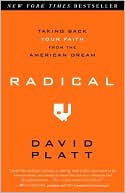
Book Review : Radical; Taking Back Your Faith from the American Dream

 In the book “Radical; Taking Back Your Faith from the American Dream”, author and pastor David Platt clearly defines a struggle facing every believer. The struggles as he sees it one between whole-hearted and selfless obedience to Christ and the pursuit and enjoyment of the America Dream. Platt uses John T. Adams definition of the American dream. Adams said it is “a dream… in which each man and each woman shall be able to attain to the fullest stature of which they are innately capable, and be recognized by others for what they are.”

 Platt paints two extremes for the reader. On the one side there is the modern-American Christian and church. He speaks of million dollar buildings, homes, and cars sitting in parking lots. He speaks of the modern Christian with fine clothes, more money than they need, and a disconnect from and a tolerance for the modern worship experience. On the other side are the house churches in countries where the gospel is illegal, believers who enjoy hours upon hours of bible study, and countries with little or no provision such as food, water, and shelter. Platt’s book is a call for us to be uncomfortable with what we have and with what others don’t have. It is a call for a new sense of obedience through understanding that our pursuit of the American Dream hinders the gospel from reaching the nations.

Platt builds his book in large parts to the story of the Rich Young Ruler of Mark 10. When asked how to inherit eternal life, Jesus told this young man to go and sell his possessions and give it to the poor. Platt does a great job of carefully explaining that works are not the basis for salvation. Instead, if there is something in life that means more to us that Jesus, we must set it aside, whether money, status, etc. He uses real-life examples of people in his congregation that have taken the step toward radical obedience by selling their possessions in order to promote the gospel. I liked this book very much for the powerful message. Ultimately, Platt is calling every believer of Christ to a decision. The decision is this: Will we continue to enjoy all the benefits of the American Dream to the detriment of the nations? In the very end, it is a call for all us to determine and decide how much Jesus means to us and how far we are willing to follow Him.

Worth Repeating

“The message of biblical Christianity is not “God loves me, period,” as if we were the object of our own faith. The message of biblical Christianity is “God loves me so that I might make him – his ways, his salvation, his glory, and his greatness – known among all nations.” Now God is the object of our faith, and Christianity centers around him. We are not the end of the gospel; God is.”

David Platt, from his book “Radical”

An Endangered Species, I Believe

It is no secret to anyone that I am a fan of the Peanuts. I have enjoyed watching Charlie Brown and his friends ever since I was a child. Every year on network television, there are several holiday specials built around Charlie Brown and the rest of the Peanuts gang. Last night was the special, “Merry Christmas Charlie Brown”. This may not seem like a big deal and it may not seem like anything important. But, what is important is that within this special that aired on network television in prime-time, was the clear presentation of the true meaning of the Christmas season. I was surprised this show was on television this year. With all the hassle and turmoil over just saying “Merry Christmas” in the stores, I thought for sure that mentioning “Jesus” and “Christ the Lord” on public television would certainly spell the end for this childhood favorite. I have to wonder, in this day intolerance and political correctness, how much longer network television will air a public testimony that the birth of Jesus Christ is the sole reason for Christmas. So, in case you missed it, here is the clip from “Merry Christmas Charlie Brown” that comes straight from Luke 2. Enjoy.

My Response to the Open Letter by the Alabama Baptist Conference of Directors of Missions

Below is my response to the recent open letter issued by the Alabama Baptist Conference of Directors of Missions dated November 15, 2010 to the Southern Baptist Convention calling for a slowdown of the Great Commission Resurgence. Their letter can be read in its entirety here.

I would like to begin by saying that in the grand scheme of all things Southern Baptist, I am merely one pastor. I am merely one pastor among thousands across the SBC who day in and day out engage our people in the reality that we have been given a mission and that mission involves people. My love for Christ and a burden for the lost motivate me as a pastor to stand before God’s people and proclaim the only certain cure for darkness is light. I am certain that is your motivation as well. I would be amiss if I did not thank you for your service to the kingdom of God. I want you to know that I appreciate all that you do in a position that I can only assume is challenging at best. Your leadership and guidance on behalf of Alabama Baptists has no doubt been selfless and beneficial.

Your open letter dated November 15, 2010 was a letter to pastors. It was a letter to the local church leader. It was a letter to the local congregation. It was a letter to a denomination of churches that had spent a considerable amount of time (nearly a year) considering a request to evaluate themselves. It was a letter to me as a 38 year old Southern Baptist pastor. Therefore, I would like to respond.

I was in the convention hall in Orlando this past June when the GCRTF recommendations were presented, debated, amended, and accepted by a great majority of the messengers. I, for one, studied both the preliminary and final reports. When asked by Dr. Floyd to do so, I committed to be a prayer partner throughout the entire process. After the year-long build up, after all the articles had been written, after all the interviews had been given, after the almost hour of discussion, and after the final vote, it was clear to me that the messengers present that day sensed a need for change in order for Southern Baptists to have any hope of putting a dent in the fulfillment of the Great Commission. I left Orlando hopeful, optimistic, and more excited than ever about the future of the SBC.

To the best of my ability, I would like to reply to a few of your statements that I feel are especially troubling. As I read the reasoning behind your letter and the letter itself, there were certain words and phrases that I found not only surprising, but discouraging. The phrases, “pull the plug”, “backed into a corner”, “when the GCR comes to pass”, “causes division”, “knows the devastation GCR will have”, “superseded”, and “dismantled” collectively send a message of fear.

First, Tom Stacey, Salem Baptist Association Director of Missions said he “knows the devastation the GCR will have”. I don’t know how this is possible. I believe that any “perceived knowledge” as to how these recommendations will affect any agency in the future is speculation at best. The recommendations that passed in Orlando are just that, recommendations. The adoption of the report of the GCRTF did not change anything, realign anything, create anything, dismantle anything, or decrease any funding on the spot. These recommendations were referred to the respective entities (Executive Committee, NAMB, etc) for study. These were non-binding and no one fully knows what will happen or what the respective agencies and entities will do. It will not be until June of 2011 in Phoenix that we know how the entities respond to the recommendations.

Second, Steve Loggins, president of the Alabama Baptist Conference of Director of Associational Missions said “we all want to see the Gospel go to the ends of the earth, but we can’t abandon what we have here. It doesn’t have to be an either/or, but a both/and.” In all fairness, your letter does not come to the defense of the nations. Two of the recommendations of the GCRTF deal with NAMB having a greater emphasis on church planting in under-served areas of North America. They also ask the IMB to help NAMB with identified people groups located within in North America. I believe the thrust of the recommendations address your concerns: pioneer areas where there are people, but a lack of churches to serve them. You speak of a “both/and”, but one recommendation dealt with the IMB receiving an additional one percent and this was absent from your letter. Instead, you addressed the areas that would affect you and only defended the funding of those areas.

Thirdly, you stated in your letter, “in our understanding, the Great Commission Resurgence Task Force and documents proceeding from the task force essentially have: superseded the Cooperative Program, Southern Baptists main funding for working together.” There were no new funding mechanisms put forward by the GCRTF. The GCRTF did not offer one channel of funding in exchange for another. You mentioned the “documents proceeding from the task force”. On page number nine of the pamphlet entitled Penetrating the Lostness; Embracing a Vision for a Great Commission Resurgence Among Southern Baptists, under Component number three, the following is written, “We reaffirm the definition of the Cooperative Program adopted by action of the 2007 Southern Baptist Convention. We honor and affirm the Cooperative Program as the most effective and efficient means of channeling the sacrificial support of our churches through undesignated giving which funds both the state conventions and the work of the Southern Baptist Convention. We call upon the churches of the Southern Baptist Convention to increase the percentage of their Cooperative Program giving.” Although the GCRTF put forth a category of giving entitled Great Commission Giving in order to recognize all categories of missions giving, the Cooperative Program appears to have remained center stage for cooperative funding. In Orlando, the GCRTF embraced an amendment to their own report that added language of further support and recognition of the Cooperative Program as the main avenue of cooperative missions giving. The wording of the amendment and the willingness of the task force to listen to the messengers should put to rest your fears of the “dismantling” of the Cooperative Program. If nothing else, their spirit of cooperation should at least give you an inclination that their motives as pure.

Lastly, Stacey said again, “We’re praying [NAMB President] Kevin Ezell will start understanding more and more that these entities and agencies will do some studies before they pull the plug on whatever they are going to pull the plug on. We’re backed into a corner and we are trying to be as gentlemanly as we can.” Who backed you into a corner? Why is there a need to be so defensive? As leaders, we should always evaluate how our ministries are being carried out in order to determine if there if there is a better way to utilize personnel, resources, time, and the Cooperative Program monies that sacrificially flow from the pews of the local congregation. As leaders, evaluation and introspection should not frighten us. At its base level, the GCRTF has asked us all to do that very thing. In all fairness to Dr. Ezell, he has just begun his duties at NAMB. He has stepped into a difficult position. He has been given recommendations from the messengers of the SBC that call for a serious look at how NAMB does business. Please give him some time to understand his office and duties before any assumptions are made. You mention that you hope some studies are done before the plug is pulled on “whatever they are going to pull the plug on.” I would like to remind you that you are a part of “they”. What I mean by that is this. Any final action will be made by messengers who come from the local Baptist church.  The recommendations that were passed in June are the studies you hope that will be done. The GCRTF gave some detail to each entity as to what to “study” to better carry out the Great Commission.

I would like to ask two things of you as an association of directors of missions and as influencers of Baptists nationwide.

First, please let the process work before you make any drastic decisions. I believe that asking for a slow-down on a renewed passion and desire for the fulfillment of the Great Commission is counter-productive and not our place. How dare we ask such a thing?

Second, please keep in mind the nearly six billion lost people throughout the nations when drawing territorial lines. Turf wars are not God-honoring and never advance the gospel. We must never become fixated on our areas so as to miss what God is doing elsewhere.  

Many challenges lay ahead of us as Southern Baptists. We are challenged to put the welfare and future of the nations first. We are challenged to seek the kingdom of God first. We are challenged to seek unity first.  There are going to be issues and positions that we don’t agree on. It is impossible to believe that everyone will always agree on everything.  Although we don’t agree, we have to remember that we serve the same Lord and it will be our ability and willingness to bridge our differences that will determine how long we travel in separate directions hoping to reach the same destination.