The Winner of Stephen Mansfield’s new book, “Healing Your Church Hurt” from Tyndale House Publishers is Lynda Buss. She will be receiving her book in the very near future. Thank you to everyone who stopped by my blog to check out the giveaway. A special thanks to Tyndale for making this free copy available.
Book Review : The Coming Revolution
 I must admit that I have always had an interest in the political landscape of our nation. I do my best to keep up with the leaders, decisions, and trends that will affect, positively or negatively, the future of the nation of which I am a citizen. The current political climate in America reminds me of someone who continues to put air into a balloon, while all the while ignoring the warning signs of the impending burst. I cannot remember a time when the decisions being made on behalf of the people of these United States were so drastic and monumental. The current political setting has caused many to become discouraged and fearful; to wonder, at times out loud, what the future hold for the United States of America.
In Dr. Richard G. Lee’s new book “The Coming Revolution; Signs From America’s Past That Signal Our Nation’s Future”, Lee reveals through past history and present circumstances that our country is on the verge of another revolution reminiscent of 1776. This coming revolution is not one of bullets and battles, but one of the ballot box. Of this coming revolution, Lee writes, “What this book proposes is a revolution that is far superior to a violent rebellion. It is a revolution of faith and ideas, a new commitment to a higher cause. It is a revolution that will fulfill the charge our forefathers gave us during the founding era. A tremendous hunger for restoration of accountability exists in this country, and the popular reaction to the progressive agenda in Washington may be a blessing. Excessive control and a burdensome taxation are driving the people of this country back to the basics and, hopefully, leading to a renewal and resurgence of the American Spirit”. Lee begins his book by giving the reader a portrait of our nation. He does so by taking a brief look at the founding of our country, the major advances that lead to America’s greatness, and the current social and political issues we face today.
Dr. Lee references many of the early documents that make up the scaffolding of what the values and principles of this country rest upon. He describes what is known as the “American Spirit” which is defined as the sense of unity that existed between the early American colonies that allowed them to work together, grow together, worship together, and prosper together. He shows how this American spirit originated with the Puritans and the sermons of the Great Awakening. Lee lists the influences the Great Awakening had upon early America. These include unity and community among the colonies, moral and spiritual worldview, a spirit of independence, and a belief in manifest destiny, among others. Lee also shows the areas where America is losing ground to popular culture. He includes health care, education, the institution of marriage, to name a few.
A note to readers. Those who label themselves as moderates, progressives, liberals, or socialists will not enjoy this book. Lee often cites how the current administration has drifted from the intentions and principles of the founding fathers. This book is written in support of the Tea Party Movement that has taken a prominent position over the past year. He said this of the Tea Party, “the movement stands for a smaller government, fiscal responsibility, individual freedom, and a conservative view of the nation’s founding documents.”. Lee chronicles just how far the Obama administration has gravitated from these formative beliefs.
The best part of this book, in my opinion, is the fact that after Dr. Lee lays out the problem, he does not leave the reader there wondering what can be done. Instead, he lists ten things that can be done right now in order to make a difference. Some of these are pray for America, register to vote and know the issues, and let your elected officials know how you feel, to name a few. I highly recommend this book. It is not an easy read, in that there is a great deal of historical information which is necessary in order to understand Lee’s position. The Coming Revolution is great food for thought on the issues facing America today.
Disclosure of Material Connection: I received this book free from Thomas Nelson Publishers as part of their Blogger Review Program. I was not required to write a positive review. The opinions I have expressed are my own. I am disclosing this in accordance with the Federal Trade Commission’s 16 CFR, Part 255: “Guides Concerning the Use of Endorsements and Testimonials in Advertising.”
Tyndale Blog Tour – Free Book Give Away
Thanks to the good people at Tyndale House Publishers, I have a free copy of Stephen Mansfield’s new book Healing Your Church Hurt; What To Do When You Still Love God But Have Been Wounded By His People to give away. If you would like to read the first chapter of this book, you can do that here. To enter, simply answer the following question in the comment stream below.
In ten words or less, which person from the Bible, excluding Jesus, do you find the most inspiring and why?
The deadline for entry will be midnight on Friday, February 17th. I will pick a winner from all the entries and notify the winner at noon on February 18th. One entry per person please. Good luck.
Book Review : Healing Your Church Hurt
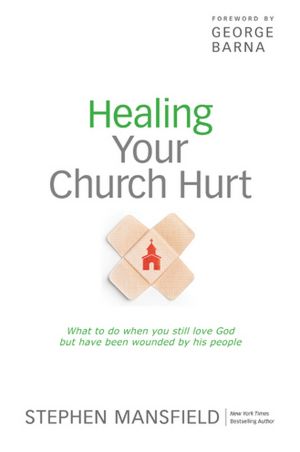 If you have ever been part of what the Greeks knew as the ecclesia, or “the called out ones”, better known today as the New Testament church, then it is likely that you have witnessed or been involved in a church hurt. As a result, either you or someone you know, made a decision to walk away from the “church”. George Barna says this “decision to permanently withdraw from a congregation” can be called “ecclesia exitus” or church dropout. In Stephen Mansfield’s new book “Healing Your Church Hurt; What To Do When You Still Love God But Have Been Wounded By His People”, he dives in to this issue and epidemic of hurt, offense, and discouragement within the body of Christ. Having been the pastor of a church who experienced a devastating church hurt himself, Mansfield is able to speak to this topic successfully.
Mansfield did not write this book to simply tell the reader that people get hurt in church. Instead, he writes to assure those who were hurt that it is possible for them to reconnect with the body of Christ. Mansfield begins by giving the root of the problem of offense and hurt: human nature and sin. He then takes a look at how we tend to look at others. He believes that how we look at others may determine our willingness to mend a relationship and length of time it might take. This chapter brings out these types of questions: Have our expectations of others that didn’t prove to be true given weight to our hurt? Are we guilty of forgetting how ugly the human nature can be?
Chapters four and five are the best chapters in the book and are very powerful. Chapter four entitled, “Lessons From a Season in Hell”, Mansfield asks the reader to do something. He asks, “I want you to take the most agonizing season of your life and examine it piece by piece.” He does this by asking five pointed and probing questions. They are:
1. Of the things your critics said, what do you know to be true?
2. How did you try to medicate your wounded soul?
3. Were you clinging to anything that contributed to your church hurt?
4. What did those closest to you do when you went through the fire?
5. During the bruising season, what fed your inspirations and your dreams?
In Chapter five, “The Throne Room of Your Mind”, Mansfield deals with how our minds process the hurt and how we tend to play the hurtful act over and over, rehearsing all the “should-have, could-have, and would-haves”. He demonstrates this by sharing a recurring dream that he has. As he sits on a grand throne, everyone who has wounded him becomes aware of their offense and they line up and come before him to make amends and tell him how sorry they are. As he enjoys having them in the palm of his hand, he touches them with his scepter and declares them forgiven. They exit thanking him for forgiving them, promising never to offend again. Of course, this is a fantasy. He says that we all have in our own minds a similar throne-room experience. Mansfield goes on to say that being hurt is about being offended, or suffering an offense. It is in this chapter that he gives to us a piercing word study demonstrating how devastating an offense can be. He concludes the book by dealing with forgiveness and restoration. He suggests that God may have a divine purpose for our hurt.
Stephen Mansfield has written a powerful book. It is efficient and to the point. His advice is practical and immediately helpful. Healing Your Church Hurt is a must read for those who have been wounded by the body of Christ. He sums up his reason for writing, “There is a myth that we need to knock in the head – and we need to knock it in the head now. When we’ve been hurt by the church we often tell ourselves that we are going to keep loving Jesus but that we no longer want anything to do with his people. The Bible makes it clear that we cannot love Jesus and hate his people.”
Disclosure of Material Connection: I received this book free from Tyndale House Publishers as part of their Blogger Review Program. I was not required to write a positive review. The opinions I have expressed are my own. I am disclosing this in accordance with the Federal Trade Commission’s 16 CFR, Part 255: “Guides Concerning the Use of Endorsements and Testimonials in Advertising.”
Book Review : Wild Goose Chase
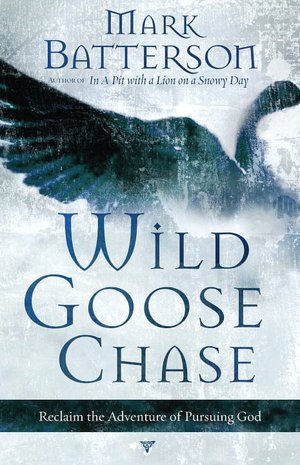 Wild Goose Chase by Mark Batterson is the prequel to his other great work In a Pit With a Lion on a Snowy Day. This book is about adventure. It is about excitement. It is about passion. It is about pursuit. All of which Batterson says is lacking in the life of institutional Christianity. The title of this book was borrowed from the Celtic Christians. They had a word for the Holy Spirit, “An Geadh-Glas”, or “The Wild Goose”. Their word hints at the untrackable and untamable nature of a wild goose, which is also true of the Holy Spirit. Batterson declares that the Christian life should not be boring because we don’t serve a boring God.
As he begins his book, he speaks of cages that we find ourselves in. He says Christians were not meant to live cages lives. Batterson writes, “Sure, you can choose the safety and predictability of the cage, forfeiting the adventure God has destined for you. But you won’t be the only one missing out or losing out. When you lack the courage to chase the Wild Goose, the opportunity costs are staggering.” The bulk of the book (six chapters) centers around six cages that, as Batterson says, “keep us from roaming free with the Wild Goose and living the spiritual adventure God destined us to.” He also introduces us to six “goose-chasers” from the scriptures.
Cage One is the cage of responsibility – the story of Nehemiah. We learn here that our main responsibility as Christians is to pursue what God is passionate about. Cage Two is the cage of routine – the story of Moses. Routines lead to rut and ritual and quench the adventurous spirit. Cage Three is the cage of assumption – the story of Abraham. Excuses and assumptions abound. God can use anyone, anywhere, anytime. Cage Four is the cage of guilt – the story of Peter. If you allow your past ways to chart your future course, it will always be safe. Cage Five is the cage of failure – the story of Paul. Failure is often the beginning of our pursuit of the unknown. Cage Six is the cage of fear – the story of Jonathan. No guts, no glory.
Batterson has a great book here. His style of writing is unique and entertaining. He has the ability to communicate a difficult truth in a practical way, much like Andy Stanley. You will enjoy this book and find it challenging and capable of rekindling lost dreams.
Disclosure of Material Connection: I received this book free from Waterbrook Multnomah Publishers as part of their Blogger Review Program. I was not required to write a positive review. The opinions I have expressed are my own. I am disclosing this in accordance with the Federal Trade Commission’s 16 CFR, Part 255: “Guides Concerning the Use of Endorsements and Testimonials in Advertising
Book Review : The Search Committee
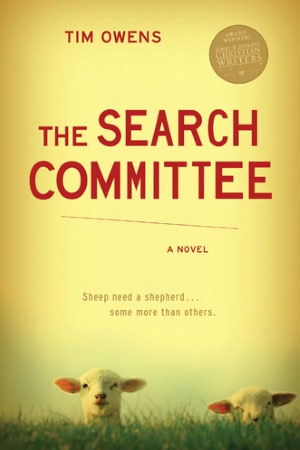 The Search Committee by Tim Owens is a story of a colorful and identifiable collection of members from a small southern Presbyterian church who have been entrusted with the task of locating the next pastor for their church. Owens introduces us to Bill, the oldest of the group and designated bus driver. Joyce, the resident northerner brand new to the south also rides along. Susie and Dot are the single mother and town gossip, respectively. Travis is the young married man struggling with his wife’s desire to start a family. Matt is the single, professional PhD type living at home with his father and Frankie is the pleasant and unassuming woman carrying a heavy burden.
Owens’ book is about a parallel journey. On one rail of the track he chronicles the committee’s travels to and from churches across North and South Carolina. He does so by providing details on such things as the condition and smell of the old church van to the people they meet during their church visits. He frequently discusses their “system” of entering churches so as not to be identified by the churches as the group coming to “steal the pastor”. As a pastor, this method of search is one that I am familiar with. Owens recounts their travels, experiences, troubles, mishaps, and portions of their life stories. On the other rail of the track, he chronicles the journey that each of the seven members are on personally. As the members listen to the sermons of each prospective pastor, we learn how each one is impacted.
I really enjoyed this book. Owens does a great job of pulling the covers back on the lives of the committee so the reader may see their vulnerable human side. As he does, Owens reminds us that although we may look as though we have it together on the outside, you never know what happening inside. The Search Committee is a great read; easy and quietly challenging. I found myself laughing out loud at the actions of the committee. In other places, I was deeply moved by their life experiences. Owens includes a study guide at the end that would allow this to be a helpful small group resource on the subtle ways in which God works in our lives. I highly recommend.
Disclosure of Material Connection: I received this book free from Tyndale House Publishers as part of their Blogger Review Program. I was not required to write a positive review. The opinions I have expressed are my own. I am disclosing this in accordance with the Federal Trade Commission’s 16 CFR, Part 255: “Guides Concerning the Use of Endorsements and Testimonials in Advertising.”
Worth Repeating
The world today views Christians and Christianity in a drastically different light from how they were viewed in the first and second century. Don’t just take my word for it.
“They dwell in their countries, but simply as sojourners. As citizens, they share in all things with others and yet endure all things as if foreigners. Every foreign land is to them as their native country, and every land of their birth as a land of strangers. They marry, as do all others; they beget children; but they do not destroy their offspring. They have a common table, but not a common bed. They are in the flesh, but they do not live after the flesh. They pass their days on earth, but they are citizens of heaven. They obey the prescribed laws, and at the same time surpass the laws by their lives. They love all men and are persecuted by all. They are unknown and condemned; they are put to death and restored to life. They are poor yet make many rich, they are in lack of all things an yet abound in all; they are dishonored and yet in their very dishonor are glorified. They are evil spoken of and yet are justified; they are reviled and bless; they are insulted and repay the insult with honor; they do good yet are punished as evildoers. When punished, they rejoice as if quickened into life; they are assailed by the Jews as foreigners and are persecuted by the Greeks; yet those who hate them are unable to assign any reason for their hatred. To sum it all up in one word – what the soul is to the body, that are Christians in the world.”
The Epistle to Diognetes, early Christian writing – AD 130
One can only imagine how different our world would be today if the same thing could be said of the Christian faith in the twenty-first century.
2011 in Review
The WordPress.com stats helper monkeys prepared a 2011 annual report for this blog.
Here’s an excerpt:
A New York City subway train holds 1,200 people. This blog was viewed about 6,700 times in 2011. If it were a NYC subway train, it would take about 6 trips to carry that many people.
Book Review : No, We Can’t; Radical Islam, Militant Secularism, and the Myth of Coexistence
 Tolerance. Acceptance. Coexistence. Compromise. Words like these, and many just like them, are being heard more and more around our world these days. Robert Stearns, in his latest book “No, We Can’t; Radical Islam, Militant Secularism, and the Myth of Coexistence” does an excellent job of demonstrating that tolerance, acceptance, and coexistence are all one-way streets. Stearns builds his argument around the premise that that everyone possesses a worldview, and this worldview is lens from which a person views and reacts to life. According to Stearns, not all lenses are the same. Several of these lenses are dangerous and misleading. In fact, the very definition of tolerance is being re-written today. Stearns writes, “they [tolerance police] have changed the definition of tolerance from agreeing to disagree to meaning that no one is allowed to disagree with them.”
Stearns has an easy free-flowing feel to his book. He begins by giving an accurate and no-holds-barred assessment of the world situation. Stearns writes to give the reader an up-to-date road map and a better understanding of our current world situation. He follows this up by introducing the reader to the “Three Houses” which he describes as “the primary ideological power structures responsible for fueling global affairs.” They are Radical Islam, Militant Secularism, and Judeo-Christianity. Stearns spends an entire chapter on what he calls the myth of coexistence. He writes that there are three reasons why coexistence is not possible. The next three chapters are spent carefully and methodically explaining these three “houses”, dedicating an entire chapter to each. He also writes that there is a spiritual element to each that is vital to their understanding. The remaining chapters are dedicated to the manner in which the battle for prominence is being fought and the church’s role in this pursuit for global influence.
“No, We Can’t” is not an easy read. There is a great deal of explanation given to the ideology of these three cultural kingdoms. I particularly like the way in which Stearns was able to clearly lay out the battle of ideas that rages around us. One particular quote shows the power of these three houses. Stearns writes, “These worldviews (or “houses”) are rapidly becoming the new scaffolding upon which the sociopolitical world is built.” Prophetic. Gripping. Frightening. A great work.
Disclosure of Material Connection: I received this book free from Bethany House Publishers as part of their Blogger Review Program. I was not required to write a positive review. The opinions I have expressed are my own. I am disclosing this in accordance with the Federal Trade Commission’s 16 CFR, Part 255: “Guides Concerning the Use of Endorsements and Testimonials in Advertising.”
Book Review : Why Church Matters
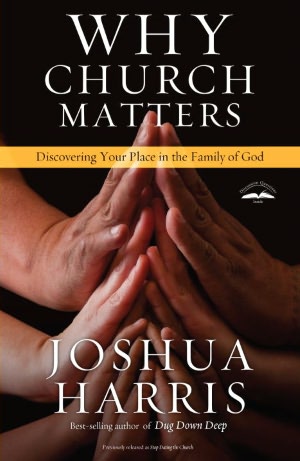 Joshua Harris’ new book is entitled “Why Church Matters; Discovering Your Place in the Family of God” and is a re-print of his 2004 work “Stop Dating the Church”. “Why Church Matters” takes on the subject of the importance of and the need for commitment to the local church on behalf of each Christ-follower. As a pastor, I can appreciate the passion and enthusiasm for the local church with which Harris writes. He begins by stating that belonging to a local church does not save you. Instead, a person who has been saved by Christ should attach themselves to a local body of believers for encouragement, care, and service. Harris also writes that when a believer does not commit to a church, everyone is cheated. He says that “you cheat yourself, you cheat a church community, and you cheat your world.”
Two chapters stood out to me. In chapter three, Harris writes about the reasons why we need the church. He says on p.44, “This is why gathering to worship with other believers in a local church is so irreplaceable. It can’t be substituted with a great devotional time, a lively Bible study with friends, a meditative nature hike, or a live TV church service. When the church is together to worship and to hear God’s Word preached, nourishment and encouragement occur that can’t happen quite the same anywhere else. Our corporate worship edifies and strengthens us and glorifies God in ways nothing else can.” He also makes note of, in his opinion, three reasons why people stay away from church. He cites Self-Centeredness (what’s in it for me?), Prideful Independence (I can grow as a believer on my own), and a Critical Spirit (the church is broken). I believe chapter 5 is the most meaningful and beneficial chapter of the entire 120 page book. Entitled “Choosing Your Church”, Harris of ten important questions to consider before joining a church. Several include “Is this a church where God’s Word is faithfully taught?”, “Is this a church committed to reaching non-Christians with the gospel?”, and “Is this a church where members are challenged to serve?” These questions possess great potential. I believe them to be a great framework by which one can make a informed and meaningful decision about a church home. These are the questions I hope a potential member would ask before joining the church I pastor.
” Why Church Matters” is a good book. It is light, engaging, smartly-written, easy to read, and scriptural. If you are looking for an in-depth study of ecclesiology, go somewhere else. The only negative for me is that I would like to have seen certain areas and topics further expanded. Included is a study guide covering each chapter which lends this book to be a great small-group resource. This would be a great book for the church-skeptic or the believer who has been hurt by the church and may be considering giving up on the body of Christ.
Disclosure of Material Connection: I received this book free from Waterbrook Multnomah Publishers as part of their Blogger Review Program. I was not required to write a positive review. The opinions I have expressed are my own. I am disclosing this in accordance with the Federal Trade Commission’s 16 CFR, Part 255: “Guides Concerning the Use of Endorsements and Testimonials in Advertising.”
 The Road Less Traveled