FIFS : Nehemiah 1:1-4

1. The words of Nehemiah the son of Hachaliah. It came to pass in the month of Chislev, in the twentieth year, as I was in Shushan the citadel, 2. that Hanani one of my brethren came with men from Judah; and I asked them concerning the Jews who had escaped, who had survived the captivity, and concerning Jerusalem. 3 And they said to me, “The survivors who are left from the captivity in the province are there in great distress and reproach. The wall of Jerusalem is also broken down, and its gates are burned with fire.” 4. So it was, when I heard these words, that I sat down and wept, and mourned for many days; I was fasting and praying before the God of heaven.

The book of Nehemiah opens with the presence of distress and heartbreak. The Jews who had returned from captivity to Jerusalem were distressed by the lack of security in Jerusalem and the ridicule from the surrounding people. Nehemiah was heartbroken by the conditions his countrymen were living under. For the walls of a city to be destroyed meant several things. First, the city was no longer secure. City walls served as the first line of defense from outside attack. Second, the self-worth of the people was at stake. With a city’s walls destroyed, the city was open to ridicule from those on the outside. Third, as was in the case of Jerusalem, the broken down walls spoke to the spiritual condition of God’s people. They were broken. They had returned from captivity, but not the entire nation. They were in desperate need of renewal and revival. Kings constructed elaborate and magnificent walls around their cities to reflect the power and status of their nation. Jerusalem was God’s city. God’s people lived there. The worship of God happened there and was the light of a nation set-apart by God Himself. The news broke the heart of Nehemiah. The news of the people’s distress and the reproach upon God drove Nehemiah to prayer.

Are our hearts broken as easily? Does the suffering and distress of God’s people drive us to a place of prayer? Are we offended by what offends God? Does it bother us as God’s to see the walls of morality and decency broken down around us? Do we pray more earnestly because of this? Is it possible that we have been so desensitized by the god of this world to the things that offend God that we just excuse them away as simply “the way the world is today”? I would hope not.

Nehemiah’s love for God and God’s people moved him to action for both. On into chapter two we see Nehemiah beginning the rebuild of Jerusalem. I believe today, more than ever, God is seeking wall builders. He is seeking those who will seek His face and fame and take an active part in removing the reproach heaped upon God by a world that does know or care about Him. It is not enough for God’s people to simply look around and be grieved by what we see. That is simply the beginning point. This grief should serve as a catalyst for action.

Leadership Lesson from Nehemiah : An Introduction

Leadership is a “buzz” word today. We hear a great deal about its importance and necessity. Books have been written on the subject. Conferences are regularly offered on the principles of leadership and how to become a better leader. Most everyone has their own ideas of what makes a good leader. Most everyone has their own idea of what makes a bad leader. Perhaps through your own personal experiences you have worked alongside effective and ineffective leadership.

I believe John Maxwell, author of ‘The 21 Indispensable Qualities of a Leader’, said it best and right when he said, ‘Everything rises and falls on leadership’. Manuals on leadership abound, both secular and spiritual. Henry Blackaby has written a must-read leadership book entitled ‘Spiritual Leadership’ that describes the process of spiritual leaders moving people to God’s agenda. Perhaps the best leadership manual I have found was not written by any best-selling author. It was not written by a leadership-model company looking to make a profit. Instead, it was written by God Himself. The manual I speak of is the Old Testament book of Nehemiah.

In recent study connected to a lesson I was preparing from this book, I come across a simple list of leadership principles from Nehemiah chapter two discovered by Donald Campbell, author and theologian. Over this series of posts, I want to take what I feel are the ten most important principles that Campbell discovered and develop them further to discover how God works through those whom He elevates to leadership roles, both inside and outside the church. Hope you enjoy.

Book Review : Running for My Life: One Lost Boy’s Journey from the Killing Fields of Sudan to the Olympic Games

Running for My Life: One Lost Boy’s Journey from the Killing Fields of Sudan to the Olympic Games is the autobiography of Lopez Lomong. At the age of six, Lopez was part of a large group of children kidnapped by the Sudanese militia in 1991. These children were trained and forced to become soldiers in the Sudanese militia. Lopez, and many like him, are often referred to as the “Lost Boys of Sudan”. Lopez goes on to tell the story of life under the control of the Sudanese rebels. He describes the deplorable sleeping, eating, and sanitary conditions, as well as the state of constant fear all the boys felt. As the months went on, we was befriended by three older boys who were from the same region as he was. Lopez referred to these boys as his “angels”. These three older boys helped Lopez escape the rebel camp. After days of running, they crossed the border into Kenya and were picked up by border control agents and sent to a United Nations refugee camp where he lived as an orphan (by choice) for the next ten years.

Lopez writes in detail about his life inside the refugee camp. He described the rationing of food, standing in line for water, the need to hide food from the gangs that were always looking to steal, and playing soccer to pass the time. Lope was also a runner. He ran around the camp every day. The faster you could run around the camp, the more time you had on the soccer field. In 2000, Lopez and a few other boys managed o sneak out of camp one night to the home of a farmer near the refugee camp. He would let them watch his black and white television that was powered  by a car battery. Each boy paid their money. (This farmer is the man Lopez was working for, illegally,). That night, Lopez watched Michael Johnson run the 400m dash in the Olympics. Lopez’s dream to one day run in the Olympics himself was forever solidified.

One day in camp, a UN worker shared that there were spots available for a certain number of boys to go to America. Lopez shows how, through God’s intervention, he was able to leave the refugee camp, find his way to America, and be adopted by an American family. Lopez enrolls in high school, joins the cross-country team, and goes off to college. His views and insights into the immigration process and the 9/11 tragedy are both humorous and moving. Lopez eventually made it to the 2008 Beijing Olympics can competed in the 1500m, although he did not medal.

Lopez says that he now “runs with a purpose”, He has used his influence and resources to help make a difference back in his home of Sudan, Partnering with World Vision, he established a foundation to help bring clean water, food, medicine, and education to his people back in Sudan. Lopez will be competing in the 5000m in the 2012 London Olympics going on now. I look forward to cheering him on to a win. Running For My Life is an outstanding and inspiring work. This review does not do the book adequate justice. It is full of humor, emotion, sadness, hope, and surprise. You will be moved by his story. An addictive read.

Disclosure of Material Connection: I received this book free from Thomas Nelson Publishers as part of their Blogger Review Program. I was not required to write a positive review. The opinions I have expressed are my own. I am disclosing this in accordance with the Federal Trade Commission’s 16 CFR, Part 255: “Guides Concerning the Use of Endorsements and Testimonials in Advertising.”


Book Review : Coming Apart

In his latest book, Coming Apart; The State of White America 1960-2010, Charles Murray has written a book that paints a picture of a segment of America that is not often covered by the mainstream media. Murray’s thesis is that there is a widening class gap in the United States today. This class gap is the result of a reoccurring race war. In fact, it is not based on different skin colors at all. This class gap is occurring within what Murray calls “White America”. Through an overabundance of statistical data that is interesting at best and burdensome at worst, Murray shows how these two worlds exist at the same time, yet rarely cross paths.

 In order to prove his point about this ever-widening gap across White America, he introduces the reader to two fictional cities; Belmont and Fishtown. Belmont represents a city of the upper class (defined by Murray as that having a population in the top 5% in both wealth and education). Belmont is marked by the high income family, the college educated, and the culturally affluent. Fishtown, on the other hand, represents the lower class of White America, everything that Belmont is not. Fishtown is marked by the absence of culture, the high school dropout, and the blue-collar worker.

The better part of the book is spent exploring the four areas that Murray believes are the causes for the widening gap in White America: marriage, industriousness, honesty, and religion. Murray does a good job demonstrating how the breakdown in and the inattention to these four areas lead to the gap being widened. I must say that this book is not an easy read. On the contrary, it is laborious at times. It is written in a very scholarly manner and format that reminds me of a textbook for a college socioeconomics class. All in all, a good book about a topic that I was not fully aware of.

Disclosure of Material Connection: I received this book free from Waterbrook Multnomah Publishers as part of their Blogger Review Program. I was not required to write a positive review. The opinions I have expressed are my own. I am disclosing this in accordance with the Federal Trade Commission’s 16 CFR, Part 255: “Guides Concerning the Use of Endorsements and Testimonials in Advertising.”

Book Review : Implosion : Can America Recover From Its Economic and Spiritual Challenges in Time?

“The United States stands as the wealthiest, most powerful nation on the face of the earth. But now, in the midst of unprecedented and skyrocketing federal debt, severe economic troubles, political uncertainty, declining morality, a weak church, growing spiritual apathy and apostasy, historic disasters, and myriad of other daunting challenges, many wonder of America’s best days are behind her” are the words of best-selling author and political expert Joel Rosenberg in his latest book Implosion; Can America Recover From Its Economic and Spiritual Challenges in Time? Rosenberg gives an honest, eye-opening, and sobering assessment of the challenges and dangers facing our country today. Rosenberg gives four possible scenarios that he believes “could make America unable or unwilling to play a key role in the unfolding prophetic events of the last days.” Although these scenarios are only speculative, they are well supported by facts, statistics, and current events.

Scenario #1: Economic Implosion – The United States implodes financially and economically.

Scenario #2: War on Terrorism – The United States is devastated by a surprise military or terrorist attack or series of attacks.

Scenario #3: Natural Disasters – The United States is devastated by an unprecedented series of natural disasters.

Scenario #4: The Rapture – The United States suddenly loses millions, or tens of millions, of people when the Rapture happens, leaving the rest of the American people devastated and triggering any number of cataclysmic events.

Rosenberg offers a fifth scenario, one that is far more optimistic. This scenario is one of a Third Spiritual Awakening. He devotes an entire chapter to the people, events, and results of the First Great Awakening and an entire chapter to the people, events, and results of the Second Great Awakening. Rosenberg believes these two spiritual movements in the history of the United States gives hope for another movement of God across our country, despite the perceived lack of hope and vision that abounds.

Implosion is an excellent book. It has something for everyone. It is not a book on partisan politics and does not set out to blame the federal government solely for the ills of this country. It is not another “the sky is falling” doomsday project. Instead, Rosenberg lays out before the reader the current state of affairs in America. Rosenberg encourages the reader to incorporate a biblical worldview, a “third lens” as he calls it, when looking at the challenges we face. It is well written and researched, fair and balanced. An outstanding work that I highly recommend.

Disclosure of Material Connection: I received this book free from Tyndale House Publishers as part of their Blogger Review Program. I was not required to write a positive review. The opinions I have expressed are my own. I am disclosing this in accordance with the Federal Trade Commission’s 16 CFR, Part 255: “Guides Concerning the Use of Endorsements and Testimonials in Advertising.”

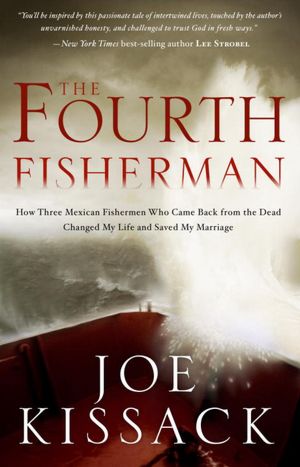
Book Review : The Fourth Fisherman

 The Fourth Fisherman; How Three Fishermen Who Came Back from the Dead Changed My Life and Saved My Marriage by Joe Kissack is a book of two stories. First, it is the story of Kissack, a former Hollywood insider who enjoyed the good life; money, fame, homes, status, who, through constant pressure and stress to “keep up”, fell victim to alcohol and drug abuse. His life began to spiral out of control and eventually found himself in a rehab facility. Kissack turned his life around through faith in God. Next, it is the story of five fishermen who set out on a routine fishing trip from their home town of San Blas, Mexico. Their story made international headlines in 2006 when three of the five survived a nine month ordeal at sea when their small fishing boat ran out of gas and they began to drift. They were rescued over 5000 miles away from where they began, surviving off of rain water, raw fish, and sea turtles.

The Fourth Fisherman is written is parallel form. Each chapter alternates between the fishermen’s story and Kissack’s story; while at the same time dealing with the same life issue. This format goes along for about half the book. Upon hearing of the fishermen’s rescue, he feels a kindred spirit with them, citing his recent “rescue” by God. Kissack puts his entire life on hold, dives into his life savings, and heads to Mexico in order to meet these fishermen and hopefully, in film, tell their story of faith in God that sustained that them for nine months.

The Fourth Fisherman moves at a quick pace and is well written. It is an easy read and not a deep treatment of the subject of faith. To be honest and truthful, faith is used in general terms. There is no mention of the gospel and the forgiveness of sin. Only faith. The only statement in the book from Kissack that even comes close to a conversion statement is “I think…God has just come into my life” and “I think I was visited by God last night.” For a book that is centered around the concept of faith and trusting God, I just wish Kissack had pointed his readers to Christ, whose death on the cross makes a relationship God possible. At the end of the day, a feel-good book.

Disclosure of Material Connection: I received this book free from Waterbrook Multnomah Publishers as part of their Blogger Review Program. I was not required to write a positive review. The opinions I have expressed are my own. I am disclosing this in accordance with the Federal Trade Commission’s 16 CFR, Part 255: “Guides Concerning the Use of Endorsements and Testimonials in Advertising.”

Book Review : The Searchers

In “The Searchers: A Quest for Faith in the Valley of Doubt” professor and historian Joseph Loconte takes his readers back in time and joins the two travelers on their journey down the ancient road to Emmaus. Using the crucifixion of Christ as the backdrop of his story, Loconte chronicles for us, by expounding the passage of Luke 24, the search these two friends are now engaged in. A search for meaning. A search for purpose. A search for understanding after their lives were shattered seeing their Savior crucified just days earlier.

Loconte shows how the journey and search of these two friends parallels our own journey and search in life. What Loconte reveals to us in that the doubts and fears of these two friends are our doubts and fears. We will all have circumstances and events that shake our foundations and challenge our beliefs. In the same way Jesus guided these two men with the facts that He was Israel’s promised Messiah, the Father’s plan for redemption through Calvary’s cross, and that He would rise again, Loconte also serves as a guide. Using elements such as philosophy, science, history, poetry, pop culture, and religion, Loconte brilliantly weaves together their journey and ours. For example, in Chapter Four, entitled “End of Illusions”, in order to draw the parallel from ancient Jerusalem to today, Loconte included references to Sigmund Freud, Robert Browning, The Bourne Identity, Cold War Communism, The Ottoman Empire, Old Testament Prophecy, Johnny Cash, and Clement Attlee.

The Searchers is a thought-provoking work. It is packed full of facts and historical information. This book is 205 pages long and is not an easy read. Although the book wrapped around the twenty-three verses of Luke 24, the supporting information will take some time to digest. I recommend this book to all who may be struggling with doubt. There is great insight to be found here. A great tool for all believers.

Disclosure of Material Connection: I received this book free from Thomas Nelson Publishers as part of their Blogger Review Program. I was not required to write a positive review. The opinions I have expressed are my own. I am disclosing this in accordance with the Federal Trade Commission’s 16 CFR, Part 255: “Guides Concerning the Use of Endorsements and Testimonials in Advertising.”

A Must See Message

Back in January I was able to attend the Pastors Conference at First Baptist Church in Jacksonville, Florida. The theme for 2012 was “God in the Life of the Pastor”. This is a conference that I look forward to each year. The quality and calibre of the speakers enlisted is top-shelf. It has been my experience that the some of the most gifted and passionate pastors, seminary presidents, seminary professors, church planters, missionaries, convention presidents, mission board presidents, and evangelists have shared the stage in order to encourage hurting and discouraged pastors and layman who have made their way to FBC Jacksonville to be encouraged, motivated, loved on, and cared for. I know this for a fact. I have been one of those pastors who has limped into this conference just needing to be preached to. This year was no different. I have heard some great sermons at this conference. Adrian Rogers, Junior Hill, Bailey Smith, Jerry Vines, Mac Brunson, Johnny Hunt, Paige Patterson are just a few of the men who have blessed my heart tremendously. This year, I believe I heard one of, if not, the best message I have ever heard. Dr. David Allen, Dean of the School of Theology at Southwestern Baptist Theological Seminary delivered a message entitled “The Pastor and His Preaching”. As I sat and listened, I was amazed, encouraged, challenged, thankful, and hopeful. Below is Dr. Allen’s message from that day. I pray you enjoy it as much as I did. Thank you Dr. Allen and Dr. Brunson.

FIFS : Matthew 8:23-24

23. Then he got into the boat and his disciples followed him.  24. Without warning, a furious storm came up on the lake, so that the waves swept over the boat. But Jesus was sleeping.

Familiarity breeds  contempt, some say. I have said before there is a danger in assuming that because you have heard a scripture passage expounded many times you find anything new in it. These verses are part of a very familiar passage. It is a powerful story of fear and concern on the part of the disciples and the care of Christ for his disciples. I have taught through this passage and  used in for the basis of a sermon, more than once.

A Christian’s life is not free of fear or difficulty. Fear is public enemy number one for the believer. Max Lucado writes,

“Fear corrodes our confidence in God’s goodness. We begin to wonder if love lives in heaven. If God can sleep in our storms, if his eyes stay shut when our eyes grow wide, if he permits storms after we get on his boat, does he care? Fear unleashes a swarm of doubts, anger-stirring doubts.”

We are never promised a life of ease just because Jesus saves us. If we could write it, our lives would be pain-free, stress-free, worry-free, and care-free. If this were true, then how would our faith in God be stretched? How then would we benefit from the promises that our God has made? What would grow us to a deeper level of trust? The reality is that Christians struggle. The reality is that Christians face persecution and distress. The reality is that Christians suffer sickness, experience financial difficulty, lose loved ones, and deal with heart-wrenching family problems.

The disciples were experiencing the same thoughts and emotions that flood our minds. The disciples got into the boat with Christ and then a great storm came upon them. Again, Lucado writes, “getting on board with Christ can mean getting soaked with Christ.” The difference for the Christian in this world is a rock, a promise, a person.  The difference for the one who has given their life to Christ is that while the storm may blow, batter, and bruise, we won’t be moved. We possess a stabilizing force in our lives that not everyone enjoys. Getting soaked with Christ means that He may not take away our storm, instead He will cover us with peace, provision, and power in order to grow us through the storm.

Worth Repeating

“God’s Word calls Satan “the god of this age”. He leverages a tremendous asset when he is on his home court. However, he is much too cunning to depend solely on closed countries, undiscovered people groups, the persecution of believers, and cultures hostile to the gospel. He employs other strategies to deter the advancement of God’s kingdom inside the Christian community to hinder believers and churches from ever deploying to vast pockets of lostness around the world.

In trying to convince Christians that missions is optional, he diverts churches to focus on their own programs and to see their mission as reaching people for their own church. If he can persuade Christians that reaching the nations has no relevancy or urgency to their own life, he has raised a barrier that makes other barriers obsolete. Who, then, will be willing to leave their own comfort and security to take the gospel and declare God’s salvation to the peoples of the world?”

Ed Stetzer, from “Spiritual Warfare and Missions; The Battle For God’s Glory Among the Nations”