FIFS : 2 Corinthians 5:14-15

14. For the love of Christ compels us, because we judge thus: that if One died for all, then all died; 15.and He died for all, that those who live should live no longer for themselves, but for Him who died for them and rose again.

Have you ever stopped to think about what drives you to do the things you do? Have you ever really took a good hard look at the reasons for which you do all that you do? What is motivating you right now to do the things you do? The need for shelter motivates and drives us to find a home to live in. The need for an income motivates and drives us to find a job. The need for higher education or an advanced degree motivates and drives us to spend extra years in school beyond the normal. The need for a healthier body motivates and drives us to exercise and diet. Some motivating force drives us to do all that we do, whether good or bad.

In Paul’s letter to the Corinthians, he talks about motivation. Paul was a driven and focused man. He tells us the reason for his drive and what motivated him. He said, “For the love of Christ compels us”. It was for the love of Christ that he kept preaching when no one seemed to be listening. It was for the love of Christ that he pushed forward after being beaten and run out of town. It was also for the love of Christ that while in prison awaiting his own death that the churches were on his mind. Paul’s motivation looks the same in the life of the believer today. The love of Christ compels the believer to tell others of a life-changing Savior. The love of Christ compels us to grant and extend forgiveness when the rest of the world simply says “get even”. The love of Christ compels us to love our fellow man beyond we see on the outside. The love of Christ also compels us to reach into the darkness of the nations and shine the light of the gospel. This love of Christ looked beyond us while we were lost, rebellious, and indifferent towards God. Jesus demonstrated what true love looks like.

Paul said, “and He died for all, that those who lives should live no longer for themselves, but for Him who died for them and rose again.”. Paul makes the assertion that there has been a change in his motivation. At one time Paul was motivated by pride, hate, and religious tradition. He was living for himself. However, when the love of Christ spilled onto his life and it became personal, he quit living for himself. We were no different. At one time we lived for ourselves and did everything that we thought was right and good. The day Jesus stepped into our lives, we were under new management. Our motivating and driving force that compels, urges, prompts, and pushes us to love, witness, preach, teach, and care is the sacrificial death of Jesus Christ.

Worth Repeating : D. Martyn Lloyd-Jones

“God is not a subject for debate, because He is Who He is and What He is. We are told that the unbeliever, of course, does not agree with that; and that is perfectly true; but that makes no difference. We believe it, and it is part of our very case to assert it. Holding the view that we do, believing what we do about our God, we cannot in any circumstances allow Him to become a subject for discussion or of debate or investigation. I base my argument at this point on the word addressed by God Himself to Moses at the burning bush (Ex. 3:1-6). Moses had suddenly seen this remarkable phenomenon of the burning bush, and was proposing to turn aside and to examine this astonishing phenomenon. But, immediately, he is rebuked by the voice which came to him saying, ‘Draw not nigh hither: put off thy shoes from off thy feet, for the place whereon thy standest is holy ground.’ That seems to me to be the governing principle in this while matter. Our attitude is more important than anything that we do in detail, and as we are reminded in the Epistle to the Hebrews, God is always to approached ‘with reverence and with godly fear: for our God is a consuming fire’ (Heb. 12:28 and 29).

To me this is a very vital matter. To discuss the being of God in a casual manner, lounging in an armchair, smoking a pipe or cigarette or a cigar, is to me something that we should never allow, because God, as I say, is not a kind of philosophic X or a concept. We believe in the almighty, the glorious, the living God; and whatever may be true of others we must never put ourselves, or allow ourselves to be put, into a position in which we are debating about God as if He were but a philosophical proposition.”

D. Martyn Lloyd-Jones from Preaching and Preachers, quoted by Jared C. Wilson in The Pastor’s Justification

Missional Monday : Go Fish Clothing and Jewelry

gofishlogoMy family and I vacationed at St. Simons Island, GA last week. While walking around the pier area, we come across as a little store called Go Fish® Clothing and Jewelry. I was intrigued by the name so I went in to take a look around. I was immediately struck by the contemporary “Christian” music that was being played overhead. As I walked around I noticed there were many different kinds of handmade items from artisans from all corners of the globe. These items ranged from hand-crafted wooden animals, blown glass figurines, hand-made clothing, and all kinds of jewelry. Alongside each display was a portrait of the family that had made the product and a description of where they lived. Go Fish® purchases their items that are sold in stores from indigenous peoples of developing nations. Prices paid for the items are never debated and their goods are bought at their asking price. Galatians 6:10 is the company’s motivating verse. The intent of Go Fish® is to give these indigenous people the dignity and respect of they deserve by highlighting their creativity and skill while providing a sustainable livelihood for the individual family. I found it refreshing that in the midst of shops that were selling everything from surfboards to swimsuits, there was a company being a missionary in the place they were planted. You can read more about Go Fish® and their work here.

FIFS : 8.9.2013

The Lord of Hosts has sworn: As I have planned, so it will be; as I have purposed it, so it will happen.” Isaiah 14:24

There is a tremendous amount that I don’t understand. I don’t understand why some people get sick and others do not. I don’t understand why some who are sick are healed, and others are not. I don’t understand how someone can observe creation and at least not consider there is a Creator. I don’t fully understand why bad things happen to good people and that evil always seem to prosper. I don’t understand how God purposed and planned for my life long before I was born.

It is at times when I lack understanding that I am pushed into a deeper trust of God’s sovereignty. I trust His absolute reign and rule over my life and the events of this world. Isaiah wrote that the very plans that God has made and sure and He will bring to pass that which He desires. It is humbling to think that we can have a place and a part in God’s history (for history really is His story). Henry Blackaby wrote, ‘When God chooses a person for His purpose, all of eternity will be shaped by His decision.’  In the times that I don’t fully understand God’s healing, or why evil seems to prosper, I have come to understand one thing. It’s not what I don’t know that matters, it is who I know that matters.

Worth Repeating : James Dennison

“The scene is one of the most breathtaking in all of Scripture. An itinerant Galilean carpenter stands surrounded by twelve very ordinary men. At the moment, the leaders of nations are plotting to destroy him as a dangerous heretic. He stands in an area which illustrates the conflict and power of religions more than any other place in the world – Caesarea-Philippi, north of Galilee.

At least fourteen temples to Baal lay scattered about the area, reminders of Canaanite paganism. Nearby is a deep cavern where the Greeks said their god, Pan, was born. The entire region is symbolic of Greek mythology. Adjacent stands the great temple of white marble built to the deity of Caesar by Herod the Great, emblematic of Roman emperor worship. And the Jews believed that their sacred Jordan River originated from beneath this very mountain. Behind Jesus stands a gigantic rock formation, with a cave which is deeper than we are able to measure to this day. It was called the “gates of Hades,” and was widely believed to be the doorway to the underworld.

It was and is an intimidating place. I’ve stood at this spot, and I remember it well. But here Jesus uttered words which astounded his followers: ‘On this rock I will build my church, and the gates of Hades shall not prevail against it’ (Matthew 16:18). Hades would not attack the church – this small band of men would attack Hades. And neither Hades, the pagan religions, nor the power of the Roman and Jewish rulers would prevail. Jesus’ church would assault the very gates of hell with the gospel – and win. The church was Jesus’ strategy for reaching a lost world.

And this strategy worked, amid some of the greatest ecotones in history. As Jewish and Gentile cultures clashed, the gospel thrived (Acts 10-11). As East met West, the church grew and prospered (Acts 16). When the gospel came to Rome itself, it took root and flowered (Acts 28). As the Roman Empire crumbled and fell, the church mushroomed in power. The strategy worked.

Across the centuries of ecotonic clashes, the church has remained Jesus’ answer to world evangelization. In a millennium of Dark Ages the gospel spread, and the church grew. In the midst of Enlightenment attacks it experienced Great Awakenings. The Industrial Age saw the greatest missionary expansion to point in history.

And our century, with two world wars and the greatest rate of change in human history, has witnessed unprecedented growth in Christian missions. According to church growth expert George Otis Jr, about 70 percent of all progress toward evangelizing the world has taken place since 1900. Seventy percent of that growth has occurred since World War II.

Now, in another ecotonic time, the church is still Jesus’ strategy for world evangelization. Change is nothing new. Only Jesus Christ is the same yesterday, today, and forever (Hebrews 13:8). He still intends to reach the world through his church.”

James Dennison, from Missiology; An Introduction to the Foundations, History, and Strategies of World Missions. 1998

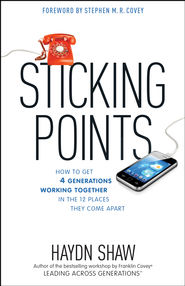
Book Review : Sticking Points

stickAs a pastor, I encounter the challenges of leading and ministering to multiple generations on a daily basis. Each one has their own preferences. Each one has their own experiences that have shaped how they think and react. I am learning more and more every day that a “one size fits all” approach to leadership is counter-productive and frustrating to everyone involved in the leadership circle. I have asked questions much like these (to myself) many times. “Why can’t everyone look at this the same way?” “Where did that response come from?” “How can we get hung up on something a small as this?” I believe I have finally found an answer. In “Sticking Points; How to Get Four Generations Working Together in the Twelve Places They Come Apart:, author and conference speaker Haydn Shaw casts a very bright and much needed light on the reasons why multiple generations do instinctively sync when it comes to decision-making, values, and priorities.

Shaw calls this friction “sticking points”. These points are areas of life and work that are most likely to cause conflict and disagreement between generations. Shaw begins by identifying the four age groups (generations) most commonly identified by researchers. These four groups become the comparison/contrast throughout the rest of the book. He begins with the Traditionalists (those born before 1945). This generation is marked by the Great Depression, World War II, and the move from the farm to the city. Shaw then moves to the Baby Boomers (those born between 1946 and 1964). This generation is marked by an incredible post-World War II birth rate, the influence of television as a unifying influence, and a spirit of optimism. The third group is Generation X (those born between 1965 and 1980). I fall in the exact center of this generation. This generation is marked by high divorce rate, the introduction of the term “latchkey” kids, high recession rates, and skepticism as seen in a lack of faith in institutions (government, corporation, religion). Finally, Shaw highlights Millennials (those born between 1981-2001). Millennials are marked by over-protective parents, the technology boom, 9/11, and have grown up with metal detectors, airport security, terrorism, and a sense of immediate gratification.

Chapter four though seven are invaluable in understanding what makes each generation think and react the way they do. Shaw refers to these observations as “ghost stories”, meaning the influences and events that have pre-conditioned their outlook on life today. These chapters alone would be worth the price of the book itself. Shaw moves on to detail the twelve sticking points most commonly experienced. The points are: communication, decision making, dress code, feedback, fun at work, knowledge transfer, loyalty, meetings, policies, respect, training, and work ethic. Shaw dedicates an entire chapter to each sticking point. Each chapter as well has a five-step plan for dealing with each point. These five steps for leading through generational differences are: acknowledge (talk about the differences), appreciate (focus on the why and not the what), flex (agree as to how to accommodate), leverage (maximize the strength of each generation), and resolve (deciding which option is best when flexing isn’t enough).

Shaw has written an excellent book. Sticking Points is a book that I needed at this point in my life. I have seen the generational breakdown that Shaw highlights. I have never seen it explained in such a simple, informational, and precise way. Although business leaders will benefit greatly from this book, parents will as well. One of the things that infuriates me most is that my sixteen year old son can’t seem to put down his phone for more than ten seconds. This book helped me understand that he, as a Millennial, utilizes technology to maintain contact with his “tribe” of friends whose plans are extremely fluid. I get it. I rarely label a book as “must read”. However, this is no doubt one of those. Whether you are a CEO, teacher, pastor, or community leader, Sticking Points will prove to be worth your time and energy. It is a book that will read several times. A five-star book.

Disclosure of Material Connection: I received this book free from Tyndale House Publishers as part of their Blogger Review Program. I was not required to write a positive review. The opinions I have expressed are my own. I am disclosing this in accordance with the Federal Trade Commission’s 16 CFR, Part 255: “Guides Concerning the Use of Endorsements and Testimonials in Advertising.”

Missional Monday : What Others Are Saying

The purpose of Missional Monday is to raise awareness for and to encourage conversation (whether here or elsewhere) around the need for Christ followers and churches to be missionaries where they are. I have my own thoughts about the subject but there are other voices speaking more loudly that you should listen to. Periodically, I will connect the readers here to others who are speaking on this subject. Enjoy.

Read:  I recommend Ed Stetzer and David Putnam’s book, “Breaking the Missional Code; Your Church Can Become a Missionary in Your Community”. They have put together a great resource for understanding how to mine out the uniqueness of your community.

Follow:  Micah Fries. Micah is VP of Lifeway Research. He is a former pastor and church planter. Micah is a strong and passionate voice for living missionally. I read behind him on a regular basis. You can find him here.

Know:  Blood:Water Mission – A grassroots organization that empowers communities to work together against the HIV/AIDS and water crises in Africa. You can find more about their work here.

Summer Vacation

It is finally here. The week I have been waiting for. Vacation. No meetings. No schedule. Although I will be away for the next week, there will still be some activity here at The Road Less Traveled. Make sure to check back here throughout the week for quotes and devotional thoughts related to ministry, the church, and God’s decisions. Hope you enjoy.

FIFS : 8.2.2013

“And there he went into a cave, and spent the night in that place; and behold, the word of the LORD came to him, and He said to him, “What are you doing here, Elijah?” 1 Kings 19:9

I enjoy the probing questions that are found throughout the Bible. Jesus asked Peter, “Do you love me?” Saul, on his way to Damascus was asked by Jesus, “Why are you persecuting Me?” In 1 Kings 19:9, we find another such question. After Elijah’s victory over Baal on Mt. Carmel, he finds himself on the run from Ahab’s wife, hold up in a cave. It is during this cave experience that God asked Elijah a powerful question: “What are you doing here Elijah?”

First of all, God knew why Elijah was in that cave and what brought him there. The question was not so much for information as it was intended to stir up something inside of Elijah. It was as if God was asking, “How did you get from the place where you were confident, fearless, and willing to defend my name, to hiding out in a cave, fearful of the king’s wife and feeling like you are all alone?” What happened?

I believe at times God asks the same question to us. As I mentioned, Elijah had a cave experience. We have them too. Elijah lost his focus. So do we. God wants to know from us how we can go from the high places of trust to the low places of doubt and fear when He is unchanging. If God asks you today, “What are you doing here?” What are you going to say?

Worth Repeating : Robert Webber

“The calling of the church in every culture is to be mission.  That is, the work of the church is not to be an agent or servant of the culture.  The churches’ business is not to maintain freedom or to promote wealth or to help a political party or to serve as the moral guide to culture.  The church’s mission is to be the presence of the kingdom. . . .  The church’s mission is to show the world what it looks like when a community of people live under the reign of God

Robert Webber, The Younger Evangelicals, 2002