A few weeks ago, Terri and I were shopping along the waterfront area of downtown Beaufort. While walking along Bay Street, we happened across as a little storefront, Go Fish® Clothing and Jewelry. The name captured my attention and we went inside. We noticed there were many kinds of handmade items from artisans all around world, including hand-crafted wooden animals, blown glass figurines, hand-made clothing, and all types of jewelry. Alongside each display was a portrait of the family who had made the product, as well as a description of the country in which the family lives. Go Fish® purchases the items that are sold in stores from the indigenous peoples of developing nations. The prices that are paid for the items are never argued. Merchandise is bought at the family’s asking price. The mission of Go Fish® is to give the indigenous people dignity and respect by highlighting their creativity and skill, while providing a sustainable livelihood for the family. I found it refreshing that amid stores selling everything from swimsuits to real estate, a company living out its missional calling exists. You can read more about Go Fish® and their work here.
Uncategorized
Sleeping Through Christmas
Today is Christmas. Much will happen today. Children will open gifts from under the tree that have taunted them for weeks. Families will gather today with those they have not seen in a very long time. Many will gather in houses of worship to celebrate the reason for the season. For the most part, the thoughts and focus of today will be on cultural traditions and not on the true meaning of why there is Christmas in the first place. We would not be the first ones to miss out on the reason for Christmas. In the Casting Crowns song, “While You Were Sleeping”, they write:
Oh little town of Bethlehem
Looks like another silent night
Above your deep and dreamless sleep
A giant star lights up the sky
And while you’re lying in the dark
There shines an everlasting light
For the King has left His throne
And is sleeping in a manger tonight
Oh Bethlehem, what you have missed while you were sleeping
For God became a man
And stepped into your world today
Oh Bethlehem, you will go down in history
As a city with no room for its King
While you were sleeping
While you were sleeping
Bethlehem was physically sleeping. While the residents of Bethlehem slept, the Son of God was born into the world among them. While the residents of Bethlehem slept, the Savior of the world was born in a lowly stable with no fan fare, no attention, and no honor due a King. While the residents of Bethlehem slept, the landscape of the known world, and those to come, changed forever. The residents of Bethlehem secured a place for themselves in history as “a city with no room for its King.” They go on to write:
Oh little town of Jerusalem
Looks like another silent night
The Father gave His only Son
The Way, the Truth, the Life had come
But there was no room for Him in the world He came to save
Jerusalem, what you have missed while you were sleeping
The Savior of the world is dying on your cross today
Jerusalem, you will go down in history
As a city with no room for its King
While you were sleeping
While you were sleeping
Jerusalem was spiritually sleeping. Thirty-plus years later, people were sleeping. This time, the residents of Jerusalem slept while the Son of God hung on a cross. The residents of Jerusalem slept while Jesus died for their sin. The residents of Jerusalem slept while the Messiah, the One the religious leaders were looking for and ought to have recognized, gave His life for the people who cried “Crucify Him.” He came as their writings and witnesses said He would. He had walked among them. He performed miracles. He taught. He loved. He testified of an for the Father. He yielded. He died. All for this while no one seemed to care. The residents of Jerusalem secured a place for themselves in history as “a city with no room for its King.”
Before we take the residents of Bethlehem and Jerusalem to task on their failure to understand the mission and person of Jesus Christ, notice again the words of Casting Crowns.
United States of America
Looks like another silent night
As we’re sung to sleep by philosophies
That save the trees and kill the children
And while we’re lying in the dark
There’s a shout heard ‘cross the eastern sky
For the Bridegroom has returned
And has carried His bride away in the night
America, what will we miss while we are sleeping
Will Jesus come again
And leave us slumbering where we lay
America, will we go down in history
As a nation with no room for its King
Will we be sleeping
Will we be sleeping
As a nation we are sleeping today. In the middle of the day, we’re sleeping. With the sun shining bright and eyes wide open, we’re sleeping. With the complete thoughts and mind God written for us that reveals our sin, points us to the cross, and calls us to die to self, we’re sleeping. Lullabies of tolerance, coexistence, and compromise rock a nation to sleep every night. Lullabies of “many paths to God”, “man is his own god”, and “feed what makes you feel good” enable a nation to peacefully sleep. Violence, hate, and greed are the most newsworthy items of our day. Most troubling is the fact that America seems to be sleeping well. What will it take to stir this nation from its sleep? What will happen to our nation if we continue to sleep? How long before God Himself says “that’s enough” and the Bridegroom splits the sky to receive His own? Will the residents America secure for themselves a place in history as “a city with no room for its King”?
Today is Christmas. We are reminded of the Luke’s words regarding this day. “Then the angel said to them, Do not be afraid, for behold, I bring you good tidings of great joy which will be to all people. For there is born to you this day in the city of David a Savior, who is Christ the Lord”.
Missional Monday : Summer Ministry
 No school. Longer days. Scorching heat. This can only mean one thing – Summer. For families, it is a time for vacations, cookouts, and road trips – good things. For families, it is also a time of bored children and interrupted schedules – bad things. The things that are good for the family during the summer are in turn bad for the church. As families travel, attendance decreases in scheduled worship times. As families spend more time together, less time is spent in church ministry. This poses a difficulty for churches. Does the church accept the fact that summer is going to be a time of little or no activity, or does it take advantage of the season? At Port Royal Baptist Church, we take advantage of the summer season. Summer is our most productive season of ministry because we place a high value on summer ministry. Here’s why.
- School is out. There is a natural tendency for families to scatter with preexisting schedules being set aside for three months. It is our desire to give families something meaningful they can do together.
- Historically, churches take one of two positions during the summer: scale down or shut down. It is our desire to shatter the expectation that the church will be less effective during the summer by offering meaningful service opportunities. Although summer is a time of declining attendance, it doesn’t have to be that way. Meaning summer ministry is our way of reversing the tide.
- The community is very active during the summer. People are moving about the beaches, farmer’s markets, and community festivals. It is our desire to be active alongside them. We believe in discovering where the community is meeting and joining them.
Two things are important in making summer ministry important at Port Royal Baptist Church.
- Summer Family Ministry Challenge. Instead of surrendering the summer, we challenge our families to serve together. Our theme for 2016 will be “The Summer 70” and will run from June 11th – August 20th. Over the course of 70 days, there will be 14 service opportunities in 7 different locations. These ministries are varied: daytime and evening, weekday, and weekend. These ministries involve different skills and abilities, demographics, and ministry approaches. We intentionally schedule opportunities that allows the entire family to participate.
- Summer Sermon Series. I do something as a pastor during the summer that goes against all conventional wisdom. I break the unwritten rule: do not start anything new during the summer. During the summer, I lead our church in a sermon series that lasts about 10 weeks. I do this because it serves a connection point for our people. I want them to feel as if they missed something by not being there. The feedback has been good.
You may ask, “Isn’t that a lot for people to feel they have to be involved in?” Good question. Our philosophy for missions and community outreach is simple. We don’t want you to be involved in everything. It’s not possible. We ask that each one find the ministry that meets their passion and then give their heart and energy to it.
2015 in review
The WordPress.com stats helper monkeys prepared a 2015 annual report for this blog.

Here’s an excerpt:
A New York City subway train holds 1,200 people. This blog was viewed about 4,600 times in 2015. If it were a NYC subway train, it would take about 4 trips to carry that many people.
Religious Liberty, Muslims, and Donald Trump
Disclaimer: The thoughts, beliefs, and conclusions drawn belong solely to the author and do not necessarily reflect the views of Port Royal Baptist Church.
Politics are not in my wheelhouse. I rarely venture into the political arena and make every attempt to not be drawn into public political debates. With that being said, my head is stuck in the sand either. I believe that part of my responsibility as a pastor is to educate my congregation on “how” they should vote based on God’s Word instead of telling them “who” to vote for. In my opinion, voting is one of the most genuine and sincere activities of the conscience. Our country is in the middle of another presidential election cycle. There are more candidates vying for the office of president than I have ever seen in my lifetime. One candidate has been, and continues to be, especially vocal and polarizing: Donald Trump. His “no holds barred, tell it like it is, truth speech” has galvanized many of his supporters while alienating many more. You either love him or hate him. He has no problem letting the media know where he stands on any given topic and does so very matter-of-factually. In itself that is not a bad thing.
Over the past month, our world has witnessed terror attacks in Beirut, France, and just this week, California. It has been concluded that these attacks were the acts of Islamic extremists or those with link to similar groups. Candidates have spoken against the attacks and have attempted to reassure the public that terrorism will be defeated and how they would go about doing that if elected. Donald Trump has been especially vocal on this subject stating that our country should go to great lengths to defeat terrorism. I could not agree more. Our agreement ends there.
In recent weeks Donald Trump has offered two startling and extreme measures to protect America from terrorism. First, he has called for a “total and complete shutdown of Muslims entering the United States until our country’s representatives can figure out what is going on.” Second, he said that he was “open to establishing a database for all Muslims living in the U.S.” On one hand, this may sound good to many Americans: don’t let them in and track the ones who are already here. He has mistakenly connected the dots by saying that, in essence, we were attacked by Muslims so all Muslims must be guilty. On the other hand, his statements and positions are at odds with the gospel and serve to further jeopardize religious liberty, an already endangered species.
Let me say this lest my theological convictions be called into question. I believe that Islam is a false religion. I believe that adherents to Islam are lost and headed toward an eternal separation from God unless Jesus saves them. They serve a god that cannot save them. They serve a god who offers them no hope at all. They serve a god that does not care for them personally. I believe the same thing applies to the adherents of Hinduism, Buddhism, Christian Science and any other religious system that denies the exclusivity and divinity of Jesus Christ. Within the Islamic/Middle Eastern economy, Islam (religion) and Muslims (people/nationality) are essentially the same thing. The gospel of Jesus Christ allows and admonishes me to see that there is a difference. It is through the gospel that I can see the truth that many Muslims (people/nationality) are trapped in Islam (religion). In the same way that every German (people/nationality) was not a Nazi (political party), and every American (people/nationality) is not a Baptist, Methodist, or Atheist (religion), every Muslim is not automatically an Islamic extremist or terrorist.
Let me say this lest my national allegiance be called into question. I’m proud to be an American. I served in our military and fought for this country as a Marine. I believe our government should make every legal and reasonable effort to protect its citizens from harm. That is the duty of government. I have no problem with refusing entry into this country any person (Muslim, Hindu, Christian, etc.) who has made credible threats to the safety of this nation or who has close ties with groups that want to harm this nation. A database to track Muslims within the United States, for no other reason than a person is Muslim, is no different than the Nazi’s numbering the Jews during World War II, for no other reason than a person being Jewish. It was an offensive proposition then and it is an equally offensive proposition today.
I believe there are at least two unintended consequences to the actions that Donald Trump advocates.
- The physical safety of our missionaries around the world, especially those in predominantly Muslim countries could be compromised. I didn’t expect Trump or his campaign to think through this possibility. Why would he? Is it worth risking physical harm to every American missionary who may be unfairly stereotyped by Trump’s comments?
- The bridges of trust that have been built over the decades between missionaries and the Muslim communities they serve and share the gospel among may come crashing down around them. I can’t imagine how difficult it is for our missionaries to work and labor in Muslim countries. The work is difficult enough without the Muslim communities being given a reason to doubt the sincerity and love of the missionaries who live among them. It is the gospel that runs along these bridges. It would be a tragedy to see the gospel be hindered because of something as ridiculous as an ill-informed blanket statement by a presidential candidate.
The denomination in which I choose to participate, the Southern Baptist Convention, has spoken to the issue of religious liberty in its statement of faith, The Baptist Faith and Message. The section reads in part, “A free church in a free state is the Christian ideal, and this implies the right of free and unhindered access to God on the part of all men, and the right to form and propagate opinions in the sphere of religion without interference by the civil power.” In its simplest terms, religious liberty says that you have the right to believe whatever you choose and to worship the same, even if I disagree with you. On the other hand, I have the same right. Government must be careful to not penalize law-abiding citizens, even law-abiding Muslim citizens for pursuing their religious convictions formed by their God-given conscience. The same protection we desire must be extended as well. If you truly value religious liberty, not just your own religious liberty, but religious liberty as a whole, then God’s Word must shape your decisions, not fear-induced rhetoric that sounds good in a sound bite.
I believe the term “prophetic” is overused today. With that being said, if the statement made earlier in the week by Dr. Russell Moore, President of the Ethics and Religious Liberties Commission of the Southern Baptist Convention, doesn’t speak in prophetic fashion to the slippery slope we’re on in terms of religious liberty, nothing does. He wrote:
“Make no mistake. A government that can shut down mosques simply because they are mosques can shut down Bible studies because they are Bible studies. A government that can close the borders to all Muslims simply on the basis of their religious belief can do the same thing for evangelical Christians. A government that issues ID badges for Muslims simply because they are Muslims can, in the fullness of time, demand the same for Christians because we are Christians. We are in a time of war, and we should respond as those in a time of war. But we must never lose in a time of war precious freedoms purchased through the blood of patriots in years past. We must have security and we must have order. But we must not trade soul freedom for an illusion of winning.”
Book Review : NKJV Foundation Study Bible
 It seems that almost daily there is a new study Bible on the market. Each one proposes to offer something special and significant that the others do not. At times, many fail to deliver on the promise of something fresh and new. The NKJV Foundation Study Bible is one of those new study Bibles that has been recently released. I really like the style of the NKJV. It is the version that I use in my pulpit ministry. It reads very well in the modern language but holds to the word structure and thought of the KJV. The NKJV Foundational Study Bible is not like other Bibles seeing that it does not attempt to give exhaustive study notes. It has a simple layout with cross-references and section titles that you would expect in a study Bible. I really enjoyed the size of this Bible. It measures approximately 8-3/4” tall, 5-3/4” wide, and 1-7/8” thick, significantly smaller and lighter than most Bibles. Individual book introductions are short and provide necessary information on the high parts of each book. This Bible does a great job of enticing the reader to want to go somewhere else and dig deeper.
Disclosure of Material Connection: I received this book free from Thomas Nelson Publishers as part of their Blogger Review Program. I was not required to write a positive review. The opinions I have expressed are my own. I am disclosing this in accordance with the Federal Trade Commission’s 16 CFR, Part 255: “Guides Concerning the Use of Endorsements and Testimonials in Advertising.”
National Night Out 2015
 For the past three years, Port Royal Baptist Church has had the privilege of participating in a community-building event known as National Night Out. National Night Out is an initiative to develop and promote crime-prevention programs in neighborhoods involving watch groups, law enforcement agencies, churches, non-profit organizations, businesses, and individuals working toward one simple goal: safer and stronger communities. Our church has long had a burden for the multi-housing community that adjoins our campus and had been looking for ways to gain entry. In the years prior, we had not been allowed access to the property for a number of reasons. We approached the property manager with the National Night Out initiative and it allowed the crack in the door we had been praying about.
This is how it works. A church, business, or non-profit organization identifies a neighborhood to “adopt” and invites local law enforcement/fire safety agencies to join them. In our case, Port Royal Police Department, Beaufort County Sheriff’s Department, and Beaufort County Fire Department will provide staff and resources from their departments to communicate their anti-crime and safety message. This initiative allows police and fire departments an opportunity to show the positive side of their work that many in the community never get to see. Our part is to host a block party (bounce house, popcorn, sno-cones, etc.) including a cookout. The property manager provides the space, power, and internal promotion to more than 100 family units. Through this initiative, foundational partnerships have been formed that have led to current ministry opportunities of ministry and involvement. On August 4th, 2015, we will all come together again to do our individual part in collectively making sure our community knows that we care about them.
Earlier I mentioned foundations for future involvement. From the church’s standpoint, we have had the privilege to go back into this neighborhood and minister in other ways. Because of a “non-church” event, we have been allowed to come back to host “church” events including those related to Easter, Vacation Bible School, Back Yard Bible Clubs, and Family Fun Days. We were able to match our burden for the community with the command to reach all people with the gospel because we built trust and earned the right to be involved in their lives. How did we do this? How can you do the same thing?
1. We took advantage of a secular event in order to lay the groundwork for ministry. Check your community calendars and involve your church in those events. I will be writing on the importance of merging church and community calendars this coming week. Check back for that.
2. We actually believe that our community is our responsibility, not someone else’s. Remember, missional is not about doing. It is all about being. Don’t allow someone else to be the missionary to your community.
3. We were not afraid to be told “no”. Neither should you. Pray, identify, and ask. We were told “no” in this particular multi-housing unit for years. Seasons change. Administrations change. Persistence pays off.
Leaving on a Jet Plane
 Well, not exactly a jet plane. The week that I have been looking forward to has finally arrived; Summer Vacation. My family and I will at the beach this coming week. I am so looking forward to no meetings, no scheduled events, and no places that I “have to be”. Between a heavy summer community ministry load, sermon study/planning, congregational care, and seminary I am very tired and look forward to some much needed rest. I will try to post a few thoughts throughout the week here at The Road Less Traveled. Make sure you check back every so often.
Book Review : History, Law, and Christianity
 Apologetic resources abound. No shortage of books that defend the validity of the Christian faith exists. Many of these resources often set Christianity alongside other belief systems and use the Bible to demonstrate the truthfulness and validity of Christianity. I have no problem with this. For I believe as Herschel Hobbs did when he wrote that the Bible is “truth without any mixture of error”. I am comfortable with using the Bible as the beginning of any apologetic discussion. However, there are many who are not willing and able to begin with the Bible itself as a starting point. Fewer apologetic resources begin the defense of the Christian message at somewhere other than the Bible. In his new book, “History, Law, and Christianity; How Does the Historic Evidence for the Christian Message Hold Up Against Cross-Examination”, Dr. John Warwick Montgomery approaches the defense of the Christian message from a strictly historical and legal perspective.
Montgomery’s book breaks into two major parts: Historical Evidence and Legal Evidence. In the first section, the author builds a case for the Christian message from a historian’s standpoint. He began by asking the question, “Are the New Testament documents historically trustworthy?” He answers by offering four tests. Test One, the Biographical Test, answers the question, “Can we arrive at a stable, reliable textual foundation for the claims of Jesus as set out in these records? Test Two, the Internal Evidence, deals with antiquity’s standard that the benefit of the doubt goes to the document itself unless under discussion the author disqualifies himself through fraud or contradiction. Test Three, External Evidence, answers the question, “Do other historical materials confirm or deny the internal testimony provided by the documents themselves?” Test Four, Form Criticism, which seeks to determine a literary work’s original form and the historical context of the literary tradition.
In the second section, Montgomery gives the reason for reasoning the Christian message from a legal perspective. He writes, “Here we shall use legal reasoning and the laws of evidence. The advantage of a jurisprudential approach lies in the difficulty of jettisoning it: legal standards of evidence develop as essential means of resolving the most intractable disputes in society. Thus one cannot very well throw out legal reasoning merely because its application to Christianity results in a verdict for the Christian faith”. Montgomery sets forth to answer the question, “What are the pertinent questions about faith?” He does so by asking and answering four key questions from the jurisprudential standpoint. Those questions are:
1. Are the historical records of Jesus solid enough to rely upon?
2. Is the testimony in these records concerning his life and ministry sufficiently reliable to know what he claimed about himself?
3. Do the accounts of his resurrection from the dead, offered as proof of his divine claims, in fact establish those claims?
4. If Jesus’ deity is established in the foregoing manner, does he place a divine stamp of approval on the Bible so as to render its pronouncements apodictically certain?
In the course of answering these legal questions, Montgomery puts the witnesses to Jesus’ ministry, death, burial, and the resurrected Christ “on trial” by utilizing the legal means of deeming a witness truthful and their testimony reliable. Montgomery writes, “In a court of law, admissible testimony is considered truthful unless impeached or otherwise rendered doubtful. The burden, then, is on those who would show that the New Testament testimony to Jesus is not worthy of belief.” It is here that Montgomery excels. He applies the criteria for credible testimony in the legal arena to the New Testament witnesses. He looks internal defects with the witnesses, external motives to falsify their testimony, internal defects in their testimony, and the external defects in their testimony. He then goes to share his conclusions that evidence for the Christian message in valid, reliable, and trustworthy. A tremendous work.
Disclosure of Material Connection: I received this book free from CrossFocused Reviews as part of their Blogger Review Program. I was not required to write a positive review. The opinions I have expressed are my own. I am disclosing this in accordance with the Federal Trade Commission’s 16 CFR, Part 255: “Guides Concerning the Use of Endorsements and Testimonials in Advertising.”
Book Review : The NIV Proclamation Bible
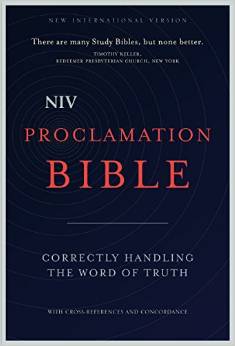 As strange as it may sound, Bibles are difficult to review. Since the reader has no authority to argue or critique the content, the features of a particular Bible are all that are left to critique. Recently I received the NIV Proclamation Bible for review. I would have to say that the first thing that caught my attention was a quote on the front cover from Tim Keller saying, “”There are many Study Bibles, but none better.” Keller missed the boat there. The NIVPB is certainly not a study Bible. The publisher doesn’t even call it a study Bible. Within a study Bible you would expect to find commentary notes throughout giving further clarification and explanation to the text itself. The NIVPB has none at all. Also, a study Bible would be expected to give a thorough introduction to each book. The NIVPB doesn’t do that either. The best way to review the NIVPB is to simply give the good and the bad.
THE GOOD.
I am not sure if this good, but there is a feature that is unique to the NIVPB. Included within is an approximately 60 page section of articles on subjects ranging from the study, interpretation, and preaching of the Bible. The NIVPB does contain the standard fare of most every other Bible; concordance, weights and measures table, maps, double ribbons, cross referenced text, dual-column design, and hardcover.
THE BAD
I have already mentioned that the billing of this Bible by a well-known theologian as a study Bible fell miserably short. Although introductory articles are present, you will find something of the like in most “real” study Bibles. These articles are so common to most Bibles I don’t feel obliged to include them here. The book introductions were terribly out of balance. The introduction of Philemon (a 25 verse book with one primary theme) and Genesis (a 50 chapter book with multiple foundational and critical themes necessary for understanding the entire Bible) were given the same treatment. Several of the book summaries seemed to me “God has saved us and, as we travel through the wilderness of this world, we need to go on exercising faith to enter the inheritance Christ has secured for us.”) I am not sure if the editors support an ongoing, works-based, or reformed approach to soteriology.
In conclusion, if you desire a Bible for simply the purpose of reading, the NIVPB will suit the need. However, if you are looking for a “real” study Bible that will aid in your teaching, preaching, and in-depth study of God’s Word, you will need to go elsewhere.
Disclosure of Material Connection: I received this book free from Thomas Nelson Publishers as part of their Blogger Review Program. I was not required to write a positive review. The opinions I have expressed are my own. I am disclosing this in accordance with the Federal Trade Commission’s 16 CFR, Part 255: “Guides Concerning the Use of Endorsements and Testimonials in Advertising.”
 The Road Less Traveled