Book Review : The Great Evangelical Recession

recessWhen you hear the word “recession”, you get the idea that something is receding. The thought is of something shrinking. The thought is of something disappearing. The thought is of something going away. The image that comes to mind is that of an outgoing tide. Standing on the beach, for a period of time, there appears to be more and more sand and less and less water. We are hearing the word recession linked to our national economy almost daily since 2009. We are seeing less money available for loans. We are seeing a decreasing number of homes being built. Paychecks are shrinking and confidence is our national leaders to remedy the situation is going away. The principles of recession are also being applied to the evangelical church today. In his new book, “The Great Evangelical Recession; Six Factors That Will Crash the American Church and How to Prepare”, pastor and journalist John S. Dickerson writes about the current state of affairs plaguing the evangelical church in America today. Drawing on his years of journalism skills and pastoral passion, Dickerson paints a picture of the evangelical church in crisis and in the midst of deep recession. Dickerson writes, “The problem with the Great Recession wasn’t that nobody saw it coming. The problem was that the people who needed to listen, to put on the brakes, to adjust course, never got the message. Or else they ignored it. The American church stands today in a similar position, on the precipice of a great evangelical recession.”

Dickerson separates his book into two clear, concise, and logical parts. In Part One, Six Trends of Decline, he lays before the reader factors causing the present decline. He identifies the six problem areas of the church as Inflated, Hated, Dividing, Bankrupt, Bleeding, and Sputtering. He devotes an entire chapter describing the symptoms and causes of each. Dickerson describes the evangelical church as Inflated. He says the church is not as large as we have been led to believe and as a result, our significance and influence in a changing world in waning. Dickerson describes the evangelical church as Hated. He says that society’s ever-increasing pro-homosexuality agenda is making evangelicals hated due to their biblical opposition. Dickerson describes the evangelical church as Dividing. He says that rather than elevating the kingdom of God, evangelicals have elevated political parties and their platforms as their defining criteria. Dickerson describes the evangelical church as Bankrupt. He writes that as churches have become so dependent upon donations and faithful givers, that very dynamic has become an Achilles heel as current giving generations pass away with no replacement.  Dickerson describes the evangelical church as Bleeding. He writes that the church is not keeping its own kids as they reach early adulthood. He writes, “Research indicates that more than half of those born into evangelicalism are leaving the movement during their twenties. And the majority of them never return.” Dickerson describes the evangelical church as Sputtering. He asserts that the church s failing in its primary mission which is marked by the simple biblical litmus test: reproducing disciples that share the good news with others.

In Part Two, Six Solutions for Recovery, he identifies six recovery strategies to be embraced  by the evangelical church in order to stem the tide of recession. They are: Re-Valuing, Good, Uniting, Solvent, Healing, and Re-Igniting. I won’t go into detail here on each one, after all, this is a review and not a report. However, in each these six chapters, Dickerson offers the proactive steps the church can take in order to pull herself out of the recessional grip she has found herself in. Throughout these two parts, it is obvious that Dickerson is not shooting from the hip, guessing, speculating, or carelessly sounding an alarmist’s bell. He is precise and thorough. He is well-documented. He is scripturally on point. He paints a portrait of the evangelical church’s future that is both frightening and stirring, without crushing the hope of God’s people.

I believe most experts in their field want to know everything they can about their business; the good, the bad, and the ugly. I believe that is what John Dickerson has done here. As the pastor of an evangelical Southern Baptist church, I needed to hear what Dickerson wrote. I can identify with a great deal in this book. “The Great Evangelical Recession” is a clarion call to the church that is sleep-walking through a commission in which she should be sprinting. I rarely label a book as “must read”.  John Dickerson has written just that. I believe every church leader would benefit at some level from what he has written. Sobering, humbling, and tempered with a measure of grace and urgency, The Great Evangelical Recession will serve as that “stake in the ground” for righting the evangelical ship. Very well done.

Disclosure of Material Connection: I received this book free from Baker Publishing Group as part of their Blogger Review Program. I was not required to write a positive review. The opinions I have expressed are my own. I am disclosing this in accordance with the Federal Trade Commission’s 16 CFR, Part 255: “Guides Concerning the Use of Endorsements and Testimonials in Advertising.”

Book Review : Loving the Church

lovingCountless books have been written on the subject of the local church. Subjects include principles of growth, recovering from hurt caused by, evangelism practices, missional tendencies, and theological types and shadows, to name a few. A discussion that is taking place in the circles of the Christian faith is how does a Christian  live out their love for Jesus Christ when the church, the bride of Christ, does not enable that, or at worst, hinders that from happening? Simply put: they love Jesus but not His bride. More and more Christians today are divorcing themselves from the body of Christ. They are saying “yes” to Jesus Christ, but “no thanks” to the church. In John Crotts’ new book, “Loving the Church; God’s People Flourishing in God’s Family”, he sets out to address and give pastoral insight to this issue that is before the church today.

Crotts’ book follows the story of a group of friends who met in a coffee shop, he tells each of their stories as it relates to their experiences in the local church. Some were not challenged by their congregation and leaders while others felt the church took too much time away from their families. One felt as though she had been abandoned by her church because of the personal choices she had made. As these friends meet regularly to discuss and come to terms with the function and purpose of the church, Crotts follows up their discussion by expounding on the scriptural principles and doctrinal matters that deal with the local church. He deals with such topics as the definition and value of the church, fellowship and gifts, and an individual’s relationship to the church staff and each other.

I believe Crotts has written a good book. The manner in which he sets up the book, interjecting this circle of friends into the storyline, makes the book easier to read and kept it from becoming too much like a textbook. It is a fairly easy read at only 131 pages. He gives an accurate picture as to why church and the church body should not be dismissed. There is one point of the book that I did not agree with and felt was severely out of place. In Chapter Five, Crotts says, “The second manner through which Jesus leads his church is a team of elders.” After previously setting up different leadership models often practiced by churches today, Crotts make this exclusive and, in my personal opinion, arrogant statement. Although I don’t personally agree with Crotts’ theology, he has written a good book from which much can be gleaned.

Disclosure of Material Connection: I received this book free from Cross Focused Reviews as part of their Blogger Review Program. I was not required to write a positive review. The opinions I have expressed are my own. I am disclosing this in accordance with the Federal Trade Commission’s 16 CFR, Part 255: “Guides Concerning the Use of Endorsements and Testimonials in Advertising.”
Book Review : Missional Moves

There is a great deal of discussion today about the health, effectiveness, passion, and future of the local church. It seems at every turn someone is offering a better, more effective, and smarter way to carry out the ministry given to the church. If you listen hard  and long enough you can hear anything you want to as it relates to what church leaders should and should not be doing. Thoughts ranging from mega churches are on their way out, to satellite campuses are the way to go to, to make the children happy and the parents will stay have been expressed in many different formats and venues. Rob Wegner and Jack Magruder, senior leaders at Granger Community Church in South Bend, Indiana have collaborated on a new book entitled, “Missional Moves; 15 Tectonic Shifts That Transform Churches, Communities, and the World” that address and speak the issues facing the local church today.

 Wegner and Magruder offer for consideration the point of view that the church today is very pragmatic, desiring the nuts and bolts of how to do effective ministry. This desire, and thus the sought after results, will be viewed through a certain paradigm that each church has established. They use the following working explanation of paradigm to make their case. “Our paradigm is our repeated life story that determines how an organization feels, thinks, and thus acts. This system story determines the way an organization behaves no matter how the organizational chart is drawn. The paradigm explains and then it guides behavior, and because of this it is the primary template that shapes all other things. Restructure the organization but leave the original paradigm in place and nothing changes within the organization.” In order for churches to be more effective, the authors propose and support certain paradigm shifts. They offer three which comprise the three main sections of the book: Section One – Paradigm Shift (Missional Imagination). Here the church is challenged to find its way into the bigger story. Section Two – Centralized Shift (Local Churches on Mission). Here churches are given a map of how to be empowered and unleashed for local and global mission. Section Three – Decentralized Shift (The People of God on Mission). Here the church is shown how to equip and then release people to accomplish the mission God has given to them.

The authors use earthquake language throughout this book. Citing the shifting of tectonic plates and resulting tsunami that struck the coast of India in 2004, they suggest certain “shifts” must take place in the local church today. Within the three main sections are fifteen “shifts”. These shifts are “from” something the church is presently doing or pursuing “to” something the should pursue or reevaluate. Each one breaks down the main section into bite-size digestible pieces. I found these shifts to be especially insightful, especially “From My Tribe to Every Tribe”, “From Professionals to Full Participation”, and “From ‘We Can Do It; You Can Help to You Can Do It; We Can Help’”.

Wegner and Magruder have written a smart book. I found it to be thought-provoking and interesting. Missional Moves is written in an easy to follow and logical format. Without a doubt the passion of the authors comes through. Most definitely worth your time. Engaging and timely, Missional Moves is one of those books that will remain in the church-health conversation for years to come.

Disclosure of Material Connection: I received this book free from Cross Focused Reviews as part of their Blogger Review Program. I was not required to write a positive review. The opinions I have expressed are my own. I am disclosing this in accordance with the Federal Trade Commission’s 16 CFR, Part 255: “Guides Concerning the Use of Endorsements and Testimonials in Advertising.”

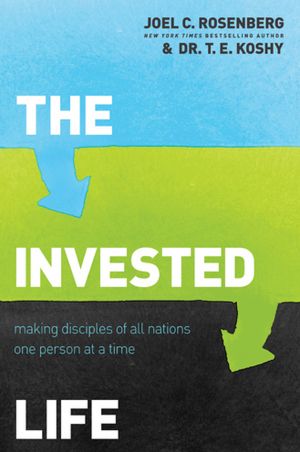
Book Review : The Invested Life

Of all the Christian disciplines and practices, personal discipleship, the intentional one-on-one process of growing closer to Jesus Christ, is one that is perhaps the most easily neglected. This can be case for many reasons: too busy, lack of motivation, fear of failure due to a lack of knowledge, too messy, and a myriad of others. That being the case, the pages of the Bible as littered with references to, procedures for, an benefits of personal discipleship. In The Invested Life; Making Disciples of All Nations One Person at a Time, authors Joel Rosenberg and T.E. Koshy have written a thought-provoking look at this subject. They have crafted their book around two foundational questions: “Who is investing in me?” and “Who am I investing in?”

Rosenberg and Koshy write, as a premise for their book, “Christianity is not a solo sport. It’s about building strong healthy teams of fully devoted followers of Jesus Christ whom God can use to change the world. It’s about older believers taking younger believers under their wings to love them, help them grow in Christ, and help them reproduce their faith in the lives of other younger believers.” They develop their case intentionally by dealing with such topics as Christ’s model for discipleship, selecting a person to disciple, seeking out a discipler for yourself, and the subjects that should be part of an investing relationship. The Invested Life is grounded in scripture and pulls examples from within of disciple-making relationships and principles. They cite the relationships between Jethro and Moses, Jesus and His disciples, and Paul and Timothy.

This is a 270 page how-to, nuts and bolts look at discipleship. The authors give many lists, points, and checklists to get their point across to their readers. For me, this is great. I learn better by those methods. This may be a drawback to other readers. Woven into the scriptural mandate are personal testimonies and study questions to further develop their burden of discipleship. All in all, a good book that worth your time.

Disclosure of Material Connection: I received this book free from Tyndale House Publishers as part of their Blogger Review Program. I was not required to write a positive review. The opinions I have expressed are my own. I am disclosing this in accordance with the Federal Trade Commission’s 16 CFR, Part 255: “Guides Concerning the Use of Endorsements and Testimonials in Advertising.”
Book Review : When Bad Christians Happen to Good People

People can be hurtful. Christians included. Unfortunately, that hurts is sometimes intentional. Fortunately, it is not always intentional. It is sad to say that this hurt , at times, comes from those who should certainly know better and who have been given the strength and spirit to refrain from such practice. Dave Burchett, author of When Bad Christians Happen to Good People; Where We Have Failed Each Other and How to Reverse the Damage, has written a smart, honest, and insightful book that pulls no punches when calling out the bad behavior that Christians display today. Burchett offers no excuses. Instead he offers a fresh perspective on the fragile relationship between those he considers his target audience; those who have “been hurt by a judgmental person or church” and the “Christians who inflict the wounds”.

Burchett has smartly divided his book into three common sense sections: The Indefensible Things We Do to One Another (evaluation), Thoughts on How We Lost Our Audience (diagnosis), and Being Real in an Artificial World (prescription). Burchett does a great job in his evaluation of Christian conduct today. He writes that Christians are at times hypocritical, prone to fuss and fight, guilty of further harming the already wounded, and successful at majoring in the minor things. Chapter three (Would Jesus Spend His Time on This?) is the most powerful in this first section. It shows how easily distracted Christians are today from what should be their true focus in life. The author’s diagnosis, or the reasons Christians are losing their audience, is shamefully accurate. Issues such as an inconsistent witness, church language, and the contrasting portraits of love and forgiveness are given as reasons for the push-back. Chapter nine (Jesus Wept… And He Still Does) is especially powerful. In the third and final section, Burchett offers a prescription for Christians to become more genuine before a watching world. Stressed are embracing the hard-teachings of Christ as being vital to growth and witness, a return to biblical literacy, and the exercising of grace when dealing with those in whom we disagree. Chapter thirteen (All God’s Children Got Souls, Even the Annoying Ones) is truly convicting. His call to “hate the message and love the messenger” is spot on.

A book such as this one needed to be written. What I really like about this book is that the author’s views and critiques do not come from a sterile laboratory, nor is it simply an academic exercise. Instead, by his own admission, he has been hurt by Christians and as Christian has hurt others. His style of writing, containing humor, scripture, and real-life stories, is engaging and insightful. A great work on a serious subject. I highly recommend.

Disclosure of Material Connection: I received this book free from Waterbrook Multnomah Publishers as part of their Blogger Review Program. I was not required to write a positive review. The opinions I have expressed are my own. I am disclosing this in accordance with the Federal Trade Commission’s 16 CFR, Part 255: “Guides Concerning the Use of Endorsements and Testimonials in Advertising.”
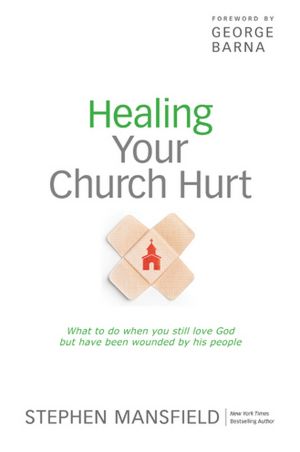
Book Review : Healing Your Church Hurt

If you have ever been part of what the Greeks knew as the ecclesia, or “the called out ones”, better known today as the New Testament church, then it is likely that you have witnessed or been involved in a church hurt. As a result, either you or someone you know, made a decision to walk away from the “church”. George Barna says this “decision to permanently withdraw from a congregation” can be called “ecclesia exitus” or church dropout. In Stephen Mansfield’s new book  “Healing Your Church Hurt; What To Do When You Still Love God But Have Been Wounded By His People”, he dives in to this issue and epidemic of hurt, offense, and discouragement within the body of Christ. Having been the pastor of a church who experienced a devastating church hurt himself, Mansfield is able to speak to this topic successfully.

Mansfield did not write this book to simply tell the reader that people get hurt in church. Instead, he writes to assure those who were hurt that it is possible for them to reconnect with the body of Christ. Mansfield begins by giving the root of the problem of offense and hurt: human nature and sin. He then takes a look at how we tend to look at others. He believes that how we look at others may determine our willingness to mend a relationship and length of time it might take. This chapter brings out these types of questions: Have our expectations of others that didn’t prove to be true given weight to our hurt? Are we guilty of forgetting how ugly the human nature can be?

Chapters four and five are the best chapters in the book and are very powerful. Chapter four entitled, “Lessons From a Season in Hell”, Mansfield asks the reader to do something. He asks, “I want you to take the most agonizing season of your life and examine it piece by piece.” He does this by asking five pointed and probing questions. They are:

1. Of the things your critics said, what do you know to be true?

2. How did you try to medicate your wounded soul?

3. Were you clinging to anything that contributed to your church hurt?

4. What did those closest to you do when you went through the fire?

5. During the bruising season, what fed your inspirations and your dreams?

In Chapter five, “The Throne Room of Your Mind”, Mansfield deals with how our minds process the hurt and how we tend to play the hurtful act over and over, rehearsing all the “should-have, could-have, and would-haves”. He demonstrates this by sharing a recurring dream that he has. As he sits on a grand throne, everyone who has wounded him becomes aware of their offense and they line up and come before him to make amends and tell him how sorry they are. As he enjoys having them in the palm of his hand, he touches them with his scepter and declares them forgiven. They exit thanking him for forgiving them, promising never to offend again. Of course, this is a fantasy. He says that we all have in our own minds a similar throne-room experience. Mansfield goes on to say that being hurt is about being offended, or suffering an offense. It is in this chapter that he gives to us a piercing word study demonstrating how devastating an offense can be. He concludes the book by dealing with forgiveness and restoration. He suggests that God may have a divine purpose for our hurt.

Stephen Mansfield has written a powerful book. It is efficient and to the point. His advice is practical and immediately helpful. Healing Your Church Hurt is a must read for those who have been wounded by the body of Christ. He sums up his reason for writing, “There is a myth that we need to knock in the head – and we need to knock it in the head now. When we’ve been hurt by the church we often tell ourselves that we are going to keep loving Jesus but that we no longer want anything to do with his people. The Bible makes it clear that we cannot love Jesus and hate his people.”

Disclosure of Material Connection: I received this book free from Tyndale House Publishers as part of their Blogger Review Program. I was not required to write a positive review. The opinions I have expressed are my own. I am disclosing this in accordance with the Federal Trade Commission’s 16 CFR, Part 255: “Guides Concerning the Use of Endorsements and Testimonials in Advertising.”

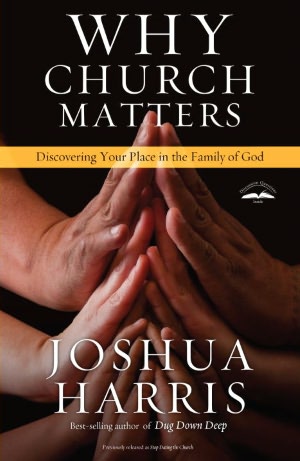
Book Review : Why Church Matters

Joshua Harris’ new book is entitled “Why Church Matters; Discovering Your Place in the Family of God” and is a re-print of his 2004 work “Stop Dating the Church”. “Why Church Matters” takes on the subject of the importance of and the need for commitment to the local church on behalf of each Christ-follower. As a pastor, I can appreciate the passion and enthusiasm for the local church with which Harris writes. He begins by stating that belonging to a local church does not save you. Instead, a person who has been saved by Christ should attach themselves to a local body of believers for encouragement, care, and service. Harris also writes that when a believer does not commit to a church, everyone is cheated. He says that “you cheat yourself, you cheat a church community, and you cheat your world.”

Two chapters stood out to me. In chapter three, Harris writes about the reasons why we need the church. He says on p.44, “This is why gathering to worship with other believers in a local church is so irreplaceable. It can’t be substituted with a great devotional time, a lively Bible study with friends, a meditative nature hike, or a live TV church service. When the church is together to worship and to hear God’s Word preached, nourishment and encouragement occur that can’t happen quite the same anywhere else. Our corporate worship edifies and strengthens us and glorifies God in ways nothing else can.” He also makes note of, in his opinion, three reasons why people stay away from church. He cites Self-Centeredness (what’s in it for me?), Prideful Independence (I can grow as a believer on my own), and a Critical Spirit (the church is broken). I believe chapter 5 is the most meaningful and beneficial chapter of the entire 120 page book. Entitled “Choosing Your Church”, Harris of ten important questions to consider before joining a church. Several include “Is this a church where God’s Word is faithfully taught?”, “Is this a church committed to reaching non-Christians with the gospel?”, and “Is this a church where members are challenged to serve?” These questions possess great potential. I believe them to be a great framework by which one can make a informed and meaningful decision about a church home. These are the questions I hope a potential member would ask before joining the church I pastor.

” Why Church Matters” is a good book. It is light, engaging, smartly-written, easy to read, and scriptural. If you are looking for an in-depth study of ecclesiology, go somewhere else. The only negative for me is that I would like to have seen certain areas and topics further expanded. Included is a study guide covering each chapter which lends this book to be a great small-group resource. This would be a great book for the church-skeptic or the believer who has been hurt by the church and may be considering giving up on the body of Christ.

Disclosure of Material Connection: I received this book free from Waterbrook Multnomah Publishers as part of their Blogger Review Program. I was not required to write a positive review. The opinions I have expressed are my own. I am disclosing this in accordance with the Federal Trade Commission’s 16 CFR, Part 255: “Guides Concerning the Use of Endorsements and Testimonials in Advertising.”

What Should Be The Standard of Cooperation In The Local Baptist Association?

Cooperation is the tie that binds in the local Baptist association. Cooperation is vital. Cooperation is fragile. Cooperation must be fostered and nurtured. Cooperation is what defines us as Southern Baptists. In a Baptist association, individual churches make the decision to come together and share resources, spiritual gifts, spaces, and finances as they work together toward a common agreed upon goal. The goal is different in every association and can be cloudy and undefined at times. Certainly the goal, at the minimum, should be the desire to see the Great Commission fulfilled. It is also  the prerogative of every local association to determine what it will accept from its member churches as the minimal level of participation as a cooperating church. The choice that is made here is so very important. This decision says a great deal about what the association values. It says a great deal about what the association pursues as its passion. This decision is often reflected in its governing documents. It must be remembered that the association is, at best, a “para-church” organization. The church has the final authority in the matter of contribution or affiliation with the association or any other institution.

I serve a church in the Savannah River Baptist Association which has 33 churches and missions. From where I sit, there seems to be some uncertainty as to what the standard of cooperation is. A standard is defined as “a basis for comparison; a reference point against which other things can be evaluated.” If there is no clearly defined statement of faith (i.e. Baptist Faith and Message) put forward by the association to unite the churches, everything becomes subjective. The Savannah River Baptist Association has no such defining statement of faith. It is this uncertainty that I want to write about openly, honestly, and in a way that is educational. Should the standard of cooperation be member participation, financial contribution, or something else all together?

Associations can choose to adopt (whether written or unwritten) the standard of member participation. This standard says that each church is expected to actively participate in and contribute to the events, fellowships, and decision making process of the association. The association as a whole benefits when this happens. When all of the member churches come together and share their talents, knowledge, and resources, the whole association prospers. There are some member churches who feel the association has nothing to offer them. That may be true. However, the member church that thinks this way may have much in the way of knowledge, experience, and resources to give that the remainder of the association could benefit from. I personally believe that participation is much more than just sending in a check every month. Looking at the  attendance numbers of both the spring and fall sessions of the Savannah River Baptist Association from 2000-2010 (11 years), I want to make a few observations. (The following numbers are based on 30 churches. Three of our churches are new works and were not active this entire time period).

* In the 11 year period between 2000-2010, 13 churches sent representatives to the Spring Session of the SRBA 6 or fewer times.

* In the 11 year period between 2000-2010, 17 churches sent representatives to the Spring Session of the SRBA 7 or more times.

* In the 11 year period between 2000-2010, 10 churches sent representatives to the Fall Session of the SRBA 6 or fewer times.

* In the 11 year period between 2000-2010, 20 churches sent representatives to the Spring Session of the SRBA 7 or more times.

* In the 11 year period between 2000-2010, 1 church sent no representatives to the Spring Session of the SRBA at all.

* In the 11 year period between 2000-2010, 2 churches sent no representatives to the Fall Session of the SRBA at all.

I am certain that churches have their own reasons why they don’t participate. Perhaps they feel the association has nothing to offer them. Perhaps they feel they are not being led adequately. Perhaps they feel abandoned. Perhaps they feel their local church work is more vital. I don’t know.

An association can also choose to adopt (whether written or unwritten) a standard of financial contribution. This standard would say that the financial gifts (frequency and amount) a member church gives defines whether or not they are cooperating. I believe there is a reality that we can all agree upon. Ministry requires money. This is true from the church pew to the foreign mission field. In all fairness, in the same way not all churches participate all the time, not every church financially supports the association every single month. This is no secret. I don’t know what the reasons are for this. Perhaps the reasons are the same as above. Perhaps they are completely different. There is one major difference. How you handle the two.

In my estimation, again, this is simply my opinion, I sense our association leaning toward the position that the standard of cooperation should be financial contribution. Our association will be voting on a significant overhaul of the Constitution/By-Laws in October. There are some really good things I agree with, and some not-so-good things I don’t agree with contained in this revision. The wording of this new document seems to speak to what I am have written here. Here is an example from that revision. Under the present constitution, there is a section entitled “Non-Reporting Churches” and it reads like this:

“When churches fail to support the work of the Association a committee appointed by the moderator shall consult with said church as to their desire and intent to continue in fellowship.”

This seems to allow for a variety of issues to be dealt with, whether those issues are lack of participation, financial, or doctrinal. Now, the proposed revision renames “Non-Reporting Churches” to “Non-Supporting Churches” and reads as follows:

“If a church fails to financially support the work of the Association, the Moderator shall request the Finance Committee to consult with said church to encourage its continued fellowship with and support of the Association. The Finance Chair shall report their findings, with or without recommendation(s), to the Executive Board at its next meeting.”

This proposed revision zeroes in exclusively on the financial aspect of support and participation. I believe the intention is very clear. How else could this be perceived, except that the member church’s  financial gift is what matters most. If this were not so, why then would the Finance Committee be asked to “consult with said church to encourage its continued fellowship with and support of the Association.”? If you combine past practices with the proposed policy, here is what you will get, whether intended or unintended: “It’s alright if you don’t come see us, just send your check. However, if you stop sending your check, we’ll come see you.”

Feel free to leave your comments and thoughts. This is a dialogue that we need to have.

Worth Repeating : David Platt

“There is a spiritual battle presently raging for the souls of billions of men and women around the world. The scope of this spiritual battle is universal. It covers and comprises every tongue, tribe, language, nation, person, and people group. There is no place on this earth where this war is not being waged.

The stakes in this spiritual battle are eternal. There is a true God over this world who desires all people to experience everlasting joy in heaven. There is a false god in this world who desires all people to experience everlasting suffering in hell. The enemy in this spiritual battle is formidable. He is like a lion looking for his kill, and he is dead set on defaming God’s glory and destroying God’s people. Where the church exists, he works to draw us in through temptation and discourage us in trial. He lures us with possessions and prosperity, and he lulls us to sleep with comforts and complacency. He deceives, deters, and distracts the church from knowing the wonder of Christ and declaring the worth of Christ to the ends of the earth.

Meanwhile, he holds thousands of unreached people groups captive through deceptive philosophies, hollow worldviews, and false religions. These people groups are virtually untouched by the gospel of the glory of God, and this is where the adversary’s stronghold exists. Any Christian and any church that desires to proclaim the gospel among the unreached people groups of the world can expect to be met with the full force of hell in the process.”

David Platt,  from the foreword of “Spiritual Warfare and Missions” by Jerry Rankin and Ed Stetzer

Summer Reading 2011

Just thought I would share what I am reading over the summer.

How Should We Then Live?: The Rise and Decline of Western Thought and Culture

The late Francis Schaeffer was one of the foremost evangelical thinkers of the twentieth century. He wrote and studied the decline of western culture. Schaeffer gives a personal analysis of the key moments throughout history which have formed our present culture, and the thoughts of the men who brought those moments to pass.

God, Marriage, and Family: Rebuilding the Biblical Foundation

Dr. Andreas Kostenberger serves as professor of New Testament at Southeastern Baptist Theological Seminary.  This book tackles the latest debates and cultural challenges to God’s plan for marriage and the family and urges a return to the original biblical foundation.

Futurecast: What Today’s Trends Mean for Tomorrow’s World

George Barna serves as president of the Barna Research  Group. Barna presents a timely look at the world in which we are creating every day and offers solid data to show the path and direction country is heading.

Be the People: A Call to Reclaim America’s Faith and Promise

Dr. Carol Swain is a college-professor, award-winning author, and regular contributor to FOX and CNN News. Dr. Swain thoughtfully examines the religious significance of the founding of our nation and the deceptions that have infiltrated our daily lives and now threaten traditional families, as well as our government.

Real-Life Discipleship: Building Churches That Make Disciples

Jim Putman is the Senior Pastor of Real Life Ministries in Post Falls, Idaho. Real-Life Discipleship explains what should happen in the life of every Christian and in every small group so that the church becomes an army of believers dedicated to seeing the world saved.

The God I Never Knew: How Real Friendship with the Holy Spirit Can Change Your Life

Robert Morris is the founding pastor of Gateway Church in the Dallas/Ft Worth metroplex. Morris clearly explains that the Holy Spirit’s chief desire is for relationship–to offer us the encouragement and guidance of a trusted friend.

What are you reading?