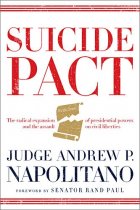
 I believe it would be safe to say that most everyone knows about the principle of erosion. It is the wearing away of a surface by outside forces such as wind, water, or waves. Whether it’s rivers that have cut their way through the landscape or beaches that have washed away from the consistent pounding of the waves, the visible effects of erosion are easy to see. There is a different type of erosion taking place in our country today. Today, we are seeing an erosion of personal freedoms and liberties in the name of national security. We often hear government officials telling us that in order for us to be safe, we must be willing to sacrifice. In his new book, “Suicide Pact: The Radical Expansion of Presidential Powers and the Lethal Threat to American Liberty”, Judge Andrew Napolitano shows how the American people have allowed this country’s founding principles of
limited government, individual autonomy, respect for privacy, and the rule of law to be traded away for an assurance that the government will do right by the citizens of this country. Napolitano calls this exchange of personal freedoms for governmental protection a suicide pact. He defines the term this way, “a Constitution which permits the government to violate it and the president to do so secretly and with impunity is a suicide pact with the states that formed it and the American people whose freedoms it was intended to secure because it will result in such a loss of liberty that it will bring about the self-immolation of our formerly free society – its suicide, if you will” .
Napolitano’s book has three main parts. Part One (1770-1880) deals with the struggles of this country in its infancy to secure, establish, and protect newly found liberties and freedom, as well as the quick erosion of these same liberties through presidents George Washington and John Adams and their courts. Part Two (1900-1946) introduces the reader to those presidents Woodrow Wilson and Franklin D. Roosevelt who through “noble lies” sought to convince the American people that their government had their best interests at heart. Part Three (1947-Present) show the further erosion of liberties through the leadership of the presidents from Harry Truman to Barack Obama. Napolitano shows that not even a decade after the Constitution became the law of the land, the Alien and Sedition Acts began to curtail civil liberties where those critical to the president and Congress could be fined or imprisoned. Other presidential overreaches include Lincoln’s suspension of habeas corpus and the use of military courts while civilian courts were still in use. Woodrow Wilson sanctioned free speech and imprisoned people for giving speeches. His Committee on Public Information made sure that Americans heard what he wanted them to hear. Other presidential low points include Roosevelt’s placement of Japanese Americans in secure camps, Truman’s seizing of private industry, Bush’s enhanced interrogation techniques and warrantless wiretappings, and Obama’s drone policies and questionable NSA procedures.
Suicide Pact is a great work. Napolitano does a fantastic job of making his book feel like an introductory law class. He analyzes major case law such as the Alien and Sedition Acts of 1798, the Posse Comitatus Act of 1878, the Espionage Act of 1917, the Sedition Act of 1918, Ex parte Merryman, Ex parte Vallandigham, Ex parte Milligan, the War Powers Resolution of 1973, and the Patriot Act to name a few. With that being said, the book doesn’t read like a law class textbook. Suicide Pact is well researched and documented. He allows the words and actions of presidents and the Supreme Court to speak for themselves. I found the chapters dealing with George W. Bush’s post 9/11 presidency and the Global War on Terror to be the most shocking. If you are fan of governmental studies or you simply want to know how we have arrived at where we are today, this book is for you.
Disclosure of Material Connection: I received this book free from Thomas Nelson Publishers as part of their Blogger Review Program. I was not required to write a positive review. The opinions I have expressed are my own. I am disclosing this in accordance with the Federal Trade Commission’s 16 CFR, Part 255: “Guides Concerning the Use of Endorsements and Testimonials in Advertising.”

 The Road Less Traveled