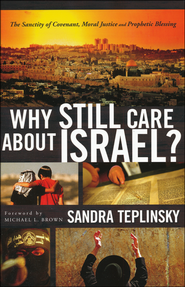
 Daily our news reports are filled with headlines which are connected to the nation of Israel. Whether it is another terrorist bombing in Jerusalem, a national leader calling for the extermination of the Jewish people, or the on-again off-again talks of peace between Israel and her neighbors, we are not allowed to forget about the significance and fragility of the nation of Israel. At the same time, the very mention of the name ‘Israel’ invokes images and feelings of compassion, anger, love, pity, confusion, and hatred; depending upon which lens you choose to view Israel through. In her latest book, “Why Still Care About Israel? The Sanctity of Covenant, Moral Justice, and Prophetic Blessing”, a revision of her 2003 book, author and former lawyer Sandra Teplinsky tackles a loaded and oft-misunderstood subject. From the perspective of a Messianic Jewish believer of Christ, Teplinsky has written a thought-provoking and heart-stirring work that introduces the reader to the history, people, religion, and political pressures of the tiny sovereign state of Israel.
The title is the premise of and scaffolding for the entire book. Teplinsky asks the reader if there is any reason to still care about what happens to Israel. Emphatically and without reservation, Teplinsky answers own question. She writes, “The Creator does not play favorites with Israel. He chose her so that people like you and me in every nation and period of history would know – through her Scriptures, her Savior and her soul – His loving mercy and grace. Perhaps to the surprise of some, He is not finished with the Jewish nation – or with how He wants to bless us through her”. She begins by introducing the reader to the depth of God’s love for Israel, His chosen people. Again, she writes, “God ties His love for the Jewish people to the oath He swore to them. He unconditionally binds Himself by His word to Abraham, Isaac, and Jacob.” It is here that we are introduced to the covenants, or the binding promises of God has made to Israel.
Teplinsky weaves together the threads of God’s love unconditional love for Israel, covenant promises, prophetic signposts, and Israel’s religion to create the fabric of a past, present, and future significance of the Jewish people. The first six chapters deal with God’s relationship with His chosen people (His love, His election) and their relationship with Him (their worship, their salvation). The remaining chapters deal with the relationship between other nations/religions and Israel. Teplinsky highlights such topics as the continual persecution of Messianic Judaism, examples of modern day anti-Semitism, the rise of Islam and its threat to Israel, the continuing battle for their God-promised land, Israel’s enemies (PLO, Palestinian Authority), and the future of Israel in light of prophecy.
Why Still Care About Israel? is a well-written and thoroughly-researched work. Teplinsky’s inside perspective; a Messianic Jewish believer of Christ and part-time resident of Israel has given her insight that many do not have. It is clear that her legal investigative and research skills have paid off. I enjoyed the historical side of this book. Teplinsky helps the reader who may be unfamiliar with the Middle East conflict to better understand it all. She gives the reason why there is a battle over al piece of land that is, as she says, “1/500th the size of the U.S.” You might expect that the aforementioned perspective would demonstrate a bias in favor of Israel. Not the case. She admits that Israel has her own struggles and is by no means perfect or without fault. She also is very sympathetic to the Palestinian viewpoint. There is one statement that I had a hard time with. Teplinsky quotes a team of Bible scholars who say “Ultimately, how a person treats the Jews will reveal whether or not he is saved”. This statement is a little far-reaching for me from a theological standpoint. Overall this is a powerful book. Insightful. Honest. Timely. I would recommend this book to anyone who wants to better understand why the simple mention of the name ‘Israel’ brings about such strong emotions today.
Disclosure of Material Connection: I received this book free from Baker Publishing as part of their Blogger Review Program. I was not required to write a positive review. The opinions I have expressed are my own. I am disclosing this in accordance with the Federal Trade Commission’s 16 CFR, Part 255: “Guides Concerning the Use of Endorsements and Testimonials in Advertising.”
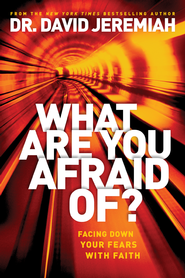 It is time once again to take a book off my bookshelf and give it away. I am giving away a copy of Dr. David Jeremiah’s newest book, “What Are You Afraid Of? Facing Down Your Fears With Faith”. Dr. Jeremiah introduces the ten areas where we are most likely to experience fear in this life. He also provides the scriptural help to overcome them.

 The Road Less Traveled