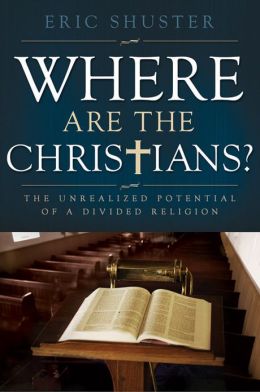
Book Review : Where Are The Christians?

whereAs a pastor, I enjoy reading behind authors who write on topics such as faith, religion, Christianity, the church, and missions. I also enjoy reading behind those authors who delve into the deeper areas such as; the reluctance of the Christian to share their faith with others, the widespread persecution against the church, the decline of the church in America, and the seemingly growing trend of Christians divorcing themselves from the church. It was for the reasons above that I was intrigued by Eric Shuster’s new book, “Where Are the Christians? The Unrealized Potential of a Divided Religion”. Shuster is the director of the Foundation for Biblical Studies and regularly studies the faith of Christians today. Shuster sets out to solve the mystery as to where the Christians are today.

Shuster divides his book into four sections. In Section One, Who Are The Christians? A History, Shuster looks at the rise of the Christian faith through four time periods beginning with Jesus Christ’s earthly ministry. In Section Two, What Is a Christian? A Definition, an attempt is made to generate a concise and exact definition for a Christian. In Section Three, Where Are The Christians? A Categorization, Shuster offers a his perspective as to the location of Christians today. He says they are leaving, hiding, vacillating, and endeavoring. In Section Four, How is Christianity to Unite? A Vision, he recommends four areas that can be strengthened to bring the Christian faith together (individual, family, church, and community).

I did not like this book at all. Section one was by far the best one. His summary of the Christian faith and the growth of the church through evangelism, corruption, and conflict were very well written and insightful. However, Shuster could have stopped after the first section and he would have had a much better book. Shuster’s attempt to define “Christian” is confusing, convoluted, and all-encompassing. As a result, there is no clear definition for the subject of his book. In sections three and four, Shuster inclusion of  graphs, lists, surveys, and charts serve no other purpose than to further muddy the waters. The number one issue I have with “Where Are the Christians?” is the erroneous theology. For example, Shuster writes, “How important is baptism? Jesus told Nicodemus, ‘verily I say unto you thee, Except a man be born of water and of the Spirit, he cannot enter into the kingdom of God. (John 3:5) The phrase ‘kingdom of God’ is interpreted in various ways with a common interpretation being ‘the Lord’s Church’. Using this interpretation, baptism is therefore not only a saving ordinance taught by Jesus Christ, but it is also a means of entering into a covenant as a member of the Lord’s Church”. It is my prayer that an individual who is seeking the Lord and has questions about personal salvation does not pick up this book. I cannot in good faith recommend this book.

Disclosure of Material Connection: I received this book free from Cedar Fort Publishing and Media as part of their Blogger Review Program. I was not required to write a positive review. The opinions I have expressed are my own. I am disclosing this in accordance with the Federal Trade Commission’s 16 CFR, Part 255: “Guides Concerning the Use of Endorsements and Testimonials in Advertising.”
Book Review : Apostate; The Men Who Destroyed The Christian West

apostateEvery so often a book comes along which forces the reader to come to terms with how mediums such as print, lecture, and music have become satanically influenced. Such books leave one saying, “I had no idea” and asking questions such as “How did that happen?” One such book is Pastor Kevin Swanson’s “Apostate; The Men Who Destroyed the Christian West”. Swanson writes of a battle. Methodically, he shows how western civilization’s foundations have shifted from that of certain definitive Christian values towards a godless, self-satisfying, and humanistic value system. Swanson’s book shines a spotlight on the men that he believes are at least partly responsible for the demise and downfall of the Christian west. In his own words, Swanson describes the battle through the following description. “The crux of the worldview conflict which has ravaged the culture and entered the foyer of the Christian church in the third millennium A.D. is the denial of God’s right to be God, and the usurpation of that right by man. In a word, it is a life and death struggle over sovereignty. Who will be sovereign—man or God?”

It is important to understand the point of view from which Apostate was written. Swanson refers to the men who “destroyed the Christian West” as apostates. An apostate is defined as a person who forsakes or departs from their religion, principles, or cause. Swanson’s book deals with the religious departure of these men. Swanson’s approaches these men and their departure from the perspective that these men possessed a Christian upbringing and point of view that they later walked away from. Swanson, throughout his book, refers to these men as Nephilim, a reference to the tribe of pre-diluvian men who come from the ungodly union of the sons of God and daughters of men referenced in Genesis 6. He says of the Nephilim, “These were men with tremendous character, but with an evil twist. The strength of a godly heritage was used for foul ends.” As the book unfolds, this statement takes on a prophetic importance. Swanson describes the process of Western civilization’s devolution that in essence becomes the outline for his book. He says that intellectual philosophers developed humanistic ideas that were revolutionary to their time period and began make them a part of their own lives. Swanson then goes on to say that the great writers and authors pulled these revolutionary humanistic ideas into their literary works which in turn were taught in classrooms from high schools to major universities. He writes, “there is no better way to radicalize nations with new ideas that by infiltrating the educational systems.” The final step in this process is today’s mass media propagating the revolutionary humanistic philosophies. Again, Swanson writes, “much of present day perspectives and attitudes, culture, media, family life, and education are rooted in the destructive ideologies of the 18th and 19th centuries”.

In part one, Swanson defines gives his definition of apostasy. He also explains the terminology that will use throughout the book. He defines terms such as epistemology, ethics, metaphysics, and truth. He introduces the reader to the Philosophical Nephilim and reveals their humanistic contributions. These men are Thomas Aquinas (Forming the Humanist Synthesis), Rene Descartes (Forming the Humanist Philosopher), John Locke (Forming the Humanist Theologian), Jean-Jacques Rousseau (Forming the Humanist Society), Jeremy Bentham (Forming the Humanist Ethic), Ralph Waldo Emerson (Forming the Humanist Person), Karl Marx (Forming the Humanist Political State), Charles Darwin (Forming the Humanist Scientist), Friedrich Nietzsche (Forming the Humanist Psychology), John Dewey (Forming the Humanist Education), and Jean-Paul Sartre (Forming the Humanist Culture). In part two, Literary Nephilim, Swanson gives the reader a look into the lives of the “great” writers and their works to show how the revolutionary humanistic ideas made their way into the classrooms. He writes of William Shakespeare, Nathaniel Hawthorne, Mark Twain, Ernest Hemingway, and John Steinbeck. I must admit that I had read these authors and their major works before coming to Christ and had thought nothing of their humanistic and at times atheistic viewpoints. After reading Apostate, it is clear, as well, as disappointing to see their departure from the Christian faith. In the final part, Swanson looks at how mass media has given a powerful voice and relevance to humanistic thinking. He speaks of the cultural Nephilim as being, for example, Madonna, Eminem, the Beatles, Marilyn Manson, Frank Sinatra, Led Zeppelin, Lady Gaga, Mick Jaggar, and John Lennon as just as a few who are beating the humanist drum today in front of an ever-increasing audience of impressionable minds.

Apostate is a powerfully-written and eye-opening work. Swanson has made a way for the reader to connect the dots between the philosophers of antiquity and the major problems our world faces today as a result of their humanistic leaning and teachings. Unless we fully understand where we have come from a society we will never be able to right the ship or moral collapse. Swanson’s book also highlights man’s total depravity and natural proclivity for self-satisfaction and self-elevation. He highlights man’s need for a Savior and for the abiding presence of the Holy Spirit on our lives. He also brings to the surface the need for our faith to be our own, not our parent’s and not our pastor’s. There is an underlying challenge to pursue Christ above all else. Powerful. Sobering. Insightful. Apostate is well researched and incredibly timely. Without a doubt this book should be a must read for all church leadership and seminary students. Swanson sums up the West’s attitude in the midst of this shift toward humanistic thought when he says, “they play their video games while Rome burns.” I enthusiastically recommend.

Disclosure of Material Connection: I received this book free from CrossFocused Reviews as part of their Blogger Review Program. I was not required to write a positive review. The opinions I have expressed are my own. I am disclosing this in accordance with the Federal Trade Commission’s 16 CFR, Part 255: “Guides Concerning the Use of Endorsements and Testimonials in Advertising.”

Friday Is For Scripture : Proverbs 1:10-16

10 My son, if sinners entice you, Do not consent. 11 If they say, “Come with us, Let us lie in wait to shed blood; Let us lurk secretly for the innocent without cause; 12 Let us swallow them alive like Sheol, And whole, like those who go down to the Pit; 13 We shall find all kinds of precious possessions, We shall fill our houses with spoil; 14 Cast in your lot among us, Let us all have one purse” 15 My son, do not walk in the way with them, Keep your foot from their path; 16 For their feet run to evil, And they make haste to shed blood. [Proverbs 1:10-16]

Solomon is given credit as being the wisest man to have ever lived. When given the opportunity to possess riches or wisdom, he chose wisdom. The book of Proverbs is a glimpse into this God-given understanding of the human race. Profound, yet simple. Funny, yet accurate. Convicting, yet truthful. In the very first chapter, Solomon gives the reader what could be the best word we could ever read in v.10, “if sinners entice you, Do not consent”. Solomon goes on to describe what kinds of activity, by citing specific examples, sinners will involve themselves and others in. This reference to “sinners” speaks to those who are opposed to God and have no desire to follow or long after Him. When a person is not led by God, there natural tendency is as Solomon wrote in v.16 saying “their feet run to evil, And they make haste to shed blood.” The old adage that “misery loves company” is applicable here.

We must be careful who influences us. It is up to us to ensure that only those who are being led by God and are listening to Him are having an influence upon our lives. In a world full of voices shouting advice, suggestion, and counsel, who are you listening to? Are you as a believer being a source of sound counsel for someone else?

Worth Repeating : Mike Huckabee

“I hope we never as a nation forget September 11. For as much as it showcased the cowardice and animalistic behavior of the terrorists, it also showcased many wonderful and selfless Americans—firemen, police officers, first responders, volunteers who gave their lives—as to why terrorism can hurt us, but never kill us. September 11 will be remembered therefore as one of America’s worst days—and yet in the rubble of the twin towers and the pentagon and Shanksville, PA, we saw Americans at their best—laying down their lives for others. As we reflect and remember today, let’s not dwell on the monsters who don’t deserve the attention, but the true heroes who do…”

Mike Huckabee

Book Review : Finally Free

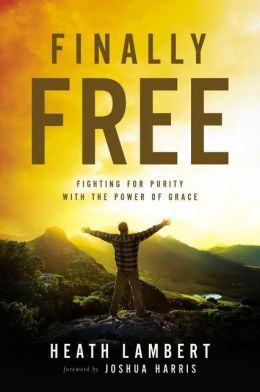
finallyfreeAddictions dot the landscape of our homes, families, businesses, schools, and churches today. Everyday people battle enslavement to everything from alcohol to drugs, food to work, success to sex. In his new book, “Finally Free; Fighting for Purity with the Power of Grace”, author Heath Lambert deals head-on with an addiction that is destroying the moral fabric of America today; pornography. This book is not about pornography, per se. This is not a book that will tell how many are involved in the industry. This is not a book that will reveal how many billions of dollars the porn industry generates every year. This book will not tell you anything about the avenues by which individuals view pornography every day. The purpose of this book, in Lambert’s own words, “is about something much better than pornography. This book is about the amazing power of Jesus Christ to free you from pornography. In this book, I want to share with you the amazing depth and affect of Christ’s power to eradicate pornography from your life”.

In Finally Free, Lambert lays out a series of practical steps for those who are struggling with pornography. His book contains nine chapters in which he lays out eight methods meant to help a person battling pornography. Lambert begins with the pivotal aspect of this battle; God’s grace. He speaks of the forgiving and transforming graces of God that make freedom possible. His forgiving grace forgives the individual of partaking in pornography and His transforming grace takes away the desire to view by filling the individual with more of Christ Himself. Lambert speaks of eight methods of battle. He writes of using sorrow, accountability, confession, humility, gratitude, and several others to fight off the desires to engage in pornography. It is not a matter of “check all boxes and be free”; rather, his book leaves the reader with practical means of applying God’s grace to their life. His theology is so solid that the eight methods could be applied against any addiction with positive results.

Of all the books that have been written recently in the “resist pornography” arena, Finally Free is head and shoulders above the rest. His book is practical, humble, loving and balances scripture, personal stories, and humor perfectly. This book will help those struggling with pornography, as well as those who are walking along side someone in the battle. Smart. Powerful. This will be one of those books that will remain at the front of the pornography addiction conversation for years to come. I highly recommend.

Disclosure of Material Connection: I received this book free from CrossFocused Reviews as part of their Blogger Review Program. I was not required to write a positive review. The opinions I have expressed are my own. I am disclosing this in accordance with the Federal Trade Commission’s 16 CFR, Part 255: “Guides Concerning the Use of Endorsements and Testimonials in Advertising.”

Monday is For Missions : Ed Stetzer on Community Engagement

Ed Stetzer, President of Lifeway Research and pastor of Grace Community Church in Hendersonville, TN is regarded as the resident expert when it comes to engaging others in missions. Of the many things that I appreciate about Ed Stetzer, his advocacy for the local church to be at the forefront of the Great Commission has to be at the top of my list. He writes, “There should be a difference in the community because the church exists, and if it left for some reason, there should be a void that’s felt.” In a recent article in Christianity Today, Stetzer wrote about practical steps that a church can take in engaging its community. You can read that article here. Well worth your time.