Worth Repeating

“The God of the Bible is a missionary God. For someone to suggest that one’s biblical beliefs should be disassociated from one’s philosophy and practice of mission ignores the important relationship between the two. In reality, one’s theology faithfully generates one’s missiology; and likewise, one’s missiology clearly reflects one’s theology.”

J. Sam Simmons, Missiology; An Introduction to the Foundations, History, and Strategies of World Missions

What Should Be The Standard of Cooperation In The Local Baptist Association?

Cooperation is the tie that binds in the local Baptist association. Cooperation is vital. Cooperation is fragile. Cooperation must be fostered and nurtured. Cooperation is what defines us as Southern Baptists. In a Baptist association, individual churches make the decision to come together and share resources, spiritual gifts, spaces, and finances as they work together toward a common agreed upon goal. The goal is different in every association and can be cloudy and undefined at times. Certainly the goal, at the minimum, should be the desire to see the Great Commission fulfilled. It is also  the prerogative of every local association to determine what it will accept from its member churches as the minimal level of participation as a cooperating church. The choice that is made here is so very important. This decision says a great deal about what the association values. It says a great deal about what the association pursues as its passion. This decision is often reflected in its governing documents. It must be remembered that the association is, at best, a “para-church” organization. The church has the final authority in the matter of contribution or affiliation with the association or any other institution.

I serve a church in the Savannah River Baptist Association which has 33 churches and missions. From where I sit, there seems to be some uncertainty as to what the standard of cooperation is. A standard is defined as “a basis for comparison; a reference point against which other things can be evaluated.” If there is no clearly defined statement of faith (i.e. Baptist Faith and Message) put forward by the association to unite the churches, everything becomes subjective. The Savannah River Baptist Association has no such defining statement of faith. It is this uncertainty that I want to write about openly, honestly, and in a way that is educational. Should the standard of cooperation be member participation, financial contribution, or something else all together?

Associations can choose to adopt (whether written or unwritten) the standard of member participation. This standard says that each church is expected to actively participate in and contribute to the events, fellowships, and decision making process of the association. The association as a whole benefits when this happens. When all of the member churches come together and share their talents, knowledge, and resources, the whole association prospers. There are some member churches who feel the association has nothing to offer them. That may be true. However, the member church that thinks this way may have much in the way of knowledge, experience, and resources to give that the remainder of the association could benefit from. I personally believe that participation is much more than just sending in a check every month. Looking at the  attendance numbers of both the spring and fall sessions of the Savannah River Baptist Association from 2000-2010 (11 years), I want to make a few observations. (The following numbers are based on 30 churches. Three of our churches are new works and were not active this entire time period).

* In the 11 year period between 2000-2010, 13 churches sent representatives to the Spring Session of the SRBA 6 or fewer times.

* In the 11 year period between 2000-2010, 17 churches sent representatives to the Spring Session of the SRBA 7 or more times.

* In the 11 year period between 2000-2010, 10 churches sent representatives to the Fall Session of the SRBA 6 or fewer times.

* In the 11 year period between 2000-2010, 20 churches sent representatives to the Spring Session of the SRBA 7 or more times.

* In the 11 year period between 2000-2010, 1 church sent no representatives to the Spring Session of the SRBA at all.

* In the 11 year period between 2000-2010, 2 churches sent no representatives to the Fall Session of the SRBA at all.

I am certain that churches have their own reasons why they don’t participate. Perhaps they feel the association has nothing to offer them. Perhaps they feel they are not being led adequately. Perhaps they feel abandoned. Perhaps they feel their local church work is more vital. I don’t know.

An association can also choose to adopt (whether written or unwritten) a standard of financial contribution. This standard would say that the financial gifts (frequency and amount) a member church gives defines whether or not they are cooperating. I believe there is a reality that we can all agree upon. Ministry requires money. This is true from the church pew to the foreign mission field. In all fairness, in the same way not all churches participate all the time, not every church financially supports the association every single month. This is no secret. I don’t know what the reasons are for this. Perhaps the reasons are the same as above. Perhaps they are completely different. There is one major difference. How you handle the two.

In my estimation, again, this is simply my opinion, I sense our association leaning toward the position that the standard of cooperation should be financial contribution. Our association will be voting on a significant overhaul of the Constitution/By-Laws in October. There are some really good things I agree with, and some not-so-good things I don’t agree with contained in this revision. The wording of this new document seems to speak to what I am have written here. Here is an example from that revision. Under the present constitution, there is a section entitled “Non-Reporting Churches” and it reads like this:

“When churches fail to support the work of the Association a committee appointed by the moderator shall consult with said church as to their desire and intent to continue in fellowship.”

This seems to allow for a variety of issues to be dealt with, whether those issues are lack of participation, financial, or doctrinal. Now, the proposed revision renames “Non-Reporting Churches” to “Non-Supporting Churches” and reads as follows:

“If a church fails to financially support the work of the Association, the Moderator shall request the Finance Committee to consult with said church to encourage its continued fellowship with and support of the Association. The Finance Chair shall report their findings, with or without recommendation(s), to the Executive Board at its next meeting.”

This proposed revision zeroes in exclusively on the financial aspect of support and participation. I believe the intention is very clear. How else could this be perceived, except that the member church’s  financial gift is what matters most. If this were not so, why then would the Finance Committee be asked to “consult with said church to encourage its continued fellowship with and support of the Association.”? If you combine past practices with the proposed policy, here is what you will get, whether intended or unintended: “It’s alright if you don’t come see us, just send your check. However, if you stop sending your check, we’ll come see you.”

Feel free to leave your comments and thoughts. This is a dialogue that we need to have.

Book Review : Our Last Great Hope

For Evangelical Christianity, the Great Commission represents the very heartbeat of our Savior Jesus Christ. For in its’ words and commands we find, with absolute clarity, the mission that we are to devote our lives to. In his new book, “Our Last Great Hope; Awakening the Great Commission”, Dr. Ronnie Floyd examines the Great Commission in a way that I have not seen or heard before. As a Southern Baptist, I am familiar with Dr. Floyd and his ministry as the senior pastor of Cross Church, a multi-site church in Northwest Arkansas. When I read that he had written a book of the Great Commission, I was immediately interested. Dr. Floyd recently chaired the Great Commission Resurgence Task Force that took an intentional and exhaustive look at how we as Southern Baptists could do better at fulfilling  the Great Commission. He shares in his book how his service on this task force gave him a renewed passion for and a heightened sense of urgency in joining Christ in the work of taking the gospel to the nations.

Our Last Great Hope is not so much an academic work that dissects the Great Commission verses and explores all its’ nuances. That being said, this work is well researched and sits on a firm biblical foundation. Instead, Our Last Great Hope demonstrates how to move the Great Commission from the classroom to the driving force in every believers heart, family, and life.

Dr. Floyd walks the reader through the ways in which the Great Commission can become a personal reality. He begins with the individual. He builds his case that the Great Commission must first be personal before it can be public. He then goes on show how a commitment to the Great Commission will affect their families, businesses, local communities, and then the nations. He also says that a commitment to the Great Commission will affect our prayer lives, plans, and our giving.

Dr. Floyd has written a very challenging work. As a pastor, I am familiar with the Great Commission, however, I have been challenged to think about it differently. If it were possible, Our Last Great Hope should be required reading for all staff members and lay leaders. This is a book that I will read again. His balance of scripture and personal experience makes this book a joy to read. I highly recommended this book.

Disclosure of Material Connection: I received this book free from Thomas Nelson Publishers as part of their Blogger Review Program. I was not required to write a positive review. The opinions I have expressed are my own. I am disclosing this in accordance with the Federal Trade Commission’s 16 CFR, Part 255: “Guides Concerning the Use of Endorsements and Testimonials in Advertising.”


Book Review : Dug Down Deep

Joshua Harris, in his new book, “Dug Down Deep; Building Your Life on Truths That Last” tells a personal growth story through the lens of a familiar parable told by Jesus Christ. He uses the story of two builders. One builder built his house upon the sand. The storm come against it and it fell. The other builder built his house upon a rock. The storm come against it and it stood. Dug Down Deep is a call for every believer to dig down and understand what God wants them to know that will lead them into a deeper and richer relationship  with Him. Harris maintains hat superficial understanding of the Bible will not hold when tried and tested by the storms of life.

The opening statement of the book sets the stage for the rest. Harris writes, “ We’re all theologians. The question is whether what we know about God is true.” Harris writes that doctrine, the proper understanding of God and what He is like, coupled with orthodoxy, the proper practice of what we know to be true about God, will make or break a believers walk with Christ. Harris deals with doctrinal matters in a way that takes them out of the classroom and places them into real-life practice. In each of his chapters, he deals with a different doctrinal discipline and makes it easy to understand. A few of those doctrines are: God, Jesus Christ, Salvation, the Bible, Sanctification, the Holy Spirit, and the Church.

I appreciate the path in which Harris took in writing this book. He has built the case for every believer becoming a student of God’s Word and not being afraid of digging deep. This book is well written, it is deep, but not overly academic. His personal story woven throughout the book is what makes the book believable. The study guide that is included in the book is a great tool for small group study. I highly recommend this book.

Disclosure of Material Connection: I received this book free from Waterbrook Multnomah Publishers as part of their Blogger Review Program. I was not required to write a positive review. The opinions I have expressed are my own. I am disclosing this in accordance with the Federal Trade Commission’s 16 CFR, Part 255: “Guides Concerning the Use of Endorsements and Testimonials in Advertising.”

Worth Repeating

“The great truths which the apostles declared were that Christ had risen from the dead, and that only through repentance from sin, and faith in Him, could men hope for salvation. This doctrine they asserted with one voice, everywhere, not only under the greatest discouragements, but in the face of the most appalling terrors that can be presented to the mind of man.

Their master had recently perished as a malefactor, by the sentence of public tribunal. His religion sought to overthrow the religions of the whole world. The laws of every country were against the teachings of His disciples. The interests and passions of all the rulers and great men in the world were against them. The fashion of the world was against them.

Propagating this new faith, even in the most inoffensive and peaceful manner, they could expect nothing but contempt, opposition, revilings, bitter persecutions, stripes, imprisonments, torments, and cruel deaths. Yet this faith they zealously did propagate; and all these miseries they endured undismayed, nay, rejoicing.

As one after another was put to a miserable death, the survivors only prosecuted their work with increased vigor and resolution. The annals of military warfare afford scarcely an example of the like heroic constancy, patience, and unblenching courage. They had every possible motive to review carefully the grounds of their faith, and the evidences of the great facts and truths which they asserted and these motives were pressed upon their attention with the most melancholy and terrific frequency. It was therefore impossible that they could have persisted in affirming the truths they have narrated, had not Jesus actually risen from the dead, and had they not known this fact as certainly as they knew any other fact.”


Dr. Simon Greenleaf, Harvard Royall Professor of Law from A Treatise on the Law of Evidence

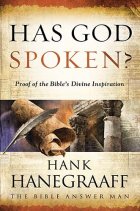
Book Review : Has God Spoken? Proof of the Bible’s Divine Inspiration

In our day, critics continually and consistently launch assaults on the validity, accuracy, reliability, and sufficiency of the Bible. Their thought seems to be that if the Bible can be reduced to just simply a collection of fables and stories, then there is no need for faith, repentance, Christianity, or even Christ Himself. In his latest book, “Has God Spoken? Proof of the Bible’s Divine Inspiration”, Hank Hanegraaff has written a powerful work that leaves no room for debate that God has truly spoken through His word. His proofs enable us to not only trust the Bible, but allow it change and guide our lives.

“Has God Spoken?” is separated into four major parts. The parts are presented by using the acrostic M-A-P-S; Manuscript Copies, Archaeological Spade, Prophetic Stars, and Scripture Lights. The first part of his book utilizes the subacronym (Hanegraaff’s term) C-O-P-I-E-S.  In this section, Hanegraaff tackles the object that errors, intended and unintended, were made in the copying of the original manuscripts which lead critics to sat the Bible is in no way accurate. The second part of his book utilizes the subacronym S-P-A-D-E. Hanegraaff demonstrates how archaeological discoveries prove the existence of, and are consistent with, places described in the Bible. The third part of his book utilizes the subacronym S-T-A-R-S. In this section, Hanegraaff shows how the truthfulness and validity of biblical prophecy only further prove the Bible’s accuracy. He also demonstrates how biblical prophecy is inconsistent with divination and predictors of the future. In his final part of the book, he uses the subacronym L-I-G-H-T-S. Here the author gives the reader tools to better understand biblical interpretation.

I enjoyed this book a great deal. Although this book is written by an apologist and serves as a defense for the validity of the Bible, it is not overly scholarly. This allows it to be used by Christians in every stage of their faith walk to better understand and be prepared to give a defense of the Bible’s accuracy. One thing I noticed seemed to get in the way. Within the subacronyms there were other acronyms that Hanegraaff likely intended to be helpful in further understanding his point. At times I found these distracting. That being said, “Has god Spoken?” is a great resource and a well-written and researched work. I highly recommend.

Disclosure of Material Connection: I received this book free from Thomas Nelson Publishers as part of their Blogger Review Program. I was not required to write a positive review. The opinions I have expressed are my own. I am disclosing this in accordance with the Federal Trade Commission’s 16 CFR, Part 255: “Guides Concerning the Use of Endorsements and Testimonials in Advertising.”